
An Architect’s Advice For Renovating On A Budget
Architecture
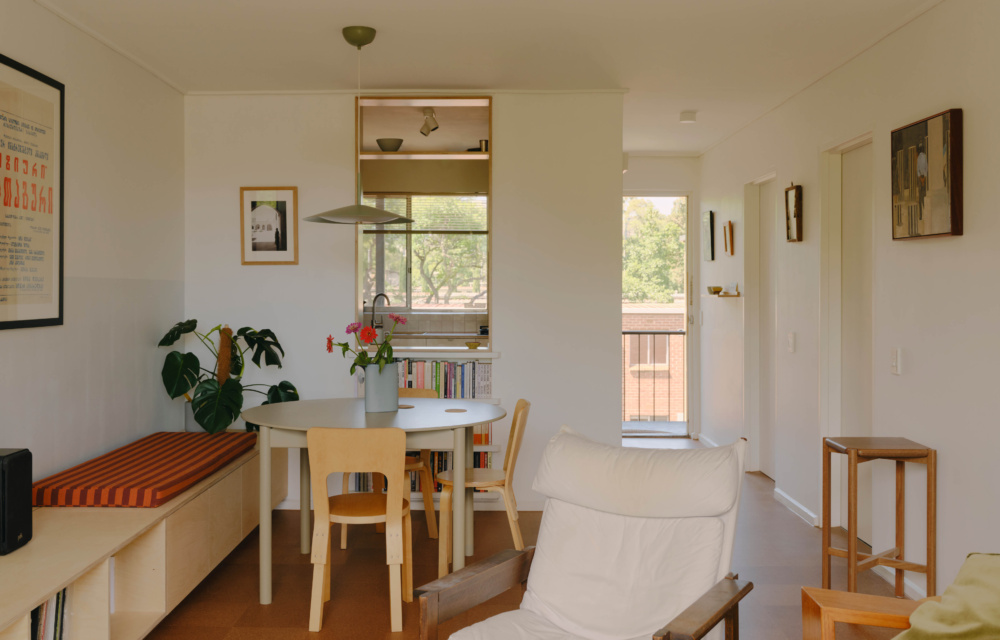
Inside CARD director Tahj Rosmarin renovated Melbourne apartment. Photo – Tom Ross.
The updated kitchen partition features a tall opening overlooking the living room. Broad Pendant Small in Eucalypt by Coco Flip. Plonk Round Dining Table in Avocado by So Watt. Photo – Tom Ross.
CARD director Tahj Rosmarin and lawyer Sione Pemberton. Photo – Caitlin Mills.
CARD transformed this first-home-buyer couple’s Coburg house on a budget, using utilitarian materials like corrugated steel. Photo – Tom Ross.
Kenmore Pavilion by CARD is an extension to a post-war home in Brisbane. Photo – Andy Macpherson.
Seamless indoor-outdoor living. Photo – Andy Macpherson.
The pavilion is constructed from sustainably sourced Kwila and spotted gum battens, along with plywood. Photo – Andy Macpherson.
Known for their quietly confident, no-frills architecture, Melbourne architects CARD have delivered everything from full home transformations to small-scale renovations with a big impact.
‘Our approach is similar no matter the budget of the project we work on,’ director Tahj Rosmarin says.
‘We always try to balance pragmatics and functionality, with architectural creativity and expression. This means we only really focus on architecture that serves a purpose and function. No frills!’
That’s why we asked Tahj for his expertise on how to navigate renovating on a modest budget.
Start with a clear plan (and be honest about your budget)
According to Tahj, it’s essential to know your goals before you begin, as this will be the cornerstone that guides you through every choice of the renovation.
‘We are more interested in collaborating with proactive clients with a clear understanding of why they are coming to us, and who can join us on a journey of creative problem solving,’ he adds.
This clarity should also extend to the budget. He notes one of the biggest mistakes people make is ignoring the reality of the costs involved: ‘We have really made sure that [budget] is a topic of discussion at almost every meeting we attend, no matter the size of the project.’
‘This is both to make sure our clients are aware that choices have implications — every small change has potential consequences.’
Prioritise function over frills
Tahj says you’ll never regret investing in the essentials, noting the importance of a thermally efficient building envelope, double-glazed windows, and insulation to ensure your home will perform well in the years to come.
If you can’t complete your dream home in its entirety right away, he suggests prioritising the spaces you need to use every day, such as the kitchen and bathroom. Meanwhile, details like joinery and laundries can be finished at a later date.
‘Getting the services and core of the building there first allows you to stage more flexible parts of the build later on. This concept is seen in the work of some of our favourite architects like Lacaton and Vassal, and BV Doshi, he adds.
And if you are splurging on things like custom joinery, Tahj’s advice is to ‘make sure it is highly functional’. For example, in his own Melbourne apartment, the joinery doubles as a bench seat, adding extra storage and personality.
Keep it simple to keep costs down
Materials and trades typically consume the most of any renovation budget. That’s why wet areas or kitchens that require detailed labour generally cost more than updating spaces like a bedroom, and why one of the best ways to save money is to avoid large-scale structural changes.
Keeping the size of your renovation to a minimum and making a few compromises (such as going for plywood instead of solid timber, or opting for off-the-shelf and pre-fabricated pieces where possible) will also have a significant impact on the cost.
‘Construction prices significantly rose during COVID, which has definitely made it harder to build. As an owner of an emerging practice during this shift, it has definitely influenced our approach to material selection and construction methodology,’ Tahj says.
‘We tend to focus on using lightweight materials and utilising conventional construction methods that combine simple details. We have also made a conscious effort to source materials locally and sustainably — avoiding items that need to be shipped from overseas or aren’t produced in Australia.’
Be flexible and trust the experts
Tahj says there’s always a level of flexibility and compromise that comes with working to a budget. But engaging a good team early on in the process can help you develop creative solutions to the problems you encounter.
‘Architects and builders have hands-on experience in how small changes, tweaks, and approaches can significantly change costs, Tahj adds.
‘Speak to your trades to understand what is required and if there are easier ways of doing things. Trust them to take you on that journey.’