
An Artist’s Mid-Century Christchurch Home Enters A New Era
Architecture
The Spencer-Bower house was originally designed by D.A Cowey & McGregor in 1968 for prolific New-Zealand based artist Olivia Spencer-Bower.
When the current owners purchased the home home, the house remained in mostly original condition.
It was Johnstone Callaghan Architects’ job to retain the home’s character, while adapting it to better suit a young family with interconnected living spaces and functional amenities.
Materials were selected to match the original mid-century and Christchurch-style architecture – styles that share a number of commonalities.
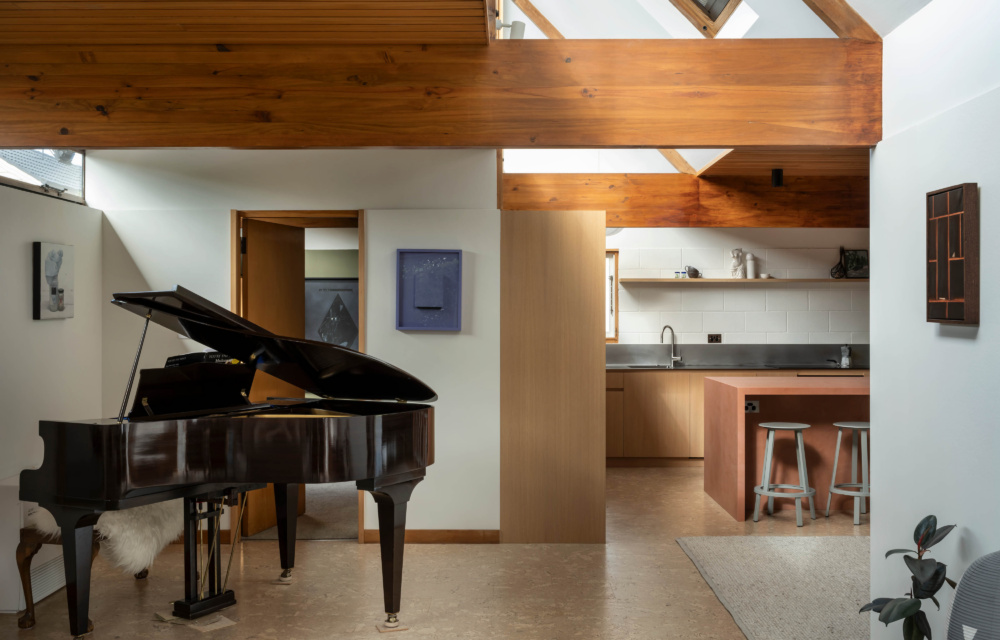
The terracotta coloured Dekton-clad kitchen island.
A low Gib ceiling added in the ‘80s was aligned with the original rooms using reclaimed timber and colour matching stains.
Painted concrete block, timber joinery, and cork flooring reference original detailing.
The house was originally designed D.A Cowey & McGregor with a second storey by Cowey & Mills in 1984 and later alterations by the subsequent owners.
Artedomus Antilia bathroom tiles.
The architects resisted changing the external fabric of the home, but were able to incorporate a new pool and deck area.
The project has ensured the house’s legacy will live on.
When the current owners purchased artist Olivia Spencer-Bower’s former home, the Christchurch-style house remained in mostly original condition.
The house was originally designed in 1968 by D.A Cowey & McGregor with a second storey addition by Cowey & Mills in 1984 after Olivia’s death, and later alterations by subsequent owners.
Having been initially designed for just one person, the original house had appropriately modest proportions, especially in the living and sleeping areas. It became Johnstone Callaghan Architects’ job to retain the home’s character, while better adapting it to suit a young family with interconnected living spaces and functional amenities. Referencing and recognising the mid-century details while providing a contemporary interpretation was the aim.
Johnstone Callaghan Architects’ approach focused mostly on internal reconfigurations to limit works, allowing the clients to remain in the home for most of the project.
‘We removed internal walls and structure, and concealed new structural elements where possible. If we couldn’t, we celebrated these and detailed these honestly to reference existing details,’ says Prue Johnstone, Johnstone Callaghan Architects co-founder.
As works unfolded, the project scope expanded to include earthquake remedial works.
Materials were selected to match the original mid-century and Christchurch-style architecture – styles that share a number of commonalities.
‘These principles, including well-proportioned spaces and an honesty of materials (and others) were key ideas we aimed to continue to carry into our design and decisions,’ says Prue.
Hero materials include painted concrete block, timber joinery, a terracotta Dekton-clad kitchen island, cork flooring, and Artedomus Antilia bathroom tiles that reference original mosaic detailing. A stainless steel plate benchtop in the kitchen introduces a contemporary element that’s both durable and functional.
A low Gib ceiling added in the ‘80s was aligned with the original rooms using reclaimed timber and colour matching stains.
The architects resisted changing the external fabric of the home, but were able to incorporate a new pool and deck area, which sensitively ties into existing landscape elements.
Prue says the most rewarding element of this project has been seeing the family use and live in the spaces as envisaged.
She adds, ‘This is a beautiful and successful project as we have retained an existing home and improved it to suit modern family life – a testament to the clients commitment to preserve architectural history and carry it into the future.’