
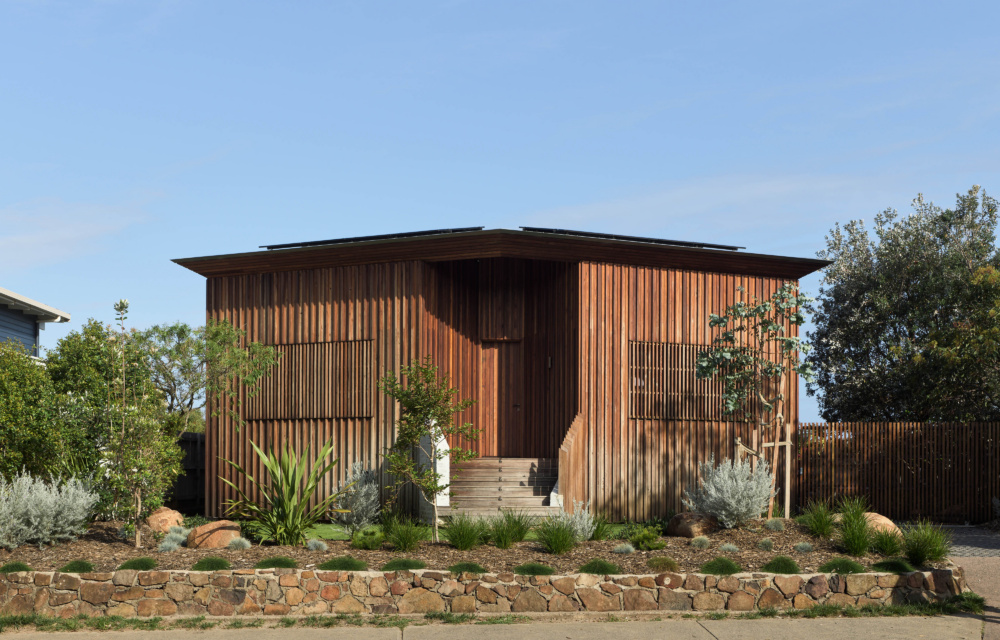
An Iconic Cake-Shaped House Gets An Architectural Upgrade
Architecture
The ‘Cake House’, as it’s nicknamed, has long been beloved by many Mollymook locals for its unique slice-like shape and position on the beach.
Alexander Symes Architect wanted to respect the existing building by minimising the scale of the addition, ensuring it is not visible from the beach, and maintaining existing view corridors.
AMA remodelled the internal spaces within the existing footprint of the existing house, resulting in four bedrooms and three bathrooms which can flexibly house up to 17 people, with the new communal spaces and bedrooms beyond.
The existing roof shape was also sharpened with a metal point and gold leaf soffit, which reflects morning light into the house.
Mollymook Beach remains the star of the show.
‘We focused on ways to better connect the existing beach shack to its surroundings by creating a series of indoor-outdoor spaces,’ says Alexander.
The living spaces can now open to avail of the sea breezes and sounds and extend onto the large deck.
Stunning water views.
‘The pragmatist in me says we should not build on such sites, however this site is so connected to Australian beach culture that we took the path of making this building to be a robust as possible against the impacts of climate change,’ says Alexander.
The house prioritises resource efficiency, by reusing and celebrating materials.
Four bedrooms are in the existing house, with additional bedrooms tucked underneath the outdoor terrace
The house can sleep up to 17.
Inn Studio designed the interiors with a contemporary, coastal feel.
The ‘Cake House’, as it’s nicknamed, has long been beloved by many Mollymook locals for its unique slice-like shape and position on the beach.
At the same time, the original home was weathered, and its planning arrangement lacked connection with its stunning surroundings.
Alexander Symes Architect (AMA) recognised the merits of the original house from the outset when engaged to ensure the home’s longevity and ability to host large groups.
‘The unique shape of the house has served as a sentinel for surfers,’ says AMA director Alexander Symes. ‘The alteration worked to embrace the iconic shape of the house whilst improving the connection to the ocean.’
Indeed, AMA’s extensive renovations and additions have improved the house inside and out, addressing multiple issues in the home’s floor plan and environmental performance.
The celebration of the existing building was paramount to the project, calling for reuse of as much of the building structure and materials as possible, and maintaining the building’s beach-facing shape.
‘The existing dwelling siting to the road was maintained and was setback from the beach view. We wanted to maintain the coastal vernacular and maintain the existing view corridors from across the street and adjacent sites, explains Alexander.
‘The response was to design the additions to the rear so as not to be seen from the street. The design takes inspiration from the original building form, while enhancing the connection to the surrounding outdoor environment.’
Original hardwood floors and aluminium cladding were thoughtfully detailed as part of the concrete formwork paired with recycled Australian hardwood cladding – the new icing on the original cake house. The existing roof shape was also sharpened with a metal point and gold leaf soffit, which reflects morning light into the house.
Inside, again to preserve its iconic shape, AMA remodelled the internal spaces within the existing footprint of the existing house, resulting in four bedrooms and three bathrooms that can flexibly house up to 17 people, with the new communal spaces on the first floor beyond.
‘Many of the existing walls remained in place with the new program, and the additional bedrooms are tucked underneath the outdoor terrace,’ says Alexander. ‘Coupled with the eastern facing glazing, the terrace provides various opportunities to visually and physically connect the external environment, which was limited in the existing house.’
The living spaces can now open to avail of the sea breezes and sounds and extend into the large deck, spilling into the garden.
AMA’s design has future-proofed the home, better ensuring it can withstand climate change and sea level rises. A berm has been incorporated into the landscape design to assist in deflecting sea surges, and the ground floor level has been constructed in concrete to withstand significant water inundation.
While the resulting embodied energy of Cake House is higher compared to other recent AMA projects, mostly due to the concrete, this was offset by additional features, including recycled materials, solar power, a battery, and a 30,000 in-ground water tank, and heat recovery ventilation system. The physical and natural landscape was also retained where possible, including the driveway, fences, topsoil, and endemic landscape species such as banksias.
Life cycle analysis results show that as well as being net zero in operation use, the project is carbon negative across its predicted 55 year lifespan.
AMA’s alterations and additions have overall dramatically improved how the house performs and practically functions, which is best experienced at dawn.
‘Being able to arrive at the completed house in the early hours and see the sunrise through the centre of the building – the pink morning light reflecting off the pointed gold leaf soffit and running down the central brass channel – was a particularly special moment. To have material and light interplay the way it was intended has become my favourite moment of the space,’ says Alexander.
‘The clients’ positivity towards the unique and unexpected surface finish [especially in the reused existing aluminium cladding downstairs], and the builders’ meticulous execution, showed a combined passion and dedication to celebrating refused materials in construction. It has been very memorable to work together with such an aligned and open-minded team.’
The house is a private holiday home that is rented out as accommodation when not in use.