
Most workspaces end up messy, with serious task lights that look like they belong in a lab and a general lack of objects that feel genuinely happy. A lot of lighting is either ultra-technical or purely decorative, rarely landing in the sweet spot where a lamp can handle focused work and still make you smile when you glance over at it. Analog was born from a designer who wanted a light that could sit in the middle of that chaos and still feel joyful.
Chris Granneberg was sitting at his messy desk in 2021 after playing Lego with his daughter when he sketched a stack of four cubes with another cantilevered off the side. That sketch became the Analog Task Light, a geometric lamp built from 10cm cubes, with a small footprint, a pop of color, and a form you want to look at during the day, even when it is off, which is exactly what he was after.
Designer: Chris Granneberg
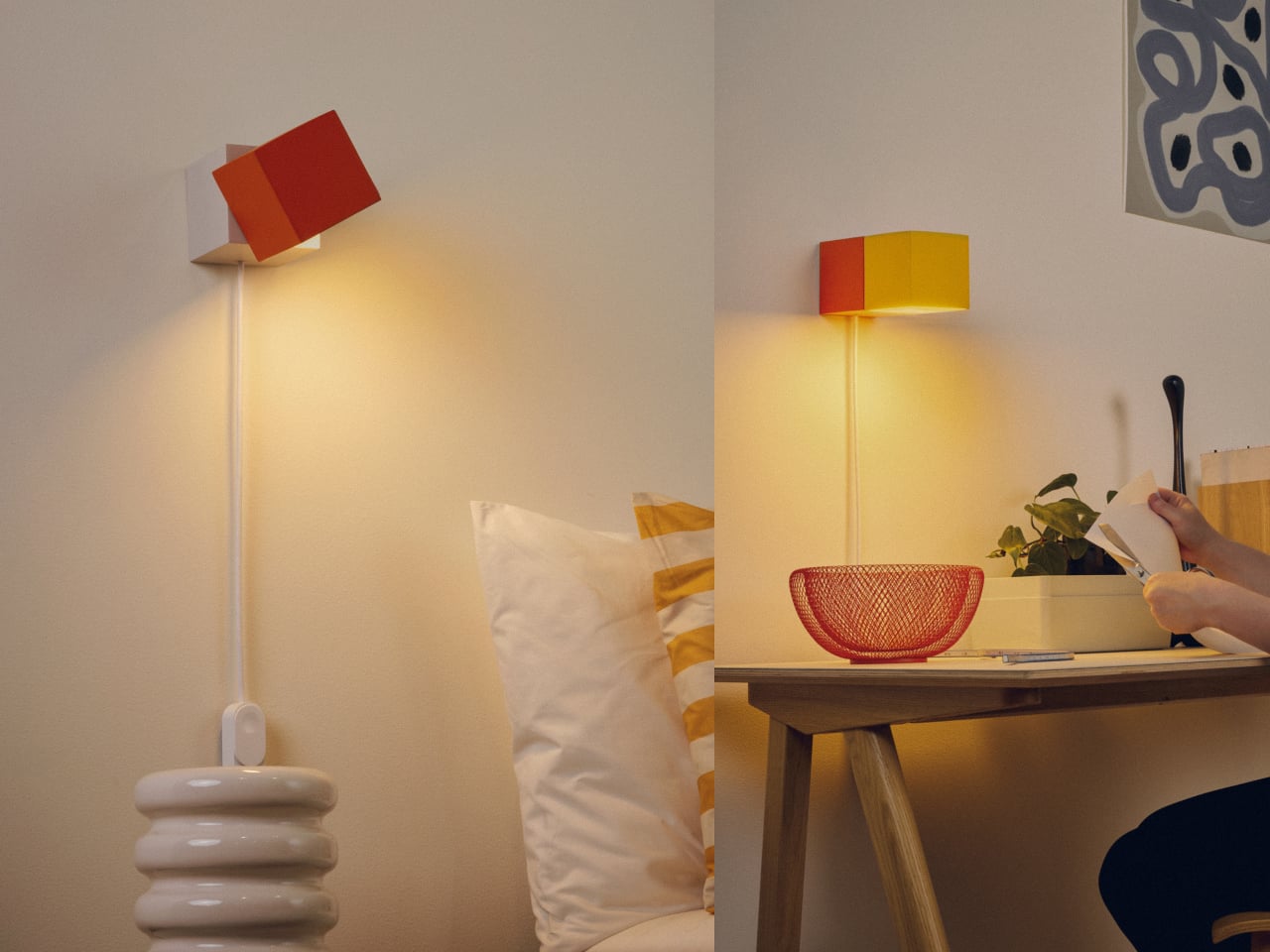
The task light turned into a family, with floor and wall versions built from the same cube language. The floor light stretches the stack into a tall stem with a cube head at the top, while the wall light compresses it into two cubes side by side, one as a mount, one as shade. The result is a collection that can move from desk to sofa to bedside without losing its identity or feeling like three different products that happen to share a name.
The three colorways shift the mood without changing the form. A bright orange and yellow combination leans into the toy reference, an all-black version feels more architectural, and a light grey body with an orange head sits between playful and neutral. The same geometry reads differently depending on the palette, which lets Analog slip into a MoMA-style white box or a more casual home office without feeling out of place.
Granneberg’s line about wanting something fun he would enjoy looking at during the day is the key. The stacked cubes and bold color blocking nod to Lego and building blocks without becoming literal toys. They are serious enough to light a desk or a reading corner, but soft enough in shape and proportion that they feel like characters in the room rather than anonymous fixtures you ignore until you need to turn them on.
What started as an Instagram render became a real collection when Gantri reached out to produce the lights, handling engineering details like how to remove the diffuser to change the bulb. The fact that Analog is also sold at the MoMA Store gives it a certain cultural stamp, but the story still traces back to a designer, a messy desk, and a sketch of cubes that felt joyful instead of just functional or serious.
Analog fits the current moment, where many people are rethinking their workspaces and looking for objects that do not feel purely utilitarian. A lamp that stacks cubes like a kid’s toy, throws a warm glow, and holds its own as an object when it is off fits that brief neatly. Analog makes the case that a task light can be both a tool and a small, daily source of joy, proving that even something as mundane as a desk lamp can feel happy if you build it from the right shapes and colors.
The post Analog Lamps Were Born From Lego Play and Now Sell at MoMA first appeared on Yanko Design.