
Coopparatus installation forms a sequence of Rotating Images
Coopparatus is an anamorphic, rotating installation by Thomas Medicus in which four images assemble sequentially through controlled mechanical movement and perspectival alignment. The project introduces a shift in the artist’s approach by composing the fragmented imagery in central perspective, allowing for closer viewing distances and more direct spatial engagement.
At the center of the installation stands a cubic image body constructed from 144 vertical glass strips and enclosed within a transparent hood. Distributed across these strips are four fragmented images. Through precise arrangement in central perspective, each image resolves into legibility after a 90-degree rotation of the cube. Between these indexed positions, the images disintegrate into dispersed fragments, appearing as a cloud of visual shards. The rotation mechanism consists of a turntable driven by a geared motor. The indexing system moves stepwise: after each 90-degree rotation, the structure decelerates gradually, pauses, and then resumes motion. This mechanical rhythm establishes a measured sequence of appearance and dissolution, structuring the viewer’s encounter with the work.
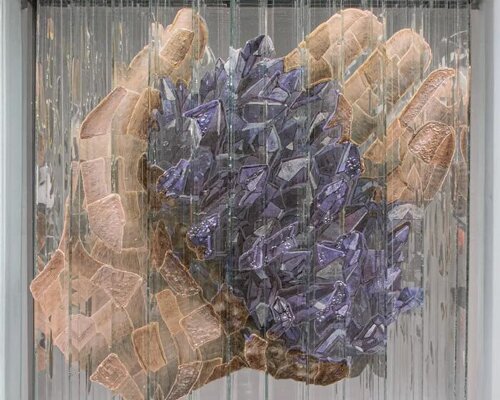
The installation presents four depictions of hands arranged in opposing pairs, each occupying the same silhouette. In one pairing, a hand holding gathered mushrooms is mirrored by a counterpart in which the hand itself becomes substrate, overgrown with bracket fungi. In another pairing, a hand holding an amethyst is opposed by a petrified version embedded with garnets. Each image pair shares identical contours while presenting reversed thematic conditions.
a hand that is petrified and set with garnets | all images courtesy of Thomas Medicus
Medicus positions seeing as an active and conditional process
Coopparatus operates not only as an image-producing device but also as an examination of perception. The installation shifts attention from the question of what is seen to how the image becomes visible. The images resolve only from specific vantage points and appear more distinctly when viewed with one eye closed. Outside these positions, the imagery collapses into fragmented abstraction. Through mechanical construction, material assembly, and perspectival calibration, the installation foregrounds the conditions that structure vision. The apparatus itself becomes perceptible as part of the experience. The boundary between object and observer becomes unstable, as the clarity of the image depends on the viewer’s position and adjustment within space.
The mirrored hand motifs further reinforce this dynamic. Where one side presents a distinction between human and nature, the opposing image reverses that relationship, dissolving the separation. The work frames this distinction not as inherent but as a construct dependent on perspective. Coopparatus engages broader questions related to mediated observation. In contemporary contexts shaped by technical devices, visibility is structured through apparatuses that define what can be seen and what must remain excluded. By making its own mechanism visible and contingent, the installation exposes these conditions. The image appears only under precise circumstances; recognition requires alignment, while all other positions produce fragmentation.
In this way, Coopparatus positions seeing as an active and conditional process. Designer Thomas Medicus’s work renders perception observable, demonstrating that visibility is structured through inclusion and exclusion. The act of seeing becomes inseparable from the apparatus that enables it.
a hand that holds an amethyst
a hand that holds various picked mushrooms
a hand that became a nutrient ground and is overgrown by bracket fungi
four images assemble sequentially through controlled mechanical movement
a cubic image body is constructed from 144 vertical glass strips
between rotations, the imagery dissolves into scattered fragments
four shattered images are distributed across the glass strips
each image resolves after a precise 90-degree rotation
close-up of hand-painted image fragments created with kiln-fired enamel pigments
project info:
name: Coopparatus
designer: Thomas Medicus | @tomedicus
materials: low-iron glass, anti-reflective glass, laminated glass, aluminium, structural steel
image technique: painting with opaque vitreous enamels, kiln-fired
drive: ~0.8 rpm, 4-index cam-driven rotary indexing table, 0.06 kW geared motor
viewing point: X: 144 cm from the glass hood, Y: centered, Z: 60 cm above the base surface
dimensions: (LxWxH) ~55 x 55 x 90 cm Weight: ~90 kg
designboom has received this project from our DIY submissions feature, where we welcome our readers to submit their own work for publication. see more project submissions from our readers here.
edited by: christina vergopoulou | designboom
The post anamorphic installation by thomas medicus rotates into four shifting hand images appeared first on designboom | architecture & design magazine.