
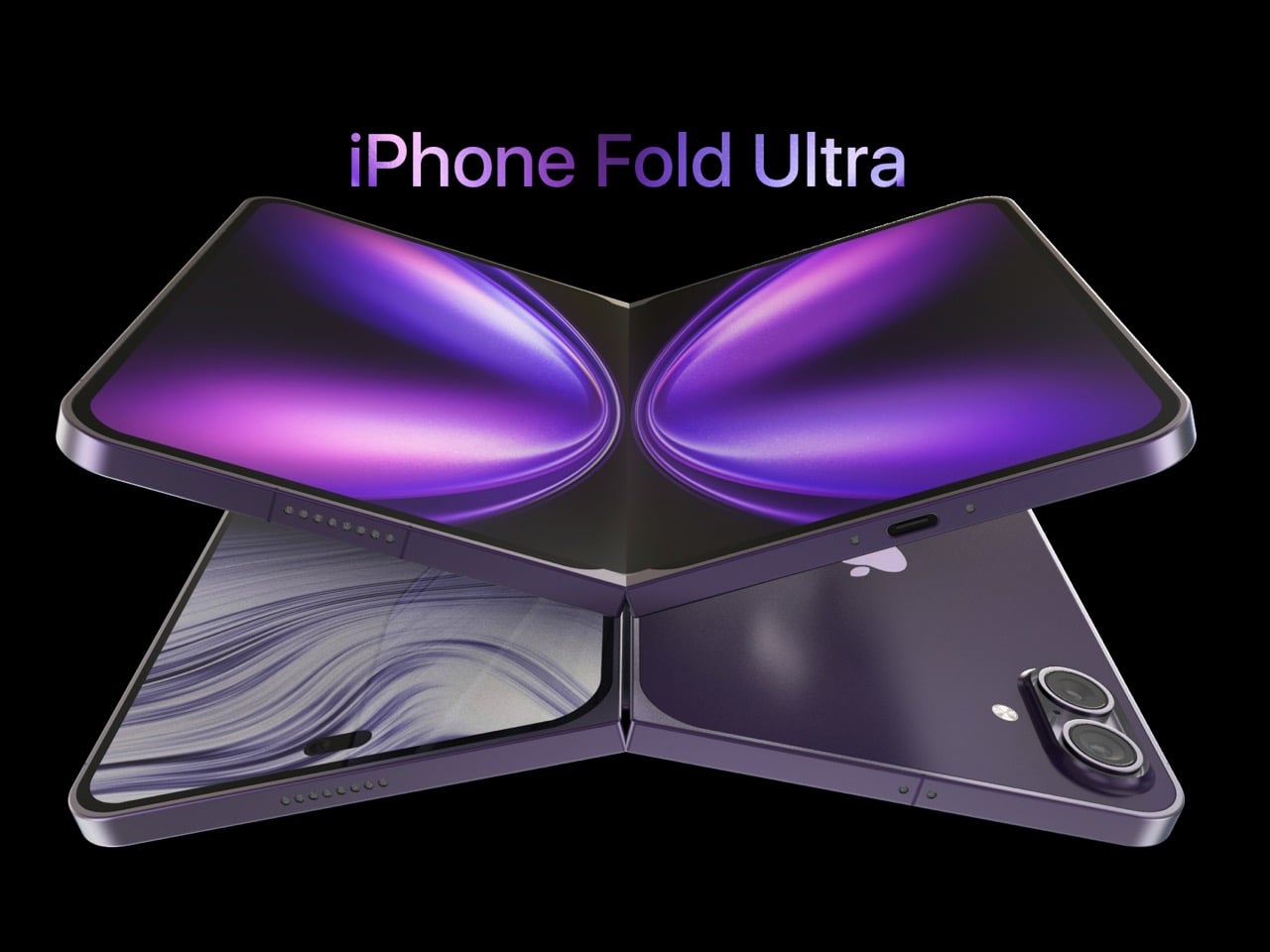
Apple got thousands of people to pay $3,499 for an ambitious “spatial computing device.” Can they convince millions to shell out $2,299 for a foldable iPhone? Let’s just take a second to piece the logic. $2,299 gets you TWO latest iPhone Pros and some duct tape to hold them together. You’d get two screens, two camera modules, two processors. Heck, for $2,299 you could almost buy three iPad minis, giving you three 8.3-inch displays with Apple Intelligence running on all of them. What could a $2,299 iPhone Fold offer that would justify such a markup? Well, here’s everything we know.
The rumored clamshell-style foldable iPhone is shaping up to be a serious piece of hardware, not just a folding parlor trick. We’re looking at a 5,700mAh battery, which would be the largest ever in an iPhone by a significant margin, promising legitimate all-day power despite running dual displays. The device is expected to feature a 7.8-inch inner display with a 4:3 aspect ratio, essentially giving you an iPad-like canvas that folds into a pocketable form. The outer 5.5-inch screen would function as a standard iPhone when closed. Apple has reportedly solved the crease problem with advanced hinge technology, and the whole package would come wrapped in titanium, measuring just 4.5mm when unfolded.
Designer: 4RMD
Design studio 4RMD has visualized what this device could look like, and they’ve added the “Ultra” moniker to their concept to spice things up. The specs they’ve compiled from various leaks and reports paint a picture of a device that belongs in the upper echelons of Apple’s lineup, alongside the Apple Watch Ultra and potentially justifying that eye-watering price tag. The renders show a book-style foldable with dual 48MP rear cameras and a 24MP ultra-wide front camera, all running on the upcoming A20 Pro chip built on a 2nm process. Three color options appear in the concept: White, Black, and Deep Purple, the latter being a callback to the iPhone 14 Pro’s most popular finish.
Of all those specs, the 5,700mAh battery is the one that really stops you in your tracks. It’s a direct shot at the Achilles’ heel of every single foldable currently available. Samsung’s Galaxy Z Fold 7 limps along with a 4,400mAh cell, and anyone who has used one knows that’s barely enough to get through a busy day. Google’s Pixel Fold does a bit better with 4,821mAh, but it’s still a compromise. A battery that large, combined with Apple’s legendary efficiency, means this could be the first foldable that you can actually use without constantly hunting for an outlet. That alone is a massive selling point.
Of course, stuffing a battery that big into a chassis brings up the immediate question of weight. Foldables are notoriously heavy; the Pixel Fold is a hefty 283 grams, and the Z Fold 6 is 239 grams. For context, an iPhone 16 Pro Max is around 227 grams. This is where the rumored titanium frame becomes critical. Titanium provides the necessary rigidity for a complex hinge mechanism without turning the phone into a pocket brick. If Apple can keep the weight manageable while achieving that 4.5mm unfolded thickness, they will have solved a core ergonomic problem that competitors are still struggling with.
The physical interaction model also gets a rethink, with Touch ID making a comeback on the power button. This isn’t a step backward; it’s a pragmatic engineering choice. Putting Face ID on both the inner and outer screens would mean two expensive, space-consuming TrueDepth systems. A single fingerprint sensor on the side works seamlessly whether the device is open or closed, and it’s a proven, reliable technology. If anything, it makes sense after years of FaceID not working when the phone isn’t facing you head-on. Just let me unlock my phone while it’s beside me in bed, Apple…
All this premium hardware would be for nothing if the main screen still felt like a compromise, which brings us to the crease. The concept details a nearly invisible one, which lines up with reports of Apple using advanced ultra-thin glass and a unique Liquidmetal hinge. Competitors have made progress, but you can still feel and see the fold on every device out there. If Apple truly manages to create a seamless internal display, it will remove the last major psychological hurdle for potential buyers. It would finally make a foldable screen feel like a single, uninterrupted canvas.
So, when do we actually get our hands on this thing? The consensus has been fall 2026, launching alongside the iPhone 18 Pro. That timing is now looking a bit shaky. Apple has reportedly pushed the standard iPhone 18 into 2027 because of component shortages, and the company is still wrestling with getting Apple Intelligence just right. If the Fold’s software isn’t ready (or even a better Apple Intelligence to pair with it), a delay seems inevitable. A slip from late 2026 to early 2027 would place its release right inside the window for the iPhone’s 20th anniversary. The original launched in June 2007, and it feels fitting that the 20th anniversary iPhone be one that bends in half on purpose.
The post Apple iPhone Fold ‘Ultra’ Could Have a 5,700mAh Battery and $2,299 Price Tag first appeared on Yanko Design.