
tsyuyoshi tane on his method of ‘archaeology of the future’
Architecture is often viewed as an act of looking forward, a race toward the sleek, the new, and the unprecedented. but for tsuyoshi tane, the most radical way to build the future is to dig into the past. ‘I believe that architecture begins from the memory of a place,’ tane tells desigboom in an interview from his paris based studio. Behind him, the walls are a mosaic of references, much like his projects: a collision of archaeological fragments and modernist ambition. ‘We are not just designing shapes; we are excavating stories that have been buried by modernization.’
This ‘archaeology of the future’ — tane’s personal manifesto — is currently taking center stage at the Louisiana Museum of Modern Art in Denmark. As part of the architecture connecting series, the exhibition ‘memoryscapes’ (running until may 2026) pairs tane with Chinese architect xu tiantian. Together, they challenge the industry’s obsession with the tabula rasa, proposing instead that we treat the earth as a living archive. It is a quiet rebellion against the generic glass towers that define our contemporary skyline, asking instead what the soil beneath them has to say. ‘We want to create architecture for the future that no one has ever seen, experienced, or even imagined yet,’ he explains, ‘but it does not mean we want to make a novel and futuristic type of architecture.’
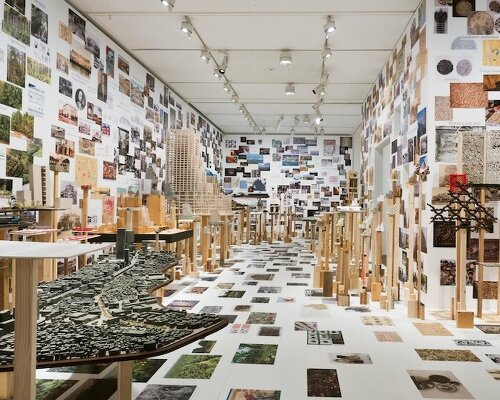
installation image of ‘memoryscapes’ at the louisiana museum of modern art | image by camilla stephan
ATTA uses archaeological methodology to excavate space
At the Louisiana, Tane’s installation is a sensory overload of research. Thousands of images and physical models, some built from raw, site-specific materials, fill the space. It feels less like a traditional architectural gallery and more like a laboratory of time. One room, titled ‘archaeological thinking,’ displays Tane’s personal archive of found objects, proving that a rusted nail or a specific soil sample can be as vital to a blueprint as a CAD drawing. His process is exhaustive, often beginning months before a single line is drafted on a computer.
‘When we start a project, we don’t draw immediately,’ Tane explains during our conversation.‘We are really diving into the research process of archaeologically collecting images, even scientifically, reading books and documents… to find out what buried memories have been almost lost or forgotten.’ For Tane, the architect is less of a creator and more of a translator, someone who interprets the whispers of history into the language of steel, wood, and light. ‘The process of searching and researching allows deep thinking and gives us surprises and the joy of encountering things that have been forgotten, erased or vanished due to global modernization.’
tsuyoshi tane | image by yoshiaki tsutsui
case study imperial hotel tokyo: structure as a container of time
One of the most anticipated ‘excavations’ in his current portfolio is the renovation of Tokyo’s legendary Imperial Hotel. It is a project heavy with ghosts, sitting on a lineage that includes the work of Frank Lloyd Wright. For Tane, this isn’t about mere restoration; it’s about a ‘new modernism’ that honors 130 years of history while addressing a green, contemporary Tokyo. he treats the existing site as a living organism rather than a static monument, looking for ways to integrate the weight of the past into the lightness of tomorrow. ‘the new will always eventually become old and be forgotten,’ tane notes of his philosophy. ‘to avoid that fate, we can uphold the legacy of the past and use those memories to create the future.’
His approach to material is equally grounded. from the Tane Garden House on the Vitra campus, which utilized local stone and thatch, to his larger urban interventions, there is a tactile honesty in his work. ‘We take architecture as a language… learning from local crafted maturity to take into our project,’ he notes. He views memory as a structural element itself, stating, ‘until now, the structure was only the engineering, but actually we put the memory and the structure of the building together.’ He describes his experience with Wright’s work as ‘something akin to a symphony, with its dramatic spatial composition and use of light and furnishings,’ a feeling he hopes to translate into his own structural choices.
vitra tane garden house | image by Julien Lanoo, Courtesy of ATTA and Vitra
memoryscapes at louisiana: bridging geology and the social
In ‘Memoryscapes,’ Tane proves that architecture can be a bridge. By looking deep into the geological and anthropological layers of a site, he creates buildings that feel like they have always been there, yet belong entirely to tomorrow. This is evident in the films produced by the Louisiana Channel and showcased in the exhibition, which document his studio’s working method. They reveal a practice that values the slow process of ‘thinking with the hands,’ where models are built from found materials to test how a building might sit within its historical context.
This focus on ‘site specific architecture’ is what makes Tane’s work so resonant in an era of rapid displacement and climate uncertainty. As we face the homogenization of our cities, his ‘archaeological’ method offers a grounded, soulful path forward. ‘All places have memories,’ Tane asserts. ‘Architecture inherits the memories and carries them into the future.’ It suggests that the answers to our current urban crises might not be found in new technologies alone, but in the forgotten wisdom of how we once lived with the land. It is a radical humility that places the site above the ego of the architect.
at the louisiana, tane’s installation is a sensory overload of research | image by Atelier Tsuyoshi Tane Architects
museum shows site specific interventions as the ultimate catalyst
Tane’s work is less about looking backward with nostalgia and more about finding a launchpad for innovation. The exhibition at Louisiana serves as a testament to this, showing how ‘productionscapes’ and ‘memoryscapes’ can revitalize traditional professions and local cultures. he isn’t interested in museums that preserve the past in amber; he wants factories, hotels, and gardens that pulse with the energy of what came before.
‘Memory is not something from the past,’ Tane concludes. ‘Memory is the energy for the future.’ It is this energy that drives ATTA to continue digging, ensuring that every project is not just a building, but a continuation of a story that started long before we arrived and will continue long after we are gone. At the Louisiana, visitors are invited to start looking at the ground beneath their feet. ‘We want to build architecture that drives our time forward and creates memories in the future,’ Tane says, a final nod to the cycle of time his work seeks to inhabit.
archaeological research | image by Atelier Tsuyoshi Tane Architects
imperial hotel tokyo | image by Atelier Tsuyoshi Tane Architects
installation image of ‘memoryscapes’ at the louisiana museum of modern art | image by camilla stephan
project info:
name: Architecture Connecting II: Memoryscapes – Archaeology of the Future
architect: ATTA – Atelier Tsuyoshi Tane Architects
location: Louisiana Museum of Modern Art, Humlebæk, Denmark
dates: january 22, 2026 – may 17, 2026
The post ‘architecture begins from the memory of a place’: tsuyoshi tane on archaeology of the future appeared first on designboom | architecture & design magazine.