
the grid that swallowed the world
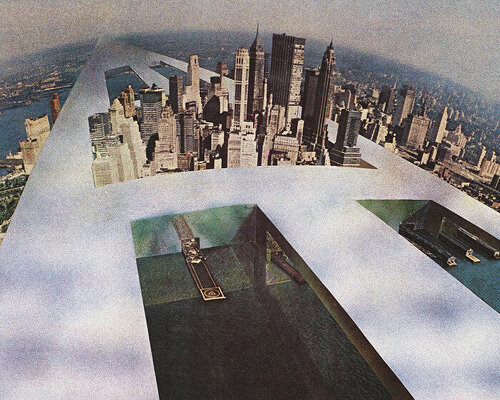
In 1969, an apocalypse appeared in architectural magazines. A pristine white grid slides across Manhattan, glides over deserts, rests on cliffs, stretches across oceans. The endless structure simply continues ignoring its surroundings. This was The Continuous Monument, possibly the most iconic project by the Italian collective Superstudio. At first glance it resembles the ultimate modernist dream, an infinite infrastructure in total order, the planet redesigned as a single architectural system.
Founded by Adolfo Natalini and Cristiano Toraldo di Francia, and later joined by Gian Piero Frassinelli, Alessandro, and Roberto Magris, and Alessandro Poli, Superstudio constructed a vision so geometrically perfect that it reveals something disturbing. If architecture pursues absolute rationality and total design, the result might not be liberation but uniformity. The Continuous Monument stretches across the Earth like a mirror held up to modernism itself.
For the collective, utopia was not a place waiting somewhere in the future but a way of thinking. By constructing extreme scenarios, Superstudio could examine the ambitions and contradictions of modern architecture. Looking at the architects’ radical projects, designboom traces how utopian speculation became a tool for questioning architecture. To understand how this image reshaped architectural thinking, we have to return to Florence in the late 1960s, where a group of young designers began turning utopia into critique.
Arizona Desert, 1969 | image via Centre Pompidou
the spark: superarchitettura, 1966
The story begins in Florence in 1966, when a team of architects, including Adolfo Natalini and Cristiano Toraldo di Francia, formed Superstudio. Their emergence coincided with a moment when architecture was losing its certainty. The postwar decades had celebrated progress through new cities, megastructures, and technological optimism. Yet the late 1960s introduced friction. Student revolts, political unrest, and the contradictions of consumer society exposed cracks in the modernist narrative.
Before the global grid and the photomontages that wrapped the planet, a group of young Florentine designers staged the Superarchitettura exhibition in Pistoia, a short train ride from Florence. Organized by Superstudio together with Archizoom Associati, the show featured rooms filled with brightly colored furniture, pop graphics, exaggerated forms, and ironic slogans. Lamps resembled sculptural objects, and furniture embraced kitsch and artificial materials. Architecture behaved like pop culture.
The exhibition manifesto famously proclaimed that Superarchitettura is the architecture of superproduction, superconsumption, superinducement to consumption. The participating designers exaggerated consumer culture until it became absurd.
Superarchitettura launched what would soon be called Radical Architecture, Italian collectives experimenting with speculative design, critical theory, and visual storytelling. Superstudio’s later projects may appear austere and philosophical, but they grow out of the same radical impulse that animated Superarchitettura, out of a strong will to expose the ideological machinery behind design.
Superstudio, The Continuous Monument, New York, 1969 | image via MAXXI
the paradox of total design
Across Europe and Japan, architects were experimenting with speculative futures. Groups like Archigram imagined plug-in megacities, while the Metabolism Movement proposed cities that could grow like living organisms. Superstudio moved in another direction, using mainly photomontages, manifestos, films, and speculative narratives. Architecture became a medium for critique, aiming to reveal the absurdities of the present through a futuristic aesthetic.
The Continuous Monument is a perfectly modular grid that wraps the Earth, transforming every geography into the same neutral surface. Mountains, rivers, historic cities, and deserts dissolve beneath the same infinite structure. In one photomontage, the monument glides across a rocky coastline. In another, it hovers above Manhattan like a mirrored horizon.
Superstudio exaggerated modernism’s logic until it collapsed under its own weight. If architecture believes it can rationally organize the world, then why stop at cities? Why not design the entire planet? The team proposes a utopia that behaves like a dystopia. The grid promises equality, efficiency, and universal order, but at the same time, it erases difference, history, and culture, merging everything into the same system. Natalini later pushed the idea to its logical extreme, suggesting that if architecture only serves to formalize consumer society and social divisions, it may be better for architecture to vanish altogether.
the Continuous Monument is a perfectly modular grid that wraps the Earth | image via Cristiano Toraldo Di Francia
the anti-architecture experiment
If the Continuous Monument imagines architecture as infinite infrastructure, Supersurface imagines the opposite. Developed between 1971 and 1972, the project proposes a world where architecture dissolves into an invisible network. The planet becomes a continuous energy grid, where information, power, and communication circulate through a hidden technological mesh. People move freely across landscapes, forming temporary communities that appear and disappear like migrating constellations.
The idea appeared within Superstudio’s multimedia project Five Fundamental Acts, which explored the universal rituals of life: birth, education, love, ceremony, and death, through narratives in which architecture only provides the conditions for life to unfold.
By the mid-1970s, Superstudio reached a radical conclusion. If architecture risked becoming an instrument of consumption and control, then architects should question their own discipline. The collective gradually abandoned conventional architectural practice and turned toward theory, media, and teaching, introducing the idea of counter-design, a strategy where design operates against its own assumptions. Photomontages, storyboards, and fictional narratives became instruments for examining power, technology, and social organization. In a curious twist, projects that were never intended to be built became some of the most influential images in architectural history.
Superstudio, Terza città: New York of Brains, 1971 | image via Centre Pompidou, MNAM-CCI/Georges Meguerditchian/Dist. GrandPalaisRmn
from ideal cities to cautionary tales
While The Continuous Monument remains Superstudio’s most recognizable image, it was only one chapter in a much larger series of speculative projects. Among the most notable of these experiments is Twelve Ideal Cities (1971), a sequence of speculative urban scenarios that present twelve different cities operating according to a rigid social principle. One is organized through absolute equality, another through total consumption, another through technological control, all drawings exposing the boundary between utopian order and dystopian control.
Another project from the same period is Histograms of Architecture (1969), a set of abstract diagrams that reduce architecture to a simple modular grid. Buildings are no longer designed as individual objects but as expandable systems capable of extending infinitely across space. This graphic language later migrated into everyday objects through Superstudio’s Quaderna furniture series, where tables, desks, and cabinets are wrapped in the same continuous grid pattern.
In Twelve Cautionary Tales for Christmas (1971), the group created a series of illustrated stories that read like architectural fables speculating on possible futures shaped by technology, consumption, and ideology, warning that systems designed to improve life can easily become mechanisms of control.
Positano, 1969 | image via Centre Pompidou, MNAM-CCI/Georges Meguerditchian/Dist. GrandPalaisRmn
the influence of superstudio
The image of the Superstudio’s global grid still feels contemporary half a century later, echoing the invisible infrastructures that shape life: data networks, satellite systems, logistics chains, and algorithmic platforms. Superstudio sensed this trajectory early and anticipated a future where architecture might no longer be defined by buildings but by networks.
Although the collective built very little, their ideas traveled widely through exhibitions, magazines, and academic circles. The photomontages of the Continuous Monument became some of the most recognizable images in architectural discourse. Their influence spread through ways of thinking about architecture. One of the architects often associated with this legacy is Rem Koolhaas. His fascination with architecture as narrative, speculation, and cultural analysis echoes Superstudio’s practice. In projects and writings produced with OMA, architecture becomes a tool for examining urban systems, global infrastructure, and ideological frameworks rather than simply producing objects.
Another figure who absorbed this speculative attitude is Steven Holl, whose early conceptual drawings and theoretical explorations treat architecture as a poetic and philosophical investigation. Similarly, architects like Bjarke Ingels and his studio BIG often use diagrams and narrative storytelling to frame architecture as a response to larger social systems. More broadly, Superstudio’s legacy can be seen in the resurgence of speculative and paper architecture. Many contemporary studios explore fictional scenarios, climate futures, or planetary infrastructures through drawings, installations, and research-based projects. This lineage also runs through architecture schools. For generations of architecture students, Superstudio’s collages suggest that architecture does not always need to result in a building. Drawings, films, and speculative narratives can operate just as powerfully, transforming architecture into a medium for questioning the systems that shape everyday life.
Salvages of Italian City Centers (Your Italy), Venice | image via MAXXI
utopia as a question
Superstudio treated utopia as a way to test ideas at an extreme scale. Their visions ask a deceptively simple question. What happens when design becomes total? What happens when architecture succeeds too well at organizing the world?
In their work, the promise of absolute order quickly begins to feel uneasy. The perfectly rational grid of the Continuous Monument offers equality, efficiency, and clarity, yet it also suggests a world stripped of difference. Landscapes become interchangeable. Cities lose their identities. Culture dissolves into a single universal system.
Superstudio understood that utopian visions often hide a paradox. Perfectly organized environments may leave little room for spontaneity, improvisation, or cultural friction. In this context, their projects function like architectural stress tests, pushing ideas until their hidden consequences appear. This strategy allowed Superstudio to transform architecture into a critical lens through their drawings, collages, and films. Their utopias do not provide answers but suggest that architecture becomes most powerful when it exposes the systems already shaping our lives.
Fundamental Acts (1971–1973), developed by Cristiano Toraldo di Francia and Superstudio, is a series of films, storyboards, and texts exploring the relationship between human life and architecture through five themes: Life, Education, Ceremony, Love, and Death | image via MAXXI
Twelve Ideal Cities – Twelve Cautionary Tales, 1971 | image via MAXXI
Fundamental Acts: Education 1971–1972, collage image by Cristiano Toraldo di Francia | image via MAXXI
Superstudio, self-portrait, 1973, collage by Cristiano Toraldo di Francia | image via MAXXI
Sofo for Poltronova, 1968, image by Cristiano Toraldo di Francia | image via MAXXI
Gherpe (1968) by Superstudio for Poltronova
Passiflora (1967) by Superstudio for Poltronova
The post architecture utopias: superstudio appeared first on designboom | architecture & design magazine.