
marjetica potrč seeks unique knowledge around the globe
What if cities were shaped through agreements instead of plans? What if housing could adjust as people need it? These questions sit behind the work of Slovenian artist Marjetica Potrč, whose projects trace how people build, adapt, and live together through systems that remain open to change.
Across two decades, her work focuses on water use, energy, and the ways communities organize themselves around these systems. She looks closely at how communities from different parts of the world already manage resources, often outside formal planning frameworks, and treats those situations as a starting point.
Rather than proposing ideal forms, she works through examples that show how environments are negotiated over time. In this sense, Utopia appears as something practiced, shaped through decisions that continue beyond the moment of construction.
Marjetica Potrč, image via University of Ljubljana
Forest Rising: learning from existing models
In Forest Rising (2007), an installation which exhibited at The Barbican, Potrč reconstructs a small elevated settlement based on communities in the Amazon. The installation includes tree trunks supporting a platform, solar panels, and a satellite dish. These elements are specific and direct, drawn from places where rising water levels and deforestation influence how people build.
The artist brings attention to a way of living that balances local independence with access to global networks. Energy is generated on site, structures respond to environmental conditions, and communication extends outward through accessible technology.
By presenting this configuration in a gallery setting, Potrč shifts the focus toward recognition, acknowledging that these systems are already in place, and they operate through wisdom developed across generations within the community. The work suggests that architectural thinking can begin by studying and understanding these practices in detail.
Marjetica Potrč, Forest Rising (2007), tree trunks, building materials, energy and communication infrastructure, Forest Rising, The Curve, Barbican Art Gallery, London, 2007
‘Caracas: Growing Houses’: dwellings that adapt
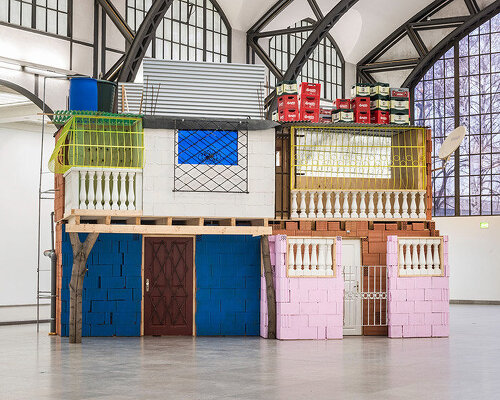
Caracas: Growing Houses (2012) turns toward informal settlements in Venezuela, where residents build and expand their homes over time. Construction takes place in stages, often guided by immediate needs rather than long-term plans. Walls extend, additional rooms appear, and infrastructure is adapted as resources become available.
Potrč presents this process as a form of urban development that operates through use. The city grows through decisions made at the scale of the household, and those decisions accumulate into a larger structure. There is no fixed end point. Instead, the environment remains open, shaped by changing conditions and priorities. Within this framework, Utopia is connected to the ability to respond, to adjust, and to continue building without finalizing the form.
Marjetica Potrč, Caracas: Growing Houses, 2012, building materials, energy-, communications- and water-supply-infrastructure, installation view at Hamburger Bahnhof, Museum für Gegenwart, Berlin
‘Shelter: Closed and Open’: architecture as a social condition
Marjetica Potrč brings two contrasting forms of housing into a single structure with Shelter: Closed and Open (2018). The lower portion, Prishtina House, reflects a defensive architecture that emerged in Kosovo during the political changes of the 1990s. Built for protection, it is enclosed, inward-looking, and shaped by a need for security. Above it sits Palafita, a stilted structure from Amazonian Brazil that remains open, with no enclosing walls.
The pairing is direct and easy to read. One structure limits exposure, the other invites it. Potrč uses this contrast to frame architecture as a reflection of social conditions rather than a neutral object. The installation is supported by drawings that connect these two examples to broader questions of how societies organize themselves. In this context, Utopia is tied to the possibility of shifting between forms of living, from protection toward openness, depending on how communities define their needs and relationships.
Marjetica Potrč, Shelter: Closed and Open, 2018, building materials, energy and water-supply infrastructure, installation view VISUAL Carlow, Ireland
‘House of Agreement’: giving rights to the land
With The House of Agreement between Humans and the Earth (2022), Potrč shifts toward a more explicit framework that connects architecture with governance. The installation combines a modest structure with a series of drawings that outline relationships between humans and the environment. These references draw from ongoing discussions about granting legal rights to rivers and land.
Here, the focus moves toward the terms under which people inhabit a place. Living on land involves decisions about use, access, and responsibility. Potrč frames these decisions as agreements that must be defined and maintained. Architecture becomes a way to express these relationships in physical form, linking spatial organization with systems of accountability. The project expands her earlier work on infrastructure by placing emphasis on how those systems are governed.
Marjetica Potrč, The House of Agreement between Humans and Earth, 2022 (Detail), installation View, 23rd Biennale of Sydney, rīvus, 2022, Museum of Contemporary Art Australia
‘Between the Waters’: shared systems in practice
Between the Waters: The Emscher Community Garden (2010), developed with Ooze Architects, brings these ideas into a working environment. Located in Germany’s Ruhr region, the project integrates a community garden with a visible water system that collects, filters, and reuses water from local sources.
Pipes, pumps, and storage are placed in view, allowing residents to follow how water moves through the site. The system supports food production and creates a direct connection between resource management and the use of the space. People can see how the garden depends on the water system, and how their involvement influences its operation. This visibility supports a shared understanding of infrastructure, making it possible for the community to participate in its maintenance and development.
site specific installation ‘Marjetica Potrč and Ooze (Eva Pfannes and Sylvain Hartenberg) – Between the Waters: The Emscher Community Garden’, building materials, energy and water-supply infrastructure, vegetable garden, Emscherkunst, Essen 2010
utopia as method
Taken together, these projects trace a consistent approach in Potrč’s work. She begins by identifying existing practices, then develops systems that people can engage with directly, and finally frames those systems through agreements that guide how they are used. Each step builds on observation, participation, and exchange.
Within this trajectory, Utopia is understood as a method that continues over time. It depends on collaboration, on knowledge shared between communities and disciplines, and on the ability to adapt to changing conditions. Her work stays close to specific situations and focuses on how people secure water, expand their homes, and manage shared resources. Through these examples, architecture becomes a way to support ongoing processes rather than define a final state.
site specific installation ‘Marjetica Potrč and Ooze (Eva Pfannes and Sylvain Hartenberg) – Between the Waters: The Emscher Community Garden’, building materials, energy and water-supply infrastructure, vegetable garden, Emscherkunst, Essen 2010
The post artist marjetica potrč learns from communities worldwide to rethink how we live together appeared first on designboom | architecture & design magazine.