
Reconfiguring a Neighborhood marker as a domestic Object
White Picket Chair by Brooklyn-based artist and designer Han Seungmin reconfigures stainless steel fence components commonly found in New York City’s Asian and West Indian neighborhoods into a functional seating object. The project examines how architectural elements associated with security, aspiration, and visibility can be translated into the domestic sphere.
Flashy and present, the chair demands one’s attention just as much as the real fences, guardrails, awnings, and doors do in the streetscape of Sunset Park or Flushing. Originated and mass produced in China in the 80s, these stainless steel architectural components spread quickly into countries near and far-like South Korea, where Han encountered them on a day-to-day basis growing up, due to their affordability, as well as ease of maintenance and customization. Not long after, these components landed in New York and were quickly adapted by not only Asian homeowners, but also West Indian homeowners as well, and became one of the signifiers of achieving the ‘American Dream.’ The fences’ aesthetic can certainly be polarizing to many, but it definitely is unapologetic. Han finds that this defiant attitude is quite apt for today’s political climate where many immigrant communities are constantly being targeted. In that vein, the name of the chair, White Picket Chair, directly questions what the image of the American Dream is supposed to be.
all images courtesy of Han Seungmin unless stated otherwise
Stainless Steel White Picket Chair Reframes the American Dream
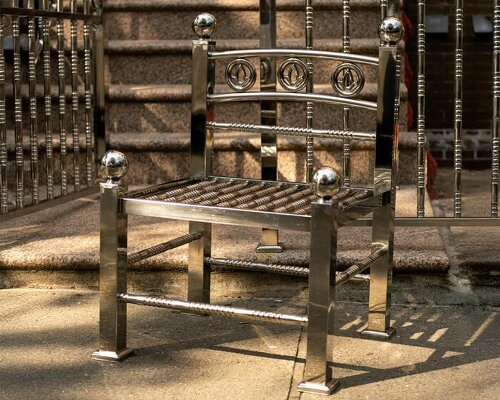
White Picket Chair by Brooklyn-based designer Han Seungmin reconfigures and transforms the mass-manufactured parts that make up the fences and railings. While the chair’s decorative finials and arched, emblemed rails resemble a fence commonly found in the streets, the additional posts at the front and the ribbed tubes connecting to the back add unlikely dimensionality that whimsically puts the chair in a space between the familiar and the unfamiliar. In this shift from architecture to furniture, outward declarations of security and presence are brought into the domestic sphere, and what was experienced at the scale of the street becomes bodily and tactile. Consequently, White Picket Chair amusingly yet pointedly invites the user to reexamine the iconic stainless steel fence and all of the nuances it carries about the ‘American Dream’ through the immigrant perspective. The series features four made-to-order White Picket Chairs available to purchase. Part of the proceeds from the sale are to be donated to the New York Immigration Coalition.
the chair teeters between the familiar and the unfamiliar of New York City’s Asian and West Indian neighborhoods
Han Seungmin brings the iconic architectural elements and all their nuances into the domestic sphere
polished stainless steel fences are popular among Asian and West Indian homeowners in New York City
the steel fence, as a marker within immigrant neighborhoods, carries cultural and socioeconomic connotations
White Picket Chair by Han Seungmin in front of the same fences from which it is fabricated
White Picket Chair is fabricated by using mass-manufactured hollow stainless steel tubes | image by Gene Han
the chair retains the ornamental language of these fences while altering their function and scale | image by Gene Han
the stainless steel elements originated in China, and quickly spread to New York City | image by Gene Han
the name references the image of the ‘white picket fence’ as a symbol of the American Dream | image by Gene Han
project info:
name: White Picket Chair
designer: Han Seungmin | @sonny.han
photographers: Han Seungmin, Gene Han | @genehan
designboom has received this project from our DIY submissions feature, where we welcome our readers to submit their own work for publication. see more project submissions from our readers here.
edited by: christina vergopoulou | designboom
The post assembled from steel fence components, white picket chair challenges the american dream appeared first on designboom | architecture & design magazine.