
Greece clears the way for Archaeological Museum expansion
Greece approves the preliminary studies for the long-anticipated expansion and upgrade of the National Archaeological Museum in Athens, designed by David Chipperfield Architects in collaboration with Alexandros Tombazis Architects (find designboom’s previous coverage here).
Announcing the approval, Greece’s Minister of Culture Lina Mendoni stated: ‘Greece is acquiring the National Archaeological Museum it deserves.’ Her statement frames the project as a recalibration of a complex architectural organism shaped by 19th-century neoclassicism and successive modernist additions. The existing building, originally conceived for a very different museological era, now struggles to accommodate contemporary visitor numbers, conservation standards, and curatorial practices. The expansion addresses these pressures by consolidating fragmented additions, restoring aspects of the original structure, and introducing new spaces that align the museum with current international standards.
all images courtesy of Greece’s Ministry of Culture
Chipperfield and Tombazis reorganize circulation and light
The David Chipperfield Architects team, together with local Alexandros Tombazis Architects, proposes restructuring how the museum operates and how it connects to Athens. A new main entrance on Patission Street leads to a public plaza and an interior foyer designed as a civic threshold. Above and below ground, the museum extends into a landscaped public park that acts as an urban garden. Conceived in dialogue with Ernst Ziller’s original 1889 building and the romantic park traditions of its era, the landscape design unfolds through winding paths, layered planting, and subtle changes in topography that create a sense of depth and discovery within a dense urban context.
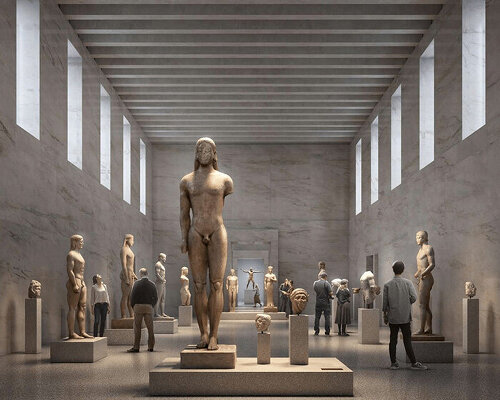
Architecturally, the new galleries alternate between large, free-flowing exhibition halls with diagonal views and access to daylight and smaller, more introspective cabinet-like rooms designed for focused encounters with individual works. This variety allows the museum to respond to different types of objects and narratives while shaping a more nuanced visitor experience. A central water element in the underground level reinforces orientation and daylight penetration, addressing long-standing issues of humidity and water ingress that have affected the building.
Greece approves the preliminary studies for the expansion and upgrade of the National Archaeological Museum
Museological route traces Greek culture across four levels
Approximately 17,000 antiquities will be displayed across two major thematic zones, organized into 13 sections and multiple sub-narratives. The prehistoric collections, Neolithic, Cycladic, and Mycenaean, more than double in size, expanding from 1,100 square meters to 2,500 square meters. Temporary exhibition spaces also grow substantially, while new storage, logistics, and conservation facilities are integrated to support both daily operations and international collaborations. Educational spaces increase more than threefold, reinforcing the museum’s role as a place of learning rather than passive display.
The approved museological concept introduces a clear chronological route tracing Greek culture from the Neolithic period to Late Antiquity. Visitors move across four levels, two within the new extension and two within the historic building, guided by a central axis that provides spatial clarity and orientation. In the extension, this axis is organized around a naturally lit central atrium that anchors the experience and presents key objects from different historical periods. Within the monument itself, a sequence of galleries along the main axis offers varying scales, lighting conditions, and spatial rhythms, particularly evident in the presentation of ancient Greek sculpture from the archaic to the classical era.
introducing new spaces that align the museum with current international standards
Athens moves forward with landmark cultural upgrade
Beyond exhibitions, the project strengthens the research and professional infrastructure of the museum. Conservation laboratories nearly double in size, storage areas are expanded and modernized, and the library and historical photographic archive gain additional space and dedicated facilities. Secure circulation routes for staff and artifacts are integrated into the plan, improving both operational efficiency and conservation standards. The static study of the building addresses the heterogeneity of its structure, introducing targeted interventions to enhance seismic performance while accommodating new architectural and mechanical requirements.
Environmental performance is a central concern of the upgrade. The project introduces comprehensive energy improvements, enhanced climate control for the protection of antiquities, and systems designed for long-term adaptability. Accessibility is addressed throughout, with elevators, ramps, and clearly dimensioned paths ensuring universal access to both the museum and the surrounding park. The landscape design includes tree planting along Patission Street to mitigate heat, reduce airborne dust, and create a shaded transitional space between the city and the museum.
restructuring how the museum operates and how it connects to Athens
the museum extends into a landscaped public park
large, free-flowing exhibition halls
a central water element in the underground level reinforces orientation and daylight penetration
approximately 17,000 antiquities will be displayed across two major thematic zones
project info:
name: Renovation of the National Archaeological Museum | @namuseumathens
architect: David Chipperfield Architects | @dca.berlin and Alexandros N. Tombazis & Associates
location: Athens, Greece
client: Hellenic Ministry of Culture
The post athens’ national archaeological museum upgrade by chipperfield and tombazis gains approval appeared first on designboom | architecture & design magazine.