
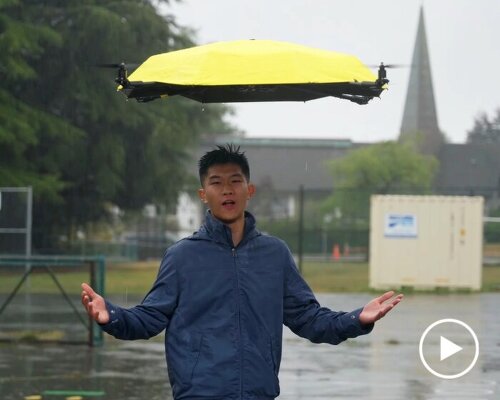
Upgrading the flying umbrella with autonomous capabilities
John Tse of I Build Stuff creates an autonomous flying umbrella that follows and shields the users from rain and sunlight. An updated version of the remote-controlled one, the hands-free device hovers above the user and trails them wherever they go, keeping them dry and cool without needing to hold anything. The autonomous flying umbrella is a drone disguised as an everyday object. Its design keeps the familiar shape of a normal umbrella but hides flying technology just under the yellow surface. Four propellers are mounted around the material using a custom internal frame, and they provide the lift and control, just like a quadcopter drone.
The creator admits that attaching them is one of the design challenges of the autonomous flying umbrella. It’s because the umbrella’s center rod is the only strong part, but mounting everything directly there would make it bulky and hard to carry. The solution was folding arms, where each propeller sits on an arm that folds inward when not in use and locks firmly into place when opened. This allows the flying umbrella to stay compact when carried and stable when flying. The locking system uses hinges, rubber bands, and carefully designed plates to reduce shaking and keep everything tight during flight.
all images courtesy of I Build Stuff
Camera detects the user’s position in 3D
The most important feature of the autonomous flying umbrella, however, is its ability to hover on its own. The project was not just about flying, since the creator already did that, but about following a person automatically. To do this, the designer first built a smaller test drone, which made it easier to experiment without risking the large umbrella frame. The tracking system went through many versions, including regular cameras, GPS, and finally a time-of-flight depth camera. The latter works by sending out light and measuring how it reflects back, creating a depth image instead of a flat picture. It allows the system to detect a person’s position in 3D, even in low light. A Raspberry Pi processes this depth data and figures out where the person’s head is. It then sends instructions to the flight controller, telling the umbrella which direction to move so it stays centered above the person.
Most of the structural parts were made using 3D printing as well as robust materials like carbon-fiber nylon. Advanced 3D printers made it possible to produce precise hinges, locking mechanisms, and a central hub that connects the whole system to the umbrella. Inside the autonomous flying umbrella is a collection of electronics that make it work. There’s also a professional flight controller that acts as the brain, keeping the device balanced in the air while an embedded GPS helps it hold position outdoors. The project faced many failures. Parts broke, software didn’t work, components disconnected, and entire systems had to be replaced. But after nearly a year of work, the autonomous flying umbrella finally succeeded. It could hover, follow a person, and even fly in heavy rain. It was not perfect, but it worked, and with this, the project became more about making an idea a real, functional object.
the hands-free device hovers above the user and trails them wherever they go
four propellers are mounted around the material using a custom internal frame
each propeller sits on an arm that folds inward when not in use
the locking system uses hinges, rubber bands, and carefully designed plates to reduce shaking
the installed camera allows the system to detect a person’s position in 3D
most of the structural parts were made using 3D printing
project info:
name: Autonomous flying umbrella
channel: I Build Stuff | @ibuildstuff_yt
The post autonomous flying umbrella follows and shields users from rain and sunlight appeared first on designboom | architecture & design magazine.