
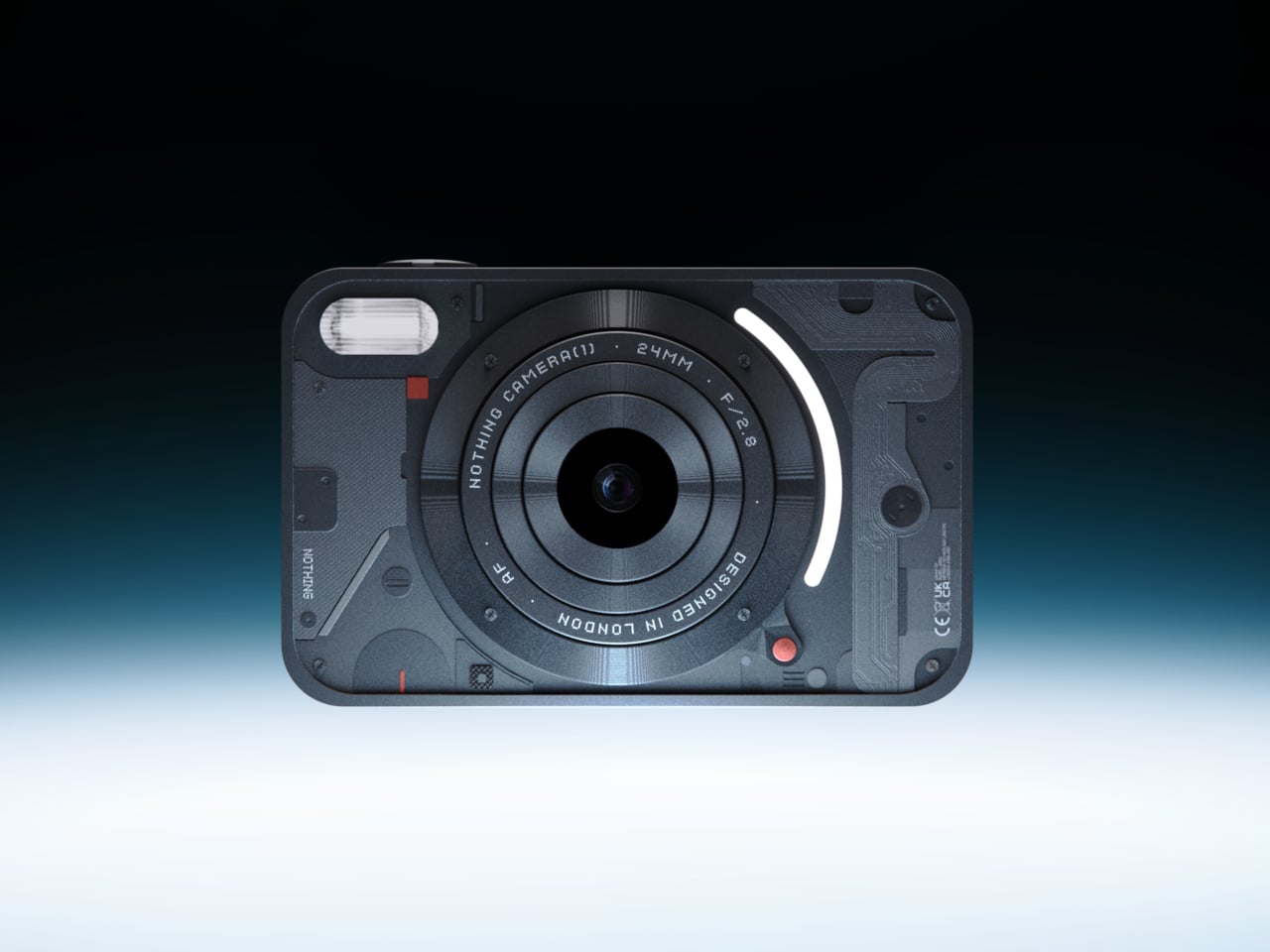
Most photos now live inside phones, buried between notifications and apps. A new generation has started picking up old digital cameras to make shooting feel more intentional again, separate from scrolling and messaging. Many of those cameras still carry clunky menus and dated interfaces. Camera (1) is a concept design that asks what a modern compact could feel like if it were designed around touch and light instead of software layers.
Camera (1) is a compact, metal-bodied device with softly rounded corners, sized to slip into a pocket but solid enough to fill the hand. All the main controls live on one edge, so your thumb and index finger can reach the shutter, a circular mode dial with a tiny glyph display, and a simple D-pad without shifting your grip or poking at a touchscreen. The concept is inspired by the now familiar transparent, hardware-forward design language of Nothing.
Designer: Rishikesh Puthukudy
Taking the camera to a dinner or a show means twisting the lens ring to frame, feeling the click of the shutter under your finger, and glancing at the little icon on the dial to know whether you are in stills or video. The camera encourages you to look at the scene more than at the screen, letting the physical controls carry most of the interaction so the rear display stays out of the way.
The dot-matrix glyph on the dial shows simple icons for modes, while a curved light strip around the lens can pulse for a self-timer, confirm focus, or signal that video is rolling. Instead of deep menu trees, you get a handful of physical states you can feel and see at a glance, which makes the device feel more like an instrument than a gadget you have to decipher before you can take a picture.
The engraved lens ring, marked with focal length and aperture, invites you to twist rather than pinch. Zooming or adjusting focus becomes a small, satisfying motion instead of a jittery rocker or on-screen gesture. That tiny bit of resistance under your fingers reinforces the idea that changing perspective is a choice, not something you do absentmindedly while flipping through feeds.
The bead-blasted metal shell, the layered front panel with circuit-like relief, and the small red accents and screws give the camera a technical, almost transparent character without actually exposing its internals. It feels like a piece of hardware that is honest about how it works but still restrained enough to live on a café table or hang from a wrist strap without looking like it is trying too hard.
Camera (1) is not trying to beat the phone at convenience. It is offering a different relationship with photography, one where you press real buttons, read simple glyphs, and let light and tactility tell you what the camera is doing. In a world where every screen wants something from you, a compact that just wants you to notice what is in front of it feels like a refreshing thought experiment.
The post Camera (1) Imagines a Tactile Digicam for a Screen-Tired Generation first appeared on Yanko Design.