
Rice as Material: Reframing Discarded Grain Through Design
SSAL: Rice as Matter is a material study by designers Juwon Kim and Na Hyeon that investigates discarded rice as a design medium rather than a consumable product. The project focuses on rice that has fallen out of circulation, either past its shelf life, unsuitable for sale, or produced as byproducts of the milling process, and examines how material value can emerge once use-value is removed.
The study responds to the shifting role of rice in contemporary Korean society. While rice retains strong cultural significance, its presence in daily consumption has declined, generating repeated cycles of storage, redistribution, and disposal. Within these systems, rice is frequently excluded due to grading standards, expiration dates, or maintenance costs, making disposal more viable than reuse. The project began with field research conducted in collaboration with a local rice mill, including site observations and interviews, and developed through iterative material experiments.
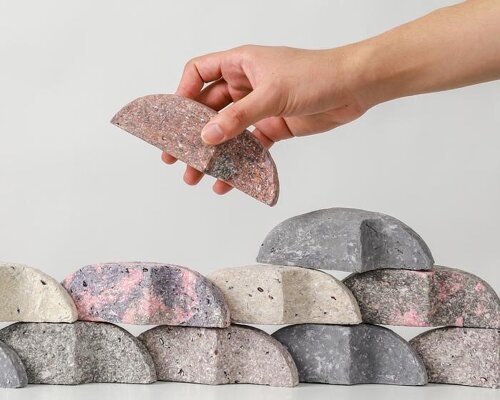
Rather than approaching rice as food, the designers treat it as a physical substance with distinct structural and sensory properties. By combining rice with various binders, they produced a moldable and dryable composite material. Particle size emerged as a primary design variable. Larger grains remain visible and tactile on the surface, while finer grinds produce smoother and more uniform finishes. When multiple particle sizes are combined, the interlocking grains create denser structures and more complex textures. This relationship between rice particles and binders functions similarly to aggregate and adhesive in construction, influencing strength, cohesion, and surface character.
Rice Material Experiments Exhibited at Hongik University | all images courtesy of Juwon Kim & Na Hyeon
Testing Durability, Texture, and Color in Rice-Based Composites
After drying, surface treatments and natural preservatives were tested to adjust durability, allowing the material to extend beyond speculative samples toward potential applications. Color experiments incorporated natural additives such as green tea and chili powder, as well as different rice varieties, including brown and black rice, each contributing inherent tonal qualities. The resulting palette ranges from light, warm hues to darker, more subdued surfaces. In several samples, the designers emphasized the natural coloration of rice, retaining its familiar visual character.
Milled rice revealed a soft ivory tone with slight translucency, particularly evident in samples made from fine flour. Coarser samples emphasized the grain structure, producing more pronounced texture and surface variation. The use of natural materials also introduces the assumption of biodegradability, situating the material within a temporal framework distinct from conventional permanent building materials.
Rather than framing discarded rice as waste, the project examines the conditions under which its value is displaced by fluctuations in consumption, inventory pressures, and disposal costs. In these moments, rice loses its designated purpose and is removed from attention, often ending in disposal despite its cultural and ethical significance. By reintroducing discarded rice as matter, the study by designers Juwon Kim & Na Hyeon documents its material capacities while questioning how value might be reassigned once familiar systems of use are suspended.
the project reassigns value to discarded rice through material research
transforming surplus rice into a design medium
material’s character forms through drying, pigmentation, and grain size
sample of materials and mixtures
material composition analysis
samples for rigidity testing
sampling for texture development
surface during sample drying
samples utilizing various processed forms of rice
formed and pre-dried
mixture made by mixing pure rice flour with a binder (pre-drying)
adding rice in different particle sizes to other materials
project info:
name: SSAL : Rice as Matter
designers: Juwon Kim & Na Hyeon
designboom has received this project from our DIY submissions feature, where we welcome our readers to submit their own work for publication. see more project submissions from our readers here.
edited by: christina vergopoulou | designboom
The post can discarded rice become building material? examining a value cycle for wasted grain appeared first on designboom | architecture & design magazine.