
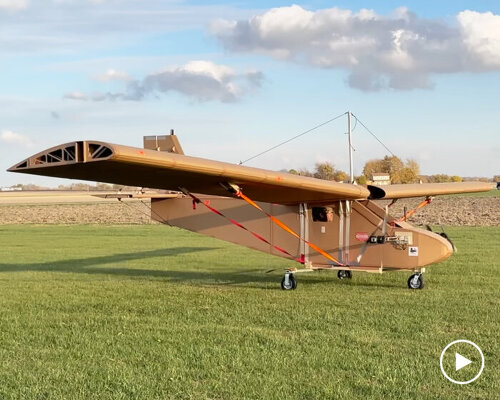
Making the cardboard airplane with wooden wings with glue
The cardboard airplane with wooden wings attempts to fly in the sky using a remote control and a set of exposed propellers. Built by Peter Sripol and his team, the personal air vehicle is lightweight enough to carry one person to the sky, or at least it tries to. The project begins with the fuselage, which is built entirely from cardboard panels cut into side profiles and glued together.
The shape follows a simple airplane body form that narrows toward the tail and widens near the seating area, and the team reinforces high-load areas using doubled, tripled, and stacked layers of cardboard. These reinforcements are placed where the pilot sits, where the wings connect, and where the landing loads are transferred. Then, hot glue is used as the main adhesive because it sets quickly and allows them to assemble the cardboard airplane with wooden wings as quickly as possible.
all images courtesy of Peter Sripol via Youtube
Plywood embedded inside the wing to strengthen it
The two-part videos document how the cardboard airplane with wooden wings comes to life. The first part focuses on the design of the personal aircraft and in the second part, the creator Peter Sripol sits inside it to test if it can fly. These clips show the team designing a layered floor with internal cardboard ribs arranged like corrugated slats to create a box structure that can support the pilot’s weight without collapsing.
The small cutouts let the pilot see forward and to the sides, and they can’t see so much because the intended flight profile is straight, short, and low. The controls are on the sides, with plans for rudder pedals on the floor. The wing attachment is one of the main challenges because the cardboard isn’t an ideal material under compression, so the team embeds small plywood plates inside the wing structure to strengthen it. The wings are also attached using bolts and reinforced cardboard doublers.
the cardboard airplane with wooden wings attempts to fly in the sky using a remote control and a set of propellers
Personal air vehicle hopes for a second chance
The wing box uses folded cardboard sections to create stiffness. For the tail, the team adds a horizontal stabilizer, elevator, vertical stabilizer, and rudder, built from folded cardboard skins that act as closed boxes. Propulsion comes from electric motors mounted on a plywood-reinforced cardboard structure, while the batteries, speed controllers, and wiring are mounted inside the fuselage. The airspeed, altitude, and attitude sensors are also housed in a cardboard enclosure made from a pizza box.
Once everything is glued together and set, it is time for the team, led by Peter Sripol, to test the cardboard airplane with wooden wings. After several attempts, the personal aircraft can’t make it high, and at one point, it abruptly lands, or safely crashes, in the field as soon as the platform carrying speeds away. The creator has high hopes, though. He believes that his cardboard airplane with wooden wings can fly, and high this time, but for now, he will have to adjust its setup and make some improvements before trying it again.
the personal air vehicle is lightweight enough to carry one person to the sky, or at least it tries to
there are also taped parts around the fuselage
the personal air vehicle lands safely after a few seconds in the air
view of the cockpit
front view of the paper aircraft
project info:
name: Cardboard airplane
creator: Peter Sripol | @petersripol
The post cardboard airplane with wooden wings takes flight using remote control appeared first on designboom | architecture & design magazine.