
Lautner’s Castle: A Hillside Modernist Revisited
Designed in the early 1980s by John Lautner, the recently renewed Lautner’s Castle rises from a steep Los Angeles hillside, its cylindrical stone turrets marking the canyon edge. Renovation architect Conner & Perry Architects approached the project with the intention of upgrading key spaces and performance while preserving the logic and spirit of the California home.
The residence‘s south facade remains defined by its stone cylinders, each containing a distinct program — kitchen storage, bathing spaces, and circulation — within its thickened walls. Between each stone cylinder, a terrace projects outward to frame views in rhythmic intervals.
cylindrical stone turrets define the south facade and organize the interiors | images © Joe Fletcher
renewing a nautical timber roof structure
Inside Lautner’s Castle, a curving hallway follows the arc of the upper level beneath a ribbed timber ceiling. When the team at Conner & Perry Architects replaced the aging roof assembly, the diagonal board structure was briefly exposed, revealing a construction method that reads almost nautical in its precision. The rebuilt roof improves insulation and weather protection while retaining the original geometry. Copper caps now top the exterior beams, introducing a material that will patinate alongside stone and wood.
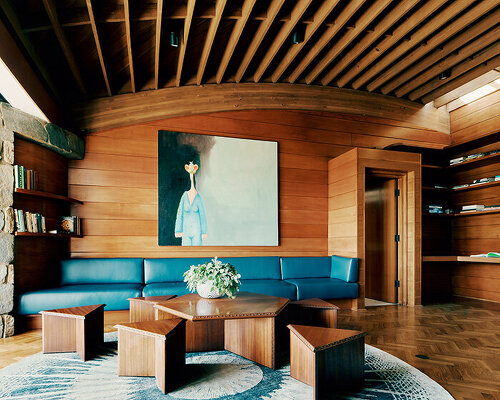
Original Douglas fir panels were stripped and refinished, restoring depth to the interior surfaces. In the living area, a suspended installation of thin wood veneer fins traces the length of the dining space, casting light across the exposed ceiling. Chrome eyeball fixtures punctuate the entry, directing attention to the grain and rhythm of the wall panels.
Conner & Perry upgrade the roof and preserves Lautner’s original structural geometry
Focused Interventions by conner & perry
The kitchen remained largely intact, its stone slab island and heavy detailing preserved. Technical upgrades were integrated discreetly, with concealed ceiling slots and a roof mounted fan addressing ventilation without disrupting sightlines. Throughout the house, flooring was replaced in kind and millwork inserted with precision, reinforcing existing lines rather than competing with them.
In the primary suite, a custom platform bed and integrated nightstands replace earlier elements while aligning with the vertical grain paneling. The bathroom received more substantial revision. A new Corian soaking tub set into a hardwood deck faces the canyon, while the cylindrical stone shower with its circular skylight continues to define the room through light and texture.
a ribbed wood ceiling and curved hallway shape the upper level experience
Extending the Terrain
Beneath the pool, Conner & Perry Architects carved out a new deck from what had been a dirt slope, revealing the underside of Lautner’s Castle’s cantilevered structure. Built-in seating and a stone fire feature establish the space as an outdoor room. Planters form a subtle edge along the drop, maintaining open views toward the canyon.
The surrounding landscape was reworked to support the architecture. A cactus garden frames the entry, while planted walkways and shaded pockets trace the hillside at the rear. These additions reinforce the dialogue between mass and terrain that has long shaped John Lautner’s work.
the kitchen retains its stone slab island and embedded storage within a turret
copper beam caps replace painted metal and will weather alongside stone and timber
copper beam caps replace painted metal and will weather alongside stone and timber
reworked landscaping strengthens the relationship between architecture and hillside terrain
a carved-out deck beneath the pool reveals the underside of the cantilever
project info:
name: Lautner’s Castle
architect (original): John Lautner | @lautnerfoundation
architect (renovation): Conner & Perry Architects | @connerperryarchitects
location: Los Angeles, California
photography: © Joe Fletcher | @joefletcherphoto
The post conner & perry reworks 1980s-built ‘lautner’s castle’ on a los angeles hillside appeared first on designboom | architecture & design magazine.