
aalto university installs outdoor stage in rural finland
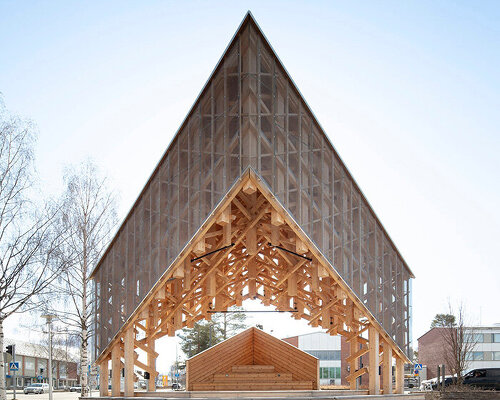
In Kuhmo, a small timber-industry town in eastern Finland, Aalto University’s Wood Program installs Kide, a crystalline outdoor stage that doubles as a civic gathering point. The pavilion responds to the need of the town for a flexible cultural venue by translating the fractal geometry of snow into an inhabitable wooden canopy. Suspended lightly on two corners, the structure offers a sheltered space for performances, markets, and everyday meetings, contributing to the social and cultural life of a community of 8,000 residents.
Formed by eight interwoven glulam trusses wrapped in a translucent metal mesh and topped with prefabricated LVL (laminated veneer lumber) roof panels, the pavilion reveals its structural logic openly, lending the square a new visual identity while maintaining a remarkably light footprint.
image courtesy of Aalto University’s Wood Program
a timber canopy shaped by snow and forest
The team grounds the project in the crystalline logic of snow and the spatiality of the forest, two defining elements of Finnish nature. The name Kide, Finnish for ice crystal, captures the geometric clarity shaping the form of the pavilion. Inside, filtered daylight, slender timber members, and a sense of enclosure evoke the calmness of woodland interiors, creating an atmosphere that shifts with the seasons and the events hosted beneath it.
Eight interwoven glulam trusses form the pavilion’s square footprint. These elements are mechanically connected in a sequence that generates both rigidity and a visual rhythm, their geometry becoming legible through a translucent metal mesh that wraps the outer surface. The mesh reveals rather than hides: it turns the structure’s anatomy into part of the architectural experience, emphasizing depth and shadow without adding visual heaviness.
All primary timber components, the glulam trusses and the LVL (laminated veneer lumber) roof panels, are prefabricated at Aalto University, then transported to the Kuhmo site for assembly. This workflow reflects long-standing pedagogical priorities within the Wood Program that include precision, economy of material, and hands-on construction experience. Prefabrication also operates as a sustainability strategy. Controlled workshop conditions reduce waste, improve structural accuracy, and shorten on-site building time. The project relies almost entirely on renewable, bio-based materials, particularly timber sourced from the region’s forests, aligning the pavilion with local identity as well as environmental responsibility.
The sustainable approach is embedded not only in its materials but also in its restrained construction logic. The minimalist assembly, durable timber species, and honest detailing ensure longevity while keeping maintenance low.
Aalto University’s Wood Program installs a crystalline outdoor stage that doubles as a civic gathering point
a snow-inspired structure that transforms the town square
Kuhmo is known for its annual music festivals and its rich history of timber architecture, yet it lacked a dedicated outdoor venue capable of supporting cultural events and everyday use. Kide fills this gap with its elevated pine-wood stage and timber backdrop frame performances ranging from folk music and choirs to dance, rock bands, and award ceremonies. Just as importantly, the pavilion hosts local markets, informal gatherings, and seasonal celebrations.
Residents embrace Kide and invite people to gather under the warm wooden canopy, and by reactivating the town’s central square, the structure contributes to cultural tourism, reinforces community identity, and enhances daily life. Its impact extends beyond aesthetics or performance programming; it creates a durable civic infrastructure that supports a wide range of public rituals.
the pavilion responds to the need of the town for a flexible cultural venue
translating the fractal geometry of snow into an inhabitable wooden canopy
suspended lightly on two corners
the structure offers a sheltered space for performances, markets, and everyday meetings
contributing to the social and cultural life of a community of 8,000 residents
formed by eight interwoven glulam trusses
wrapped in a translucent metal mesh
topped with prefabricated LVL roof panels
the pavilion reveals its structural logic openly
the name Kide captures the geometric clarity shaping the form of the pavilion
project info:
name: Kide
architect: Aalto University’s Wood Program | @woodprogram_aalto
location: Kuhmo, Finland
instructors: Pekka Heikkinen, Laura Zubillaga, Dario Vidal, Mauri Kontilla (structure)
architectural design: Ayato Hokkyo, Daniel Sars, Darya Belaya, Dimitris Kalogridis, Ishrat Tabassum, Johanna Saarela, Juri Kikuchi, Keitaro Tsubata, Kota Kawakami, Matej Požega, Meina Kobayashi, Nao Fujimoto, Olle Björkebaum, Simón Herrera Arévalo, Ville Mujunen, Wakana Ito, Yume Suzuki
structural design: Ghada Al-Adulrazzaq, Jakub Sołtysiński
The post crystalline timber canopy inspired by snow fractals becomes a gathering space in finland appeared first on designboom | architecture & design magazine.