
Stacked Volumes Organize Layered living space by anonym studio
Located within an established residential enclave in Bangkok, Thailand, oom house by anonym studio is conceived as an extension to an existing dwelling, introducing additional space while maintaining continuity with its surroundings. The project reconsiders conventional housing typologies through a design approach centered on curved geometry and spatial continuity.
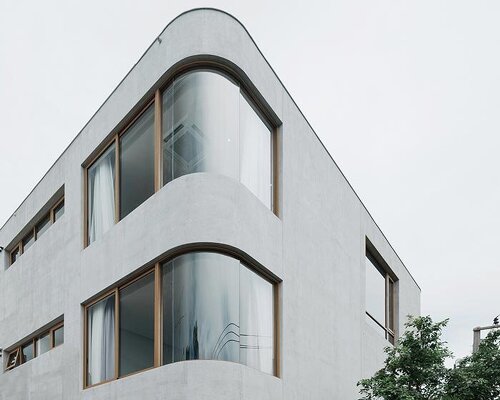
Positioned adjacent to the original house, the new structure is defined by a series of curved lines that inform both plan and elevation. These curves operate as spatial devices, enabling adjacent areas to remain connected without rigid separation. This approach establishes a continuous relationship between the two buildings while also softening the boundaries between the architecture and the site.
all images by Peepapat Wimolrungkarat
Continuous curves and shifting stair paths organize oom house
The ground floor accommodates shared functions, including the living room, dining area, kitchen, and an outdoor space that extends toward the original house. Private areas, including bedrooms, are arranged across the second and third floors. Curved geometries are introduced at key junctions, particularly along the front facade and corners near property edges, reducing angular transitions and contributing to a more continuous spatial flow.
A concave glass wall marks the intersection between the new and existing structures. This transparent surface allows the exterior space of the original house to extend into the new interior, forming a shared terrace between the two volumes. The gesture reinforces the project’s ‘space sharing’ concept while increasing daylight penetration into the ground floor. Overhanging eaves provide shading, mitigating solar gain along the glazed surface.
The designers at anonym studio organize the circulation in order to encourage movement through the house. Staircases connecting each level are positioned in different locations, distributing circulation paths and prompting varied spatial experiences throughout the interior.
a restrained, linear front facade ensures privacy, softened by a curved opening that draws light into the stair hall
Timber, concrete, and curvature establish material continuity
Material selection emphasizes contrast and continuity. Timber is used extensively at points of contact and visual emphasis, reflecting the client’s preference for natural materials. Dark-toned wood is applied to window frames, railings, and exterior decking, creating contrast against concrete walls and white exterior surfaces. Internally, lighter wood tones are used for floors, doors, and furniture, contributing to a softer spatial atmosphere.
The exterior is finished with a grey plaster that references raw concrete, with a slightly textured surface that adds depth. This contrasts with the interior, where smooth white walls create a more controlled and neutral environment. The interior palette combines light wood, grey, and beige tones, establishing visual continuity across surfaces and furnishings.
Curved geometry remains the primary organizing principle throughout the project. Exterior and interior surfaces follow corresponding radii, generating continuous spatial relationships between inside and outside. This approach supports a fluid transition between the new and existing structures, reinforcing the integration of shared spaces and the overall spatial coherence of the design.
a curved outdoor courtyard creates an active open space, linking the existing house with the new addition
a curved facade opens up to create a seamless connection with the original house
a light-filled stair hall is balanced by side walls that ensure privacy
a stair railing that aligns with the architectural language of the house
a stair railing that aligns with the architectural language of the house
the curved glass wall softens the boundary, drawing the outside into view and expanding the sense of openness
the living room is designed as an open, expansive space, wrapped around the softly curved stair hall
a curved glass wall defines the dining space, inviting the outside in and distributing natural light across the home
the stair hall flows freely, connecting the overall spatial experience of both the interior and exterior
the interior spaces flow together as one continuous volume
the interior palette is composed of calm, soothing tones, creating a warm atmosphere with vibrant touches of art
project info:
name: oom house
architect: anonym studio | @anonym.studio
location: Bangkok, Thailand
photographer: Peepapat Wimolrungkarat
designboom has received this project from our DIY submissions feature, where we welcome our readers to submit their own work for publication. see more project submissions from our readers here.
edited by: christina vergopoulou | designboom
The post curved concrete volumes interlock through glass hinge to extend oom house in bangkok appeared first on designboom | architecture & design magazine.