
from Industrial Harbor to Public Cultural space
The Brise-Vent Havre Harbor Museum is a proposal by LYT-X Studio located along the historic waterfront of Le Havre, France. Planned as an adaptive reuse of an industrial harbor structure, the project positions a former port building as a civic cultural facility woven into the maritime edge of the city.
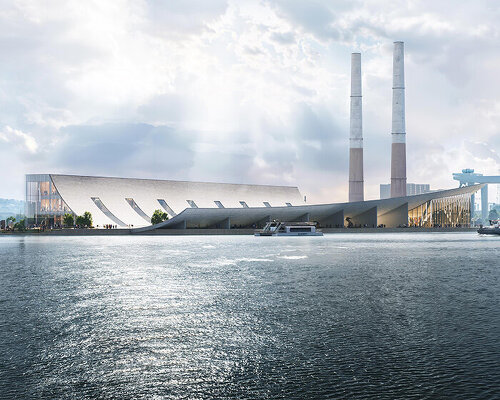
The site occupies a stretch of working waterfront that once supported industrial exchange. As port operations shifted, the structure lost daily relevance within urban life. The proposal, with its dramatically curving rooftop, treats the existing fabric as a spatial and infrastructural resource, retaining its massing and presence while introducing architectural elements that enable public access and contemporary cultural use.
visualizations © LYT-X Studio
brise-vent havre harbor museum: a threshold for le havre
The Brise-Vent Havre Harbor Museum, designed by LYT-X Studio, organizes movement as a continuous sequence linking city streets, promenade, and harbor. Circulation routes pass across and through the building, encouraging everyday passage alongside scheduled cultural activity. This approach situates the museum within the wider waterfront network, allowing informal use to coexist with exhibitions and events.
A curved roof extension forms a continuous canopy along the water’s edge. The canopy structures circulation, offers shade, and mediates between urban paths and harbor activity. Beneath it, semi open spaces and a sheltered courtyard provide access from both land and water, establishing a public environment that feels accessible throughout the day.
the project adapts an industrial harbor structure into a public cultural space along the waterfront
new waterfront spaces for the public
Public access shapes the architectural decisions across the Brise-Vent Havre Harbor Museum. The courtyard remains open beyond gallery hours, allowing the site to function as a civic space. Transitions between interior and exterior rely on spatial continuity and material alignment rather than visual devices alone. Exhibition halls, performance spaces, and circulation areas accommodate formal programming alongside daily movement.
Environmental strategies build on the reuse of the existing structure. The extended canopy supports passive shading and moderates conditions along the waterfront. Courtyards and roof openings bring daylight into interior volumes, while coastal air movement supports natural ventilation. Through these measures, the Brise-Vent Havre Harbor Museum presents a measured approach to transforming an industrial harbor structure into a lasting cultural presence within the city.
a curved roof canopy defines shaded paths and transitional outdoor spaces
courtyards and semi open areas support daily public access beyond gallery hours
new interventions extend the building toward the harbor to support public movement
circulation routes connect city streets, promenade, and water in a continuous sequence
interior programs align with views toward maritime activity
environmental strategies rely on reuse, daylight, and coastal air movement
project info:
name: Brise-Vent Havre Harbor Museum
architect: LYT-X Studio | @lytx_studio
location: Le Havre, France
area: 31,000 square meters
design team: Dingdong Tang, Zehui Li, Haisheng Xu
status: concept
visualizations: © LYT-X Studio
The post curving rooftop courtyard tops proposed brise-vent havre harbor museum in france appeared first on designboom | architecture & design magazine.