
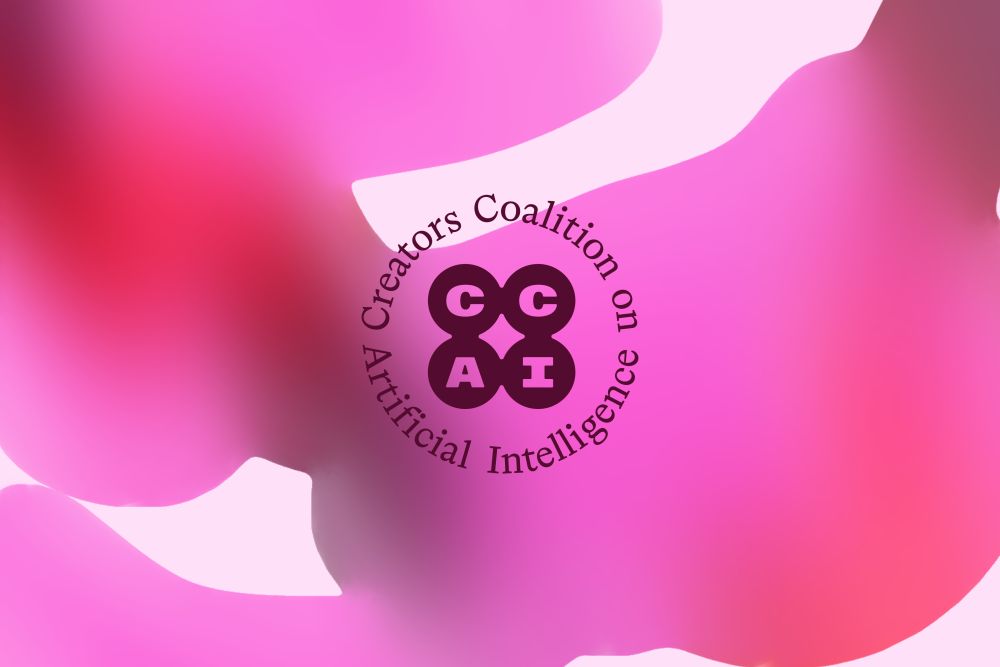
It’s a scary time to be in the creative field, filled with vast and every-growing unknowns related to AI. We’re already seeing the impact of AI on art, design, and culture at large, but there’s no telling exactly where we’re headed. Artists of all kinds are feeling degrees of helplessness and powerlessness trying to navigate the state of their industry, but a central group has formed to try to do something to protect themselves and their creative colleagues.
The Creators Coalition on Artificial Intelligence (CCAI) is an an organization newly established to define the ethical and artistic boundaries of AI in the entertainment industry. Founded by a collective of professionals—including Everything Everywhere All At Once director Daniel Kwan and actor Joseph Gordon-Levitt—the CCAI is a nonprofit organization dedicated to establishing ethical guardrails and artistic protections as generative AI reshapes the film and television industry.
As CCAI set out on this noble and essential mission, they needed a brand identity that reflected their ethos and complimented their drive to protect human creators. They teamed up with Decimal for the project, primarily seeking a logo and color system that bolstered and legitimized their important work. Decimal created that and more, going as far as to build out a web-based drawing tool as part of the system, which organically developed through their design process.
Members of the Decimal team, producer Raphael Guenassia and designer and developer Wenqing Ma, expound upon their work for CCAI below.
What was the main brief CCAI came to you with? What were their central needs for the brand?
Raphael Guenassia: Creators Coalition on AI, an organization focused on advancing policies and practices that support the sustainability of creative communities in an era of rapidly evolving AI technologies, approached us seeking a designer to help define and elevate their brand presence. They were focused on the entertainment creative business but they see their mission applying to many other industries down the road.
At the time, their primary objective for CCAI was finalizing a cohesive logo and color system for the initiative. Beyond that, they were interested in developing a broader suite of assets, including motion graphics for video content, website visuals, and social media graphics.
While they had explored several internal design directions, they were ultimately seeking a creative partner who could refine their vision and bring it to the next level.
Injecting the brand system with a clear and direct sense of the human hand was obviously a critical aspect of what you created. How did you go about achieving this? What are some details you can point to that helped underscore the concept of the human-made?
Wenqing Ma: The challenging yet interesting part of this project was how to amplify human voices as the central force while remaining relevant within the current AI landscape.
Across the identity system, we explored this tension between humans and AI in several ways. For the logo, we reinterpreted the idea of a “sparkle”—a common symbol of AI, often presented as something magical. Instead of rendering it as a self-contained form, we treat it as a negative space, emerging only as a result of the convergence of the four circles, symbolizing a coalition. The underlying message is that technology serves the collective, not the other way around.
Many AI tech companies and products use gradients in their branding, so we thought that could be part of the story, but we wanted to add a twist and make the gradients less perfect, more human. The web-based drawing tool we developed further reinforces this idea. We want to bring in a liveliness that invites people to participate, and use the tool to send out their voices. The intention always comes back to human agency, and the power that emerges when we all come together as a community to define the movement.
Can you shed more light on that web-based drawing tool you created as part of the project? Why did you decide to incorporate this into the brand and how did you develop the idea?
WM: The brush tool was actually one of the surprise components that came out of the process. At first we were just trying different visual textures, thinking about anything that has a human touch but could still work on digital screens. Since the project had a very tight timeline, we needed to be strategic about how we generated visuals in a scalable way. What immediately came to mind was creating an internal tool so we could streamline the creation of graphics.
The more we experimented with it, the more naturally it became part of the story we wish to amplify with the identity system. CCAI is intended to be a movement by people and for people, so it felt important to have a tool that actively involves the community. We also thought the way a brush gesture informs the present of the human hand tackles the relationship between human and AI; that AI is ultimately a tool, just like the brushes, and one that would not exist without the creative communities that came before it.
Hence, I also want to give major credit to Steve of Steve’s Makerspace, Tyler Hobbs and Alejandro Campos of p5.brush for making open source approaches to watercolor strokes in p5.js. This brush tool would not have been possible without their contributions.
Decimal Team Members:
Guillermo Brotons – Creative Director
Sergi Vilà – Brand Designer
Wenqing Ma – Designer and Developer
Raphael Guenassia – Producer
The post Decimal Gives The Creators Coalition on Artificial Intelligence an Optimistic Brand Identity appeared first on PRINT Magazine.