
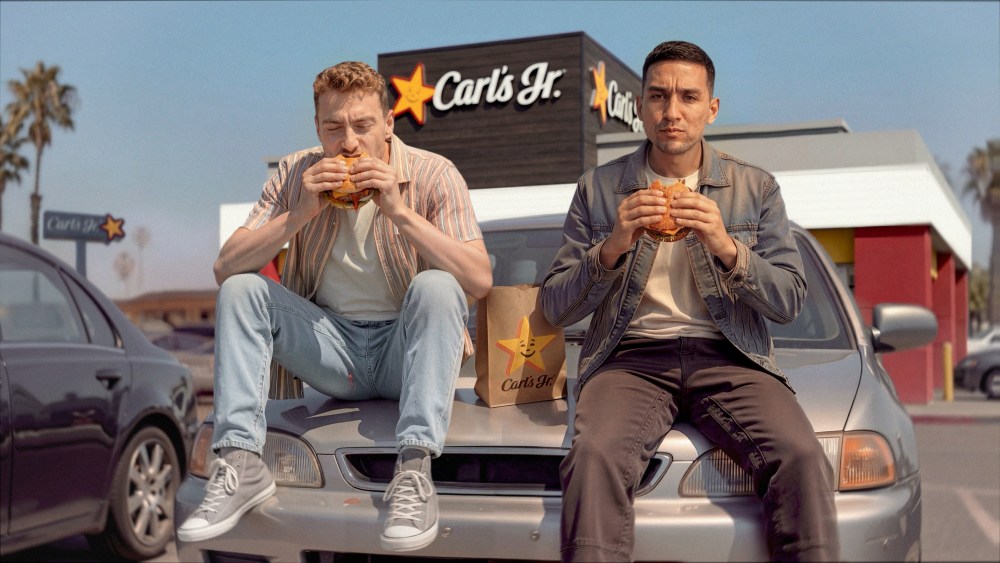
The return of Paris Hilton to a Carl’s Jr. commercial should, on paper, read as a familiar exercise in nostalgia. The original 2005 spot, equal parts spectacle and provocation, was engineered for a media landscape defined by broadcast dominance and cultural monoculture. But twenty years later, its 2025 counterpart, built using generative tools from Freepik, signals something more consequential: not simply a revival, but a recalibration of how advertising is conceived, produced, and authored.
What’s unfolding feels less of a shift in tools and, rather, in creative gravity. For decades, advertising has been anchored in the mythology of a singular vision; iconic campaigns attributed to copywriters, art directors, and filmmakers whose authorship shaped both industry standards and cultural memory. Generative AI complicates that narrative. It accelerates production, expands visual possibility, and lowers technical barriers, but in doing so, it raises sharper questions: If execution becomes frictionless, where does originality reside? If likeness can be rendered on demand, what defines collaboration, consent, and ownership? And perhaps most critically, if everyone can make, who gets to be considered creative?
The Carl’s Jr. campaign doesn’t answer these questions outright, but it does make them visible. Its existence reflects an industry in transition; one where AI is neither invisible infrastructure nor entirely novel. Instead, it sits in an uneasy middle ground: part spectacle, part system. For brands, this creates both opportunity and risk. Used thoughtfully, AI can extend storytelling into new territories. Used carelessly, it risks collapsing distinction into sameness, where aesthetic shortcuts replace intention.
To understand how creative leaders are navigating this shift — from authorship and ethics to team structure and the evolving role of taste — I spoke with Nik Kleverov, Chief Creative Officer at Native Foreign, a creative studio based in LA that helps brands and agencies explore generative tools. In the following conversation, he reflects on what it means to reinterpret cultural iconography in the age of AI, and why, even as tools evolve, the core of creative work may remain surprisingly unchanged.
The original 2005 Carl’s Jr. ad with Paris Hilton became a defining pop-culture moment; provocative, hyper-stylized, and very much of its time. What sparked the decision to revisit that campaign 20 years later through an AI-driven lens, and how did you approach reinterpreting something so culturally specific without simply recreating it for nostalgia?
In Hollywood, what do you do with a successful project? You make a sequel. Instead of trying to remake it beat-for-beat, we looked at it more like cultural source material and asked: what would that same playful, hyper-stylized energy look like if it were born in the AI era? The goal wasn’t nostalgia; it was reinterpretation with today’s instruments.
When a brand as legacy-driven as Carl’s Jr. collaborates with a cultural figure like Paris Hilton using generative tools, the result provides an interesting cultural signal. In your view, is AI primarily expanding creative possibilities, or is it fundamentally changing who gets to be considered “creative” in advertising?
I think it’s both. AI absolutely expands the palette of what’s possible visually and tonally, but it also exposes something interesting: the idea was always the scarce resource. Taste, storytelling, and point of view are still the real differentiators.
As generative tools become more sophisticated, the line between authorized creative collaboration and unauthorized deepfake manipulation becomes increasingly thin. When working with a public figure like Paris Hilton, how do you think about consent, authorship, and long-term reputational risk in an era where likeness can be replicated with alarming realism, and what responsibility do brands and creative agencies have in setting ethical precedent?
Everything we did was fully authorized and transparent because with someone like Paris Hilton, consent and collaboration are non-negotiable. As the tech gets more powerful, I think brands and agencies have a responsibility to be very clear about permission and participation, not just capability.
You’ve described your AI workflow as transformative. At what point does efficiency begin to reshape aesthetics? Are we entering a phase where the tools themselves subtly influence the look and logic of mainstream advertising?
Every tool in some way shapes the work that comes out of it. Just like digital cameras changed cinematography and non-linear editing changed pacing, generative tools inevitably influence aesthetics and structure. The trick is making sure the tools don’t dictate the taste.
There’s growing tension between spectacle and substance in AI-driven campaigns. Do you believe audiences can sense when AI is being used as a gimmick versus when it’s being used as a storytelling instrument?
Like it or not, lots of brands are exploring AI now – and many of them are just entering the space. It may seem like old news for those of us who have been doing this for years, but remember – some brands have been taking their time with AI adoption. So we’ll be seeing all sorts of AI campaigns for some time to come. The best ones lean in and make the most of the ask.
Historically, breakthrough ad campaigns were defined by a singular creative vision: a copywriter, an art director, a director. In an AI-augmented workflow, how do you preserve authorship and intentionality while working inside systems designed for speed and iteration?
I actually think that dynamic still exists, but now the creative process just has a lot more iterations happening much faster. Somewhat related – I also came up doing main title sequences for many famous TV shows, including Last Chance U, Bloodline, and Narcos. In a title sequence, you have to distill the themes and ideas of an entire show or series into a minute or less – and you work with a small team that consists of a creative director, art director, designers, edit, post, sound mix, VFX. The process of creating with AI isn’t unlike that. The authorship still comes from the human point of view guiding the system.
AI is often framed as a collaborator, not a replacement. But in practical terms, how is it reshaping creative teams — from junior designers to directors — and what responsibility do agencies have in redefining creative labor rather than quietly reducing it?
AI is changing the shape of teams more than eliminating them. Young creatives might spend less time doing mechanical production work and more time thinking conceptually earlier in their careers. Agencies have a responsibility to evolve roles rather than quietly hollow them out. However – I still believe that fundamentals are necessary and young creatives should spend time getting really good at the basics.
As AI becomes more embedded in advertising production, conversations about sustainability are emerging. Given the energy demands of generative systems, do you think the industry needs to reconcile the environmental cost of AI-driven creativity with the push for faster, more scalable content?
It’s definitely something the industry will need to reckon with. AI can make production dramatically more efficient, but the computational cost is real. Like any new technology, we’ll have to find the balance between creative scale and responsible use.
Looking ahead five years, do you imagine AI becoming invisible infrastructure within advertising, or will brands increasingly foreground the use of AI as part of the creative narrative itself?
My guess is AI becomes mostly invisible infrastructure, the same way nobody talks about using Photoshop anymore. That said, there will always be moments where the technology itself becomes part of the story. The real shift is that AI won’t feel novel, it’ll just feel like part of the creative toolbox. Until then… we’re in the Wild West!
The post Deepfakes, Fast Food, and the Future of Taste appeared first on PRINT Magazine.