
I keep my phone on my nightstand. You probably do too. According to the American Academy of Sleep Medicine, about 87% of us do, and I’d bet the other 13% are lying. It’s become such a reflexive part of the bedtime ritual that most of us don’t even question it anymore. The phone is the alarm clock, the white noise machine, the podcast player, the ambient light, and unfortunately, the portal to one more scroll through social media at 11:47 PM when you swore you’d be asleep by 11.
This is the problem that Ambient, a Boston-based company, built Dreamie to solve. At $249.99, it’s a compact bedside sleep companion that consolidates alarms, soundscapes, ambient lighting, a podcast player, and a simulated sunrise into a single, quietly opinionated little device. The pitch is straightforward: put your phone across the room and let Dreamie handle the bedside duties instead.
Designer: Ambient
What I find most interesting about Dreamie isn’t really the feature set, though it’s genuinely well-considered. It’s the philosophy behind the product. The design team, led by founder Adrian Canoso, who comes from an industrial design and audio engineering background, seems to have started from a simple question: what if we made a device that was good enough to replace the phone at night, but deliberately too limited to become another source of distraction? The touchscreen dims to near-black. There’s a redshift mode to kill blue light. No feeds, no notifications, no video. You can even hide the clock display entirely. The whole thing is designed around the idea that a bedroom device should help you disengage, not re-engage.
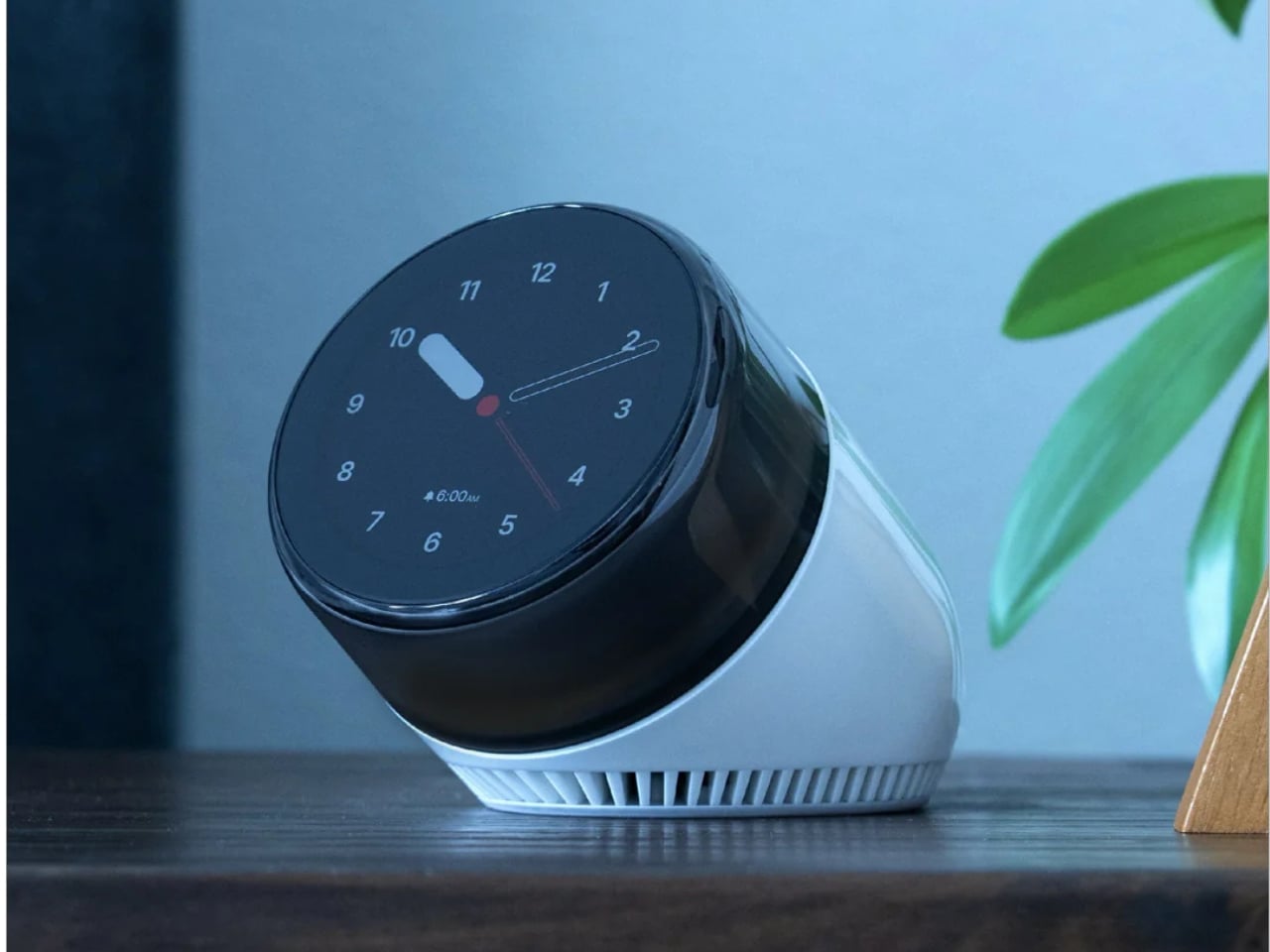
The physical design reflects that restraint. Dreamie is a truncated pill shape with a circular touchscreen, and it’s smaller than most sunrise alarm clocks on the market. A hidden dial around the display controls volume with satisfying resistance, and a touch strip along the top adjusts the lamp brightness. Early reviewers from Engadget and Athletech News have praised how intuitive these tactile controls feel, especially when you’re half-asleep and fumbling at 2 AM. The Calm Tech Institute, a group that evaluates products based on how well they respect human attention, awarded Dreamie their highest certification, with one evaluator describing the device as friendly to use, almost like interacting with a small creature.
Underneath the minimalist exterior, Dreamie packs a 50mm speaker with a 360-degree grille that diffuses sound outward rather than directing it at you like a beam. The effect, according to those who’ve tested it, is an immersive ambient quality that wraps around you rather than projecting at you. The built-in library includes brown, pink, and green noise masks, guided wind-down content, and environmental soundscapes ranging from storms to aurora borealis visualizations with accompanying RGB lighting from its 120-element LED array. Bluetooth headphone support means couples can use it without one person’s rain sounds keeping the other awake.
But here’s where Dreamie makes its most interesting bet: no app, no account, no subscription. Everything runs on-device. Setup happens entirely on the touchscreen. All sensor data, including the contactless sleep tracking coming later this year, stays local and encrypted. You never enter a name or email. In an era where every smart home product seems engineered to harvest your data and lock you into a monthly fee, Dreamie’s business model feels almost contrarian. You pay once, and the device gets better through free over-the-air updates.
I think what makes Dreamie worth watching isn’t just that it’s a nice piece of hardware, because it is. It’s that it represents a growing counter-movement in consumer tech, one that asks whether our devices could do less on purpose, and whether that subtraction might actually be the feature. The sleep tech category has been dominated by wearables that track your metrics and apps that gamify your rest. Dreamie doesn’t want to quantify your sleep so much as it wants to create the conditions for better sleep to happen naturally.
Is $250 a lot for what is, at its core, an alarm clock? Sure. But it’s also less than most people spend on a smartwatch they’ll wear to bed, and it doesn’t require a subscription to keep working. For anyone who has ever told themselves they’d stop scrolling at 10 PM and found themselves deep in a Reddit thread at midnight, Dreamie offers something genuinely appealing: a reason to leave the phone behind.
The post Dreamie Built a $250 Alarm Clock to Replace Your Nightstand Phone first appeared on Yanko Design.