
Typography shapes nearly every cultural touchpoint in our daily lives. It frames the headlines we read each morning, defines the identities of the brands we trust, guides us through cities, and structures the screens we scroll. Letters carry more than language—they carry tone, history, politics, and place. Whether bold and declarative or subtle and utilitarian, type quietly mediates how we understand information and how culture presents itself back to us.
Curated by the Master Type Design and Bachelor Graphic Design programs at ECAL (École cantonale d’art de Lausanne), ECAL A Typographic Atlas brings together an extraordinary selection of 300 typefaces created by students from around the world. Conceived as both exhibition and navigational system, the project reframes typography not simply as form-making, but as a living, evolving territory.
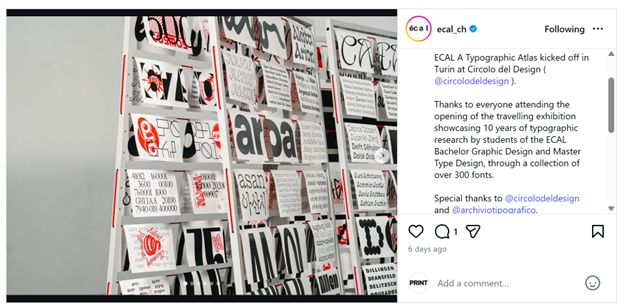
The exhibition is structured around a single indexing approach that organizes the work into alphabetical entries and numerical coordinates. This system becomes the foundation of the exhibition, turning the gallery into a map of contemporary type design
An Atlas You Can Walk Through
The spatial design, conceived by Adrien Rovero, translates this indexing logic into a modular display system. Rather than isolating individual projects, Rovero’s structure creates a continuous visual field—part archive, part landscape. Visitors move through it as if navigating a map, guided by letters and numbers that function as coordinates across typographic terrain. The result is both systematic and exploratory. The framework provides clarity, while the diversity of the work encourages discovery.
Typography as Cultural Practice
If the exhibition reads like a map, the typefaces themselves evoke a complex cultural geography. The 300 works range from experimental display forms to highly functional type families and ambitious multiscript systems. Together, they demonstrate how typography operates at the intersection of visual culture, language, and technology.
In this context, type is treated not merely as a technical craft but as a cultural practice. Experimental projects challenge conventions of legibility and structure; pragmatic families respond to contemporary editorial and digital needs; multiscript designs address the realities of global communication. The show ultimately asks us to reconsider how type mediates our everyday exchanges—on screens, in print, and across languages.
A Teaching Approach Rooted in Swiss Precision—and Beyond
The exhibition also reflects ECAL’s longstanding commitment to graphic and type design education. Recognized as one of the most influential art and design schools in the world, ECAL’s reputation is underscored by the success of its graduates, international press coverage, major awards, collaborations with leading brands and institutions, and exhibitions in prestigious venues worldwide.
Grounded in a strong Swiss design heritage, the Bachelor Graphic Design program integrates typography, image-making, publishing, and identity through a pedagogy centered on experimentation and hands-on projects. Students are encouraged to test systems, question conventions, and develop a critical relationship to visual form.
Building on this foundation, the Master Type Design—unique in Switzerland—offers advanced specialization in typeface design and typographic research. The program merges creative practice with theoretical inquiry and digital innovation, positioning type design as both craft and research discipline.
Together, these two courses embody ECAL’s excellence in contemporary visual design. ECAL A Typographic Atlas makes that excellence visible—not as a static archive of student work, but as a dynamic field of investigation.
A Traveling Map of the Present
As a traveling exhibition, ECAL A Typographic Atlas extends beyond Lausanne, carrying its modular system and its typographic GPS into new contexts. Like any atlas, it is both documentation and roadmap: a record of where type design stands today, and an invitation to imagine where it might go next.
In mapping 300 typefaces, ECAL charts more than stylistic variety. It outlines a discipline in motion—restless, rigorous, and deeply attuned to the ways letters shape how we read, think, and communicate.
For more information about the exhibition in Turin running through March 12, 2026 and upcoming locations for the tour visit ECAL or check out PRINT’s Event Calendar.
The post ECAL—A Typographic Atlas: Mapping the Territory of Contemporary Type appeared first on PRINT Magazine.