
HAMS and, Studio renovates a single-story residence in Hakone
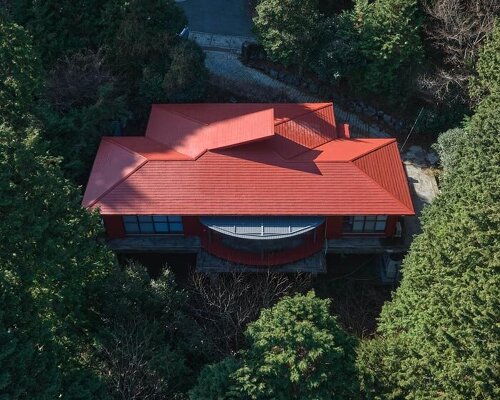
HAMS and, Studio takes over the renovation of a 60-year-old single-story house located on a forested hillside in Hakone, Kanagawa Prefecture, Japan. The site sits halfway up a mountain, reached by the local mountain railway, with the Owakudani volcanic valley rising behind it. Zoned as a low-rise residential area, the neighborhood is characterized by a mix of permanent homes and vacation houses, each maintaining a high level of privacy through generous setbacks. Surrounded by tall cedar trees and sloping gently toward the north, the site reflects Hakone’s long-standing identity as a quiet summer retreat with limited direct southern sunlight.
The existing house was built on an artificial platform extending from the slope and featured a clear and rational plan: a central living room with all other rooms directly connected to it. Rather than replacing this structure, the project sought to preserve its spatial clarity while updating it for contemporary use as a combined residence and guesthouse. Rising construction costs further reinforced the decision to work carefully with the existing building. The design is based on the idea of ‘enclosure’ as a recurring condition across different scales: the valley that surrounds Hakone, the forest enclosing the site, the original house organized around its living core, and the newly introduced architectural elements. These layers are not treated separately, but connected through a concentric spatial structure.
all images by Akira Nakamura
The engawa acts as an intermediary zone between inside and out
A circular engawa (veranda) and a semi-circular canopy were added, spanning interior rooms, a central doma (earthen floor), and an exterior balcony. The former living room was reconfigured as a doma, with the engawa wrapping around it to create a shared center where movement, sightlines, and daily activities circulate. This engawa functions as an intermediary space rather than a boundary, mediating between inside and outside, existing and new. During demolition, a large log beam spanning approximately five meters was revealed above the central space, highlighting the spatial potential of the original structure. The ceiling was opened to expose the complex roof framework, and a former ventilation louver at the roof’s peak was repurposed as a skylight, bringing natural light deep into the interior. The design team at HAMS and, Studio carefully restored the original reddish-brown exterior finish. In this project, red is not treated simply as a color, but as a condition, suggesting warmth, density, and the accumulation of life emerging within layered enclosures.
HAMS and, Studio renovates a 60-year-old single-story house in Hakone, Japan
the existing house was built on an artificial platform extending from the slope
the design is structured around the concept of enclosure at multiple scales
the living room was reconfigured as a central doma
a circular engawa wraps around the former living room
the engawa connects interior rooms with an exterior balcony
the engawa acts as an intermediary zone between inside and outside
the ceiling was opened to expose the original roof structure
the restored reddish-brown exterior reinforces the layered sense of enclosure
project info:
name: Ninotaira Engawa
architect: HAMS and, Studio | @hamsand.studio
lead architect: Yota Hokibara | @yota_hoki
project director: Takuma Tojo | @takumatojo
constructor: CODE | @code__jp
location: Hakone, Kanagawa Prefecture, Japan
photographer: Akira Nakamura | @nakamamej
designboom has received this project from our DIY submissions feature, where we welcome our readers to submit their own work for publication. see more project submissions from our readers here.
edited by: christina vergopoulou | designboom
The post elevated circular veranda and canopy wrap 60-year-old restored japanese house appeared first on designboom | architecture & design magazine.