
On any given game day, millions of us become amateur analysts, dissecting every play and scrutinizing every statistic that flashes across the screen. We track player performance with an almost scientific rigor, celebrating the numbers that signal a win and debating the metrics that lead to a loss. This deep dive into data has fundamentally changed how we watch sports, turning passive viewing into an interactive, analytical experience. Yet, for all the attention we pay to the athletes’ performance, our own physiological journey as spectators has remained completely invisible.
Dreame’s new AI Smart Ring proposes a fascinating shift in perspective, turning the sensor technology usually reserved for athletes inward on the audience. The ring’s most ambitious feature, an AI-powered emotion index, aims to quantify the rollercoaster of being a fan, tracking how your body reacts to every thrilling victory and agonizing fumble. It represents a new frontier for wearables, one less concerned with counting your steps and more interested in mapping your heart’s response to the passions that drive you. It is pro-level analytics for the rest of us.
Designer: Dreame
Instead of launching just one device, Dreame is splitting its ambition into a two-ring strategy, which is a seriously interesting market play. The company is effectively acknowledging that “health tracking” means different things to different people. For some, it is about hard, clinical data and safety nets. For others, it is about lifestyle, self-awareness, and emotional insight. So, rather than making one ring that tries to do everything, they have created two distinct products: the Dreame Health Ring, launching in early March, and the Dreame AI Smart Haptic Ring, which is slated for the second half of the year.
The Dreame Health Ring is the more advanced and serious of the two. This is the one aimed squarely at users who want professional-grade monitoring and peace of mind. Its headline feature is the ability to generate ECG reports on demand, moving it closer to a medical-grade device than a typical fitness tracker. It is built around a core of accurate health monitoring and safety alerts, using AI-driven analysis to flag potential issues. Think of this as the quiet, reassuring guardian, focused on delivering vital health data you can potentially share with a doctor, rather than tracking your mood during a movie.
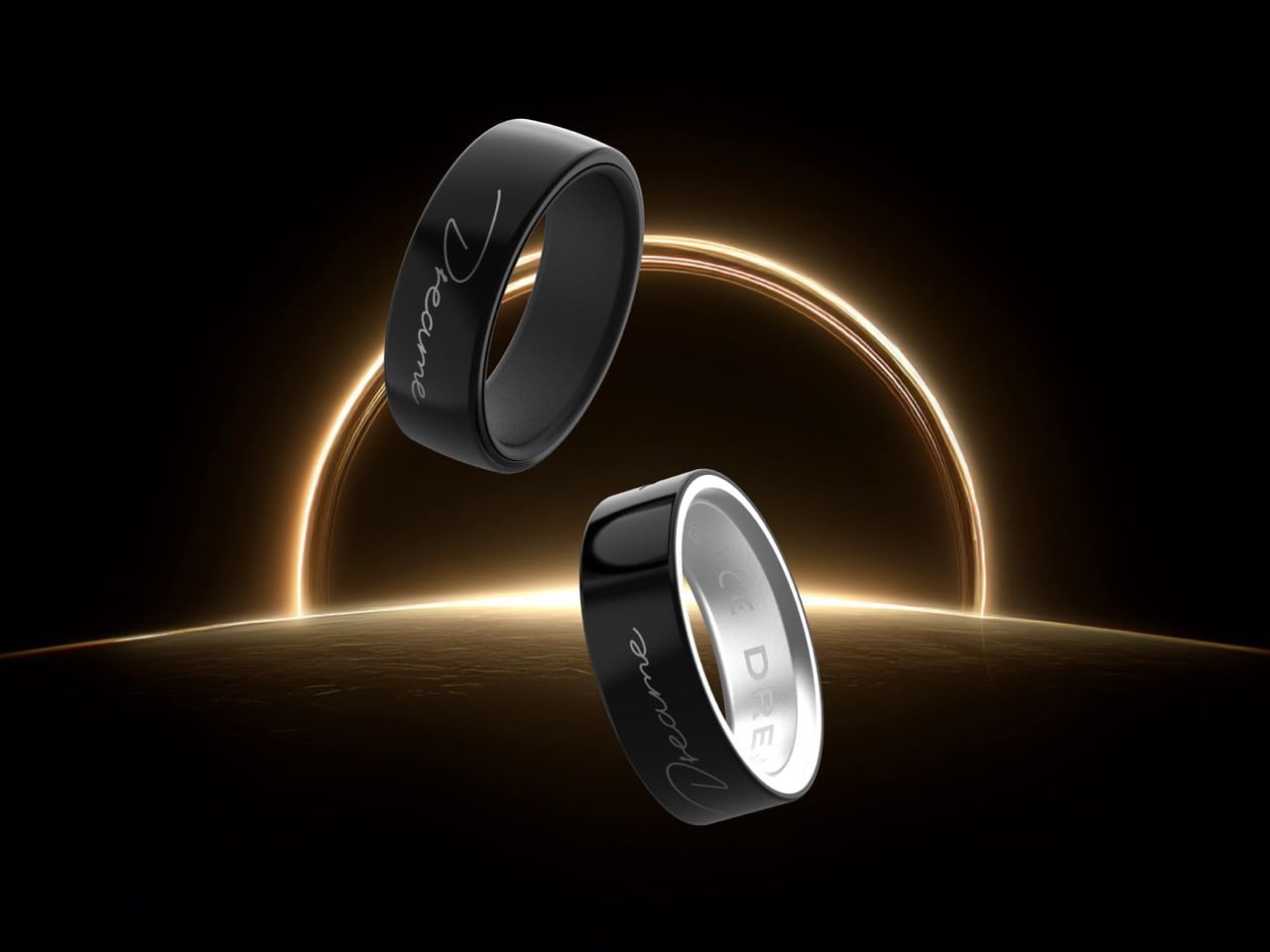
Landing later this year, the Dreame AI Smart Haptic Ring is the lifestyle-focused sibling. You are looking at a 2.5 mm thin body that is about 7.5 mm wide and weighs a featherlight 5.2 grams. The outside is a microcrystalline zirconia nano-ceramic with a Mohs hardness of 8, while the inner band is a slick antibacterial alloy. This ring is all about AI-driven health and sleep tracking, but with a focus on interpretation and daily living. It is designed to be the wearable you forget you are even wearing.
Packed inside that tiny frame is the trifecta of modern health sensors: PPG for heart rate and SpO₂, a temperature sensor, and an accelerometer. This all feeds into the AI sleep algorithms that Dreame claims can nail your REM, deep, and light sleep stages with less than a 5 percent error rate. The AI ring tracks all your key vitals 24/7 and holds about a week of data offline, which is exactly how these trackers should work. But where the Health Ring focuses on ECGs, the AI ring uses this data to power its more experimental features.
This is where we get to the AI ring’s headline feature: the emotion sensing. It claims it can generate a real-time emotion index with 92 percent accuracy. Now, is it going to replace your therapist? Absolutely not. But that is not the point. The real value is in the biofeedback. It is a tool for spotting patterns, for seeing a data-driven trace of how your body reacted to a stressful day while your brain was telling you everything was fine. It is a fascinating, and potentially humbling, new layer of self-awareness that separates it from the more advanced Health Ring.
The design of the AI ring is meant to be invisible. It is a screenless, silent loop of ceramic. Instead of a screen, you get a tiny vibration motor inside for its AI Haptic Alerts, a subtle tap on your finger for a call or message, not a jarring buzz that makes everyone in the room look at you. Those haptics also support tap gestures for controlling music or snapping a photo. The battery life reflects this always-on philosophy, with about a week on the ring itself and a charging case that gives you a claimed at least a 100 days of use before you need a wall outlet.
So why are we seeing this two-ring strategy pop up around the Championship Sunday? It is a smart move. It frames the brand not as just another gadget maker, but as a company thinking deeply about the future of personal health. We are obsessed with the analytics of pro athletes, tracking every metric to understand their performance. Dreame is betting that we are finally ready to apply that same level of nerdy obsession to ourselves, and by offering two distinct paths, they are letting us choose just how deep we want that data to go.
The post Forget Step Counters: Dreame’s New Smart Rings Focus On ECG Reports, Sleep, And Real-Time Emotion Data first appeared on Yanko Design.