
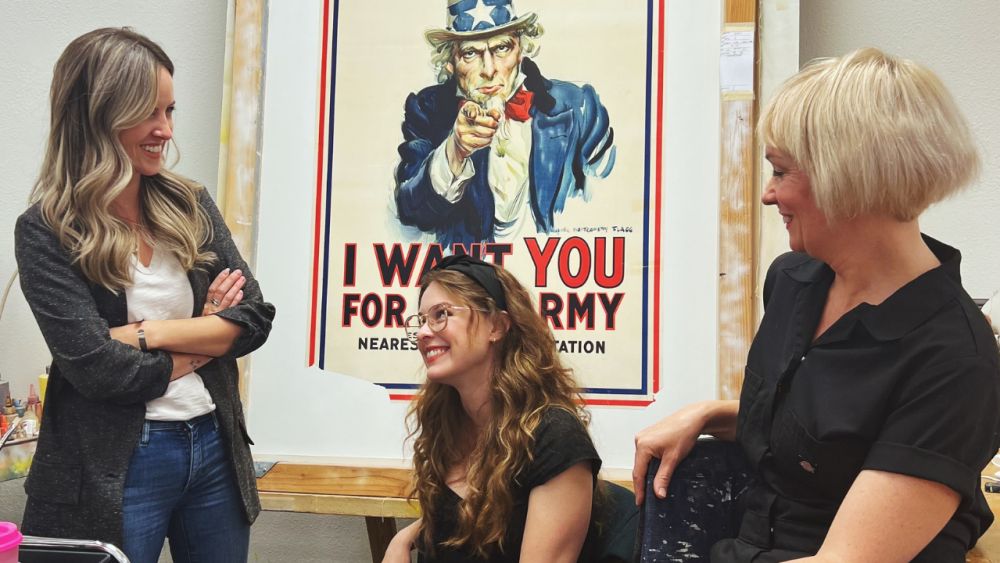
Fourth Cone Restoration is in the business of bringing old posters back from the dead. Or at least back from the weathered, worn, torn, faded, folded, and wrinkled. Co-founders and partners Katie Dimond, Melissa Scott, and Chelsea Scheller started the business 12 years ago after all meeting at a previous restoration job.
With a studio in Canoga Park, CA just outside of LA, they’ve honed meticulous techniques to make vintage posters look good as new. Process videos on their Instagram reveal just how incredible these transformations are, and the level of care and detail that goes into their process. Dimond, Scott, and Scheller elaborate on their work and the business below.
How did you all get into the world of poster restoration in the first place? What was your inroad into this niche industry that most probably don’t even know exists?
Katie Dimond: I was just out of art school in New York, working in retail, with no expectation of an art-related job. A friend of mine was working at a vintage movie poster gallery, and she kept telling me about a vintage poster restoration studio that looked like the perfect place for me. Several months later, they had an opening in their staff, and my friend referred me. It was an entry-level position, so I did all my learning on the job. For several years, I only did the simplest things at that studio. Every once in a while, I would pick up a new skill. That job functioned as an apprenticeship for me. Later, I moved back to my hometown of Los Angeles, where I found a job at another restoration studio. That was where I met Chelsea and Melissa. Several years later, the three of us branched off and started our own studio. We’ve been in business for 12 years now.
Melissa Scott: I’ve always loved history, and I’ve always been compelled to work with my hands. During college, I had a vague notion of what art restoration was after a professor mentioned it to me as a possible path. It seemed like something that would be really fascinating to do someday. I put most of my focus on the technical side of drawing and painting, hoping I would get the chance to put my skills to use somehow. After college, I worked a couple of unrelated jobs for a while until I was lucky enough to find a Craigslist ad for a job at a poster restoration studio. I apprenticed there and continued to hone my skills and learn about the business. I got lucky again in finding my wonderful partners, and we have spent the last 12 years building our company.
Chelsea Scheller: I moved to California right after college with an Associate in Arts degree and spent several years working in mid-level management roles across a range of industries. In 2011, I began managing a poster restoration studio, which unexpectedly turned into a hands-on apprenticeship. That experience shifted my career path entirely and led me to Melissa and Katie. Years later, we would go on to found Fourth Cone Restoration.
What sort of training or schooling does one typically go through to be a master poster restorer?
FCR Team: Many of us went to college for art. Melissa majored in Studio Art and minored in Art History. Katie majored in sculpture. Most of our employees are working artists, and some of them are self-taught. Everything we do is learned on the job. To our knowledge, there are no university programs geared specifically toward vintage posters; none of us went to college for art restoration. The requirements to get into one of those programs are prohibitive, so we’ve had to learn everything we know from experience and mentorship from our previous employers. The method of printing color posters was only developed in the mid-19th century, so the traditional technique for stabilizing them doesn’t go back very far. We are constantly working on ways to make improvements.
Our studio does use some museum restoration methods, but we are very forward-thinking and dynamic when it comes to our techniques and materials. Museums usually employ their own conservators, and we are an independent business. We mostly work with private collectors, galleries, poster dealers, framers, and auction houses. We collaborate with our clients on every project. While everything we do is archival and geared toward conservation of the object, we also tailor cosmetic restoration to suit the needs of our customers. Some of our clients prefer no restoration, and they feel that the damage and decay are part of the overall visual effect. Other clients want their posters to look as mint as possible. It’s really about what you want to see on your wall.
We are always working with art that was meant to deteriorate.
Our field is special in that we are always working with art that was meant to deteriorate. Posters were intended for one-time use— they’re usually made with the cheapest materials possible. Cheap paper often has a high acid content, which means it breaks down over time, turning brown and brittle. In some of the older posters, the paper was made with straight-up river water! The cheapest materials will change from time to time, so it’s difficult to predict how best to stabilize each poster. Fortunately, we have been in this business long enough to recognize most types of printing and paper. And when we don’t recognize the poster, we follow a strict protocol to test the paper for possible reactions.
What are the main tools and techniques you all use at Fourth Cone Restoration?
FCR Team: When a poster comes to us, our first order of business is to stabilize the paper. If it’s safe, we wash it with water and a mild detergent. If the paper has mold or mildew, or if it’s discolored, we perform a bleaching treatment. If the poster is getting linen backed, we apply an archival adhesive and mount it to a stretched canvas lined with acid-free paper. We let that dry for a few days, and then the poster is removed from its temporary frame and trimmed so that it has an extra margin. With some types of posters, we will do a gelatin resizing treatment instead of linen backing. This involves applying archival gelatin sizing to the back of the piece while the paper is still wet and temporarily adhering it to an aluminum board. It’s then left to dry before removing it from the board. The gelatin acts as an invisible strengthening agent. We do have other alternatives for backing and treating paper, but these are the two main ones.
Once a poster has been backed, many of the visual problems will have been solved. With glossy posters, especially, the change will be dramatic. The glare from all the ridges and waves in the paper can really confuse the eye. Once the paper is flat, you’ll be able to see what the poster actually looks like. Many clients prefer to stop there and keep all the remaining blemishes visible as part of the poster’s history. This is totally a matter of taste, and we don’t have any opinion as to whether it’s better to restore or not to restore. However, our expertise in restoration has been honed over decades, and it’s one of the skills we’re known for. We work with each client to determine exactly how seamless a result they want. Some clients want their posters to look mint, which is absolutely something we can do in most cases, no matter how badly damaged the piece is. This is done using a variety of techniques. We can replace missing paper and airbrush any stains or holes to make it seamless.
We restore simple fold lines with watercolors and colored pencils. Sometimes we will receive a poster that is the only known copy of its kind, with no known references. In those cases, if the piece has large areas of damage or missing paper, we are still able to extrapolate what the missing image should look like and can recreate it.
Why is poster restoration important?
KD: Well, as the saying goes, it’s important to remember the past so that we don’t repeat history. That does play some part in the significance of poster restoration. Most posters were printed in large groups, so they’re already documented for the historical record.
What we do, though, is more like bringing the poster into the home. We stabilize it so that it can be displayed in a frame. When a vintage poster is on a wall in your house, you have a constant visual reminder of that piece of history. You’re able to keep it in mind, and you notice new things about it during your daily life.
There’s something special about being let into the secret of information that wasn’t meant to be remembered. History books are written in the voice of people who are taking a parental role toward the future. They can be a bit condescending. The idea of an objective, fact-based record of the past is almost impossible to achieve. They’re picking and choosing their information, no matter how hard they try to stay neutral. The vintage poster has visual context. You can see that you’re looking at something old. The paper is brown, and the people are wearing strange outfits, and the design looks outdated. The message can’t pretend that it isn’t trying to sell you something. Join the army! The circus is in town! Here’s a movie about a shark! These cigarettes are sexy! It tells you so much about the era.
The first vintage poster I bought was a 1940s advertisement for a meat-curing product. It shows an entire family curing meat together at a picnic table. There are all kinds of raw meat all over the place, and the family is beautiful, and they look like they’re having such a good time. I bought it because it was campy and absurd. I know there are people who still cure meat at home, but at the time, it looked totally weird to me. That was 20 years ago, and I’ve spent all this time with that poster in my life. As a much older adult, I have a lot more context for what was going on in that scene. I can see that it’s selling itself to a country at war, to people who are interested in frugality, in protecting their children, in their perceived American ideals, and in staying united as a family and a country, to defeat an enemy. All that in an advertisement that was meant to last no more than a year or two. Posters tell you the truth of their era, because they think you’re not listening.
Can you describe how it feels bringing a weathered old poster back to life?
FCR Team: Bringing an old poster back to life can be frustrating. It can feel like you’re running a hospital full of patients who can’t tell you who they are, where they’re from, or how they got hurt. There are some posters that do not want to be saved, no matter what you do. But when you’re able to achieve a miracle, when the stars align, and you’re able to wash all the brown stuff out of the paper, or restore it to look as though it was never damaged, it does feel like you’ve achieved absolute sorcery. When we’re working on something that’s part of a client’s personal history, a poster that was maybe mistreated in college, stored in the garage, and unearthed later in life, being able to breathe new life into that piece of paper feels magical, like you’re repairing a piece of that person. It’s therapeutic both for them and for us.
Bringing an old poster back to life can be frustrating. It can feel like you’re running a hospital full of patients who can’t tell you who they are, where they’re from, or how they got hurt.
What are some of your favorite poster restoration experiences you’ve enjoyed at Fourth Cone Restoration? Are there particular posters or clients that come to mind?
FCR Team: We see really cool, unusual stuff all the time. Right now, we have a Wanted poster for John Dillinger. It has his mugshot, looking very scary, but still in a tie. J. Edgar Hoover’s name is at the bottom, and then his title as the director of the Bureau of Investigation, the precursor to the FBI. There’s so much interesting stuff packed into this tiny, simple black and white flyer. Another poster we got recently was for a drag show in Provincetown from the 1960s. We’ve never seen anything remotely like it. This would’ve predated Andy Warhol and John Waters, a rare glimpse of a counterculture that was buried, literally. It’s an honor to preserve little-known history like that.
One of the first big projects we did together as a business was restoring water-damaged wallpaper at a private residence near Hollywood. The house had some flooding, and the wallpaper had absorbed some of the water. After doing some research, we found that the wallpaper was made in Paris in 1811, predating the house by 120 years. This meant that the pigments contained lead and possibly arsenic. We’d have to take steps to make sure the rest of the house wasn’t contaminated when we began repairing the paper. After suiting up in Tyvek gear and respirators and lining the room in plastic, we were able to re-adhere the paper to the wall and restore the water stains over the course of a few weeks. That project was a jumping-off point for us, and we were able to use the money to rent a small studio.
Another woman brought us a movie poster for The Endless Summer. It belonged to her father, who’d been a surfer in the 1960’s. The poster was in bad shape, and she wanted to get it restored so that she could present it to her father on his 80th birthday. We did the whole nine yards to it, and the woman sent us a video of her father at his birthday party. Tears ran down his face when he saw the poster, and of course, we cried too.
We have another client who collects vintage snake oil advertisements. We’ve been working on his stuff for at least ten years, and most of them advertise patent medicines from the late 1800s to the early 1900s. Nearly all of them are printed on highly acidic paper and are in advanced stages of decay. At some point in time, it was fashionable to shellac one’s posters, so many of these are covered in old, yellowed varnishes of various types. The varnish creates a closed system within the paper, so the deterioration process is accelerated. Melissa has been slowly working through this collection, and the main objective is to preserve the image as best as possible, sometimes working on paper with the texture of dry oatmeal. It’s been an epic, ongoing journey.
What aspect of what you all do at Fourth Cone Restoration are you proudest of?
FCR Team: We’ve created a space where artists can do what they love and enjoy coming to our studio. Over time, we’ve grown a large, international client base that feels more like a community than a transaction, and it’s incredibly meaningful to be trusted with pieces tied to people’s memories. Preserving that history and helping keep those stories alive is at the heart of what we do.
The post Fourth Core Restoration on their Process of Restoring Vintage Posters appeared first on PRINT Magazine.