
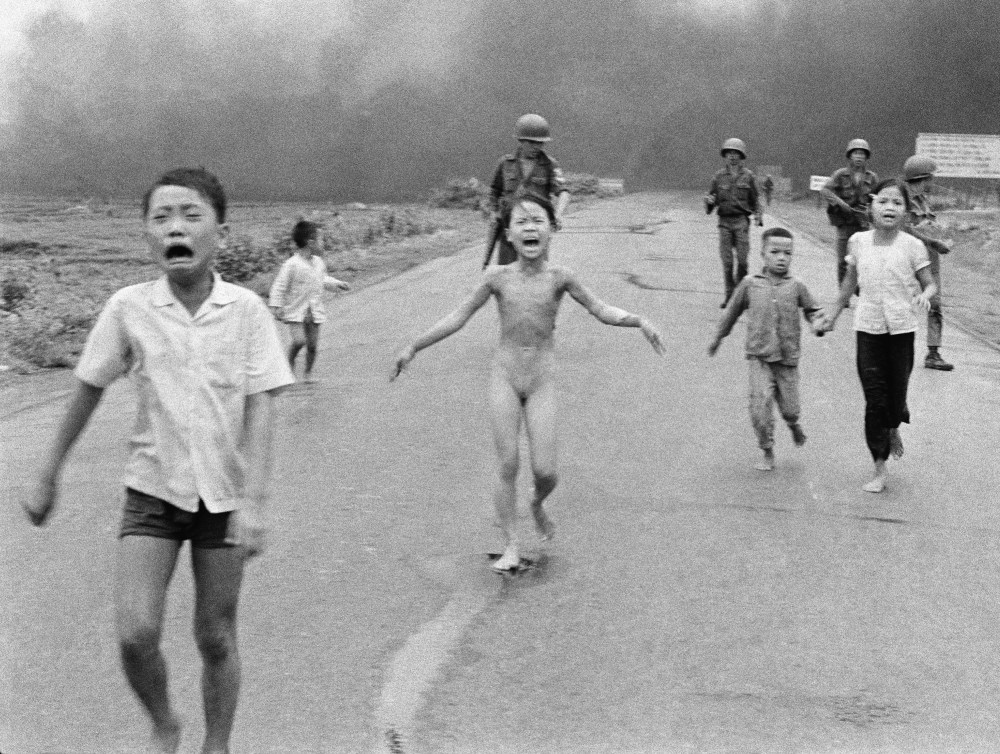
The photo was of a distraught child, with a face betraying not only pain and fear but stupefaction at being the victim of a fight started and waged by unknown adults. The still photo was somehow even more jarring than any video of the underlying events. A news video is like a movie, where viewers and cover their eyes or mentally skip through the most upsetting frames. A still image demands that the observer see what the photographer demands, without any mental editing.
That was the impact of the 1972 photo “Napalm Girl” (originally called “The Terror of War”). Americans had seen both newsreel and photos of the increasingly unpopular Vietnam War. But the image of nine-year-old Kim Phúk, running down the street screaming, naked after pulling off her burning clothes after her Trang Bang, Vietnam village was napalmed was newly shocking. The photo may not have ended the war, as some have simplistically claimed, but it cemented growing public disgust with American involvement in the war. The photo haunts to this day, and at the time, it sent a blunt message: this has all gone too far.
South Vietnamese forces follow after terrified children, including 9-year-old Kim Phuc, center, as they run down Route 1 near Trang Bang after an aerial napalm attack on suspected Viet Cong hiding places on June 8, 1972. A South Vietnamese plane accidentally dropped its flaming napalm on South Vietnamese troops and civilians. The terrified girl had ripped off her burning clothes while fleeing. The children from left to right are: Phan Thanh Tam, younger brother of Kim Phuc, who lost an eye, Phan Thanh Phouc, youngest brother of Kim Phuc, Kim Phuc, and Kim’s cousins Ho Van Bon, and Ho Thi Ting. Behind them are soldiers of the Vietnam Army 25th Division. (AP Photo/Nick Ut)
More than a half century later, we are again absorbing the emotional wallop — and genuine shock, at a time when the bar for that has risen appallingly high — with the image of five-year-old Liam Conejo Ramos. Clad in a plaid winter jacket and a Spiderman knapsack, confused and soulful eyes looking out from under a knit cap with floppy bunny ears, Liam — while not in physical agony — looked every bit as vulnerable and scared as the Vietnamese girl whose world was shattered by a chemical attack.
Liam Conejo Ramos, 5, was taken away by Immigration and Customs Enforcement officers after coming home from preschool January 27 in the Minneapolis suburb of Columbia Heights (Photo by Ali Daniels)
Like the Vietnamese girl, Liam was just living his life – coming home from preschool in the Minneapolis suburb of Columbia Heights, maybe looking forward to a snack and cartoons. Instead, Immigration and Customs Enforcement officers, armed and masked, took Liam into custody along with his father, Adrian Alexander Conejo Arias. Pleadings from neighbors and school officials to let Liam stay with another adult were ignored. Claiming Conejo Arias was an illegal alien (disputed by his lawyer, who said the father had applied for political asylum — something that legally protects the applicant from deportation), ICE packed them into a black SUV and then off to a detention center in Texas.
The two were not the first to be carted off inexplicably by ICE agents as the Trump administration wages a Reign of Terror against migrants, and the family trauma was not the worst ICE has wrought. Two people have been killed by ICE agents in Minneapolis, accelerating public outrage over the government’s tactics. But the photo of Liam — an innocent caught up in a grown-up violet political battle — had a uniquely powerful message as American public sentiment turns away from the aggressive ICE actions: this has all gone too far.
Austin, Texas pastor Zach Lambert observed on social media:
When they teach about this shameful time in America’s history, this picture will be front and center.
To be sure, video (much of it taken by non-professionals with cellphones) from the horrific events in Minnesota have been critical in spreading the truth and providing essential evidence for investigations. Government claims that the ICU nurse, Alex Pretti, had been brandishing a weapon at ICE agents are undercut by videos showing Pretti, disarmed by ICE of his legally-carried firearm, collapsed on the ground as masked agents shot numerous bullets into his body.
But it is the still photos that stay with us, marking a point in history and moving minds, even when the backstory behind the photos is more nuanced. Napalm Girl, for example, was the victim of a mistaken chemical attack by South Vietnamese, not American pilots. But it didn’t matter: students had already held protests and sit-ins in the 60s to shame Dow Chemical for making the deadly and highly flammable substance, and the photo of Kim Phúk served as inaccurate evidence of American brutality in a far-away war and helped coalesce antiwar forces. So did the equally shocking photo of a young female, arms stretched wide and screaming over the lifeless body of a Kent State student killed by National Guard troops during a peaceful campus protest. The anguished young woman wasn’t a student at Kent State, where four students were shot dead by American guardsmen, but a 14-year-old runaway who happened to be on campus. But the still photo, to this day, symbolizes the loss of not just life, but the loss of innocence and faith. As with the photo of five-year-old Liam, the pièta-like Kent State image send a disturbing lesson, that we can’t count on our own government to behave peacefully and protectively.
Pete Souza, the acclaimed photographer who served as Barack Obama’s official White House photographer, mastered the art of the history-defining still photo. His image, “Hair Like Mine,” of Obama bending down to allow a five-year-old Black boy touch his head, communicates the historic nature of Obama’ election more than any Election Night photo did.
President Barack Obama bends over so the son of a White House staff member can pat his head during a visit to the Oval Office May 8, 2009. Official White House Photo by Pete Souza.
Souza chose his career after viewing the still image of Jack Ruby shooting John F. Kennedy’s assassin, Lee Harvey Oswald. Then eight years old, Souza saw the frantic video of the shooting on his family’s small black-and-white TV. But it was the jarring photo in the next day’s newspapers of the moment Ruby shot Oswald that stayed with Souza. “I’ll never forget that. It remained in my brain for many years,” Souza says. “It’s the power of the still photograph.”
Souza points to the iconic photo of President Donald Trump raising his fist in defiance after a gunman shot at him during a Pennsylvania rally as the reason Trump won a second term. Had newspaper editors gone with another photo from that day — one that showed Trump on all fours, clearly panicked as he absorbed the reality of the assassination attempt, people might have responded differently he says. “He manufactured a photo op for him, and everybody fell for it,” he says.
The worry now is about literally manufactured images. Once the provenance of cranks and random troublemakers, Photoshopped images and AI-generated content are now a weapon of the very government that should be policing such lies. The White House took a photo of a civil rights activist in Minnesota and digitally altered it to make it appear as though the woman, Nekima Levy Armstrong, was ugly-crying as she was taken into custody. In fact (as, ironically, a Department of Homeland Security photo released earlier in the day showed), Armstrong was calm and dignified. And the White House, caught in the lie, virtually shrugged. “The memes will continue,” a White House spokesperson sneered on social media after the photo manipulation was exposed.
And the lie has collateral damage to its victims, making any photo or video, however legitimate, subject to speculation that it was altered. Georgetown University associate research professor Renée DiResta, author of the book Invisible Rulers: The People Who Turn Lies into Reality states:
The White House, which is supposed to be an authoritative source that all Americans can rely on for vetted images and video even if it’s framed in partisan ways, has chosen instead to become a manipulator.
It’s up to the rest of us, then, to be relentless with photographic proof of the atrocities being committed against migrants and American citizens alike by their own government. As for Liam, his fate changed when a judge on Jan. 31 ordered that he and his father be released from the Texas detention facility. And below his signature on the order, U.S. District Judge Fred Biery summed up why, posting the haunting photo of a frightened Liam.
From Columbia Heights Public Schools:
Liam’s release is an important development, and we hope it will lead to positive developments for other families as well, including our other four students who are being held at the Dilley facility in Texas. We want all children to be released from detention centers and hope for the reunification of families who have been unjustly separated.
The post Frames That Force Us to Look appeared first on PRINT Magazine.