
a structure that makes participation visible
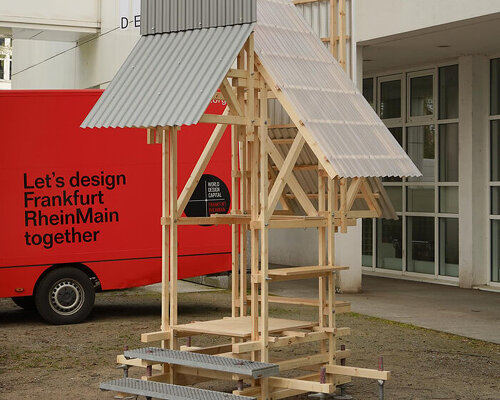
A mobile voting booth designed by architecture students at Frankfurt UAS stands outside the Museum of Applied Arts in Frankfurt as part of World Design Capital 2026 (see more here). Built at full scale, the structure positions democratic participation as a spatial condition, translating abstract principles into something that can be entered, climbed, and experienced.
The project begins with a direct question of access. Who participates, and under what conditions, becomes legible through the arrangement of platforms, thresholds, and partial enclosures. The booth’s timber structure is expressed and serves as a symbol, making the act of assembling and occupying the structure part of its meaning.
images © Astimir Kachegogu (unless otherwise stated)
timber frame and adjustable skins
The mobile voting booth’s framework relies on a lightweight timber skeleton assembled in Frankfurt from standardized elements. Bolted joints remain visible at every connection, giving the structure a legible logic that can be followed by eye. This directness allows the booth to operate as a prototype, one that can be disassembled, transported, and rebuilt in different contexts.
Corrugated panels wrap portions of the frame, alternating between opaque metal sheets and translucent plastic surfaces. These layers introduce shifts in visibility and light. Some areas compress into narrow, sheltered zones, while others open outward, allowing views across the surrounding courtyard. Movement through the booth becomes a sequence of exposures and concealments, loosely aligned with the act of forming and expressing a position.
the mobile voting booth stands outside the museum in Frankfurt as a full-scale installation
movement, elevation, and position
The structure rises vertically in small increments. Steps and platforms lead upward, offering multiple points where a user can pause. There is no single prescribed route. Instead, the arrangement encourages choice through movement, allowing each person to determine how far to enter and where to stand.
This vertical progression carries a subtle shift in perspective. As the body moves upward, the surrounding architecture of Frankfurt’s museum complex becomes visible in fragments through the panels. The act of voting is reframed as a physical alignment within a larger civic environment, rather than an isolated action.
the timber frame exposes its construction through visible joints and modular elements
a prototype for replication
Developed within the Master programs in Advanced Architecture and Architecture at Frankfurt University of Applied Sciences, the mobile voting booth operates as an open system. Its components are designed for reuse, and its assembly logic can be shared and adapted elsewhere. The project extends beyond its installation, proposing a method for constructing spaces of participation with limited means.
As part of the World Design Capital initiative, the installation situates architecture within broader social questions. It does so through direct construction, avoiding symbolic gestures in favor of tangible engagement. The booth holds its ground as a small but precise intervention, where material, structure, and movement align around the act of taking a position.
corrugated panels create shifting conditions of light visibility and enclosure
students assembled the structure using reusable and transportable components
the project functions as a prototype that can be replicated in other locations
project info:
name: Design Voting Booth
location: Museum of Applied Arts (MAK), Frankfurt, Germany
seminar leads: Julian Busch, Ruth Schlögl
event: World Design Capital Frankfurt RheinMain 2026
organization: World Design Organization | @worlddesignorg
photography: © Astimir Kachegogu
design, coordination: Abdullah Khaleel, Cristina Iachimov, Lakal Piyarathna
team: Kimia Bahrami, Flavio Freudenberger, Astimir Khachegogu, Lilly Kolb, Irem Metin, Fatima Millan-Garcia, Mennatalla Mohamed, Cem Eren Polat, Devanshi Roopesh Shah, Uzair Shoukat
flag design, seminar lead: Christoph Knoth
Yeji Cheon, Class Digital Graphics – HFBK Hamburg
tutor: Pia Seewald
The post frankfurt students build mobile voting booth with timber frame and climbable platforms appeared first on designboom | architecture & design magazine.