
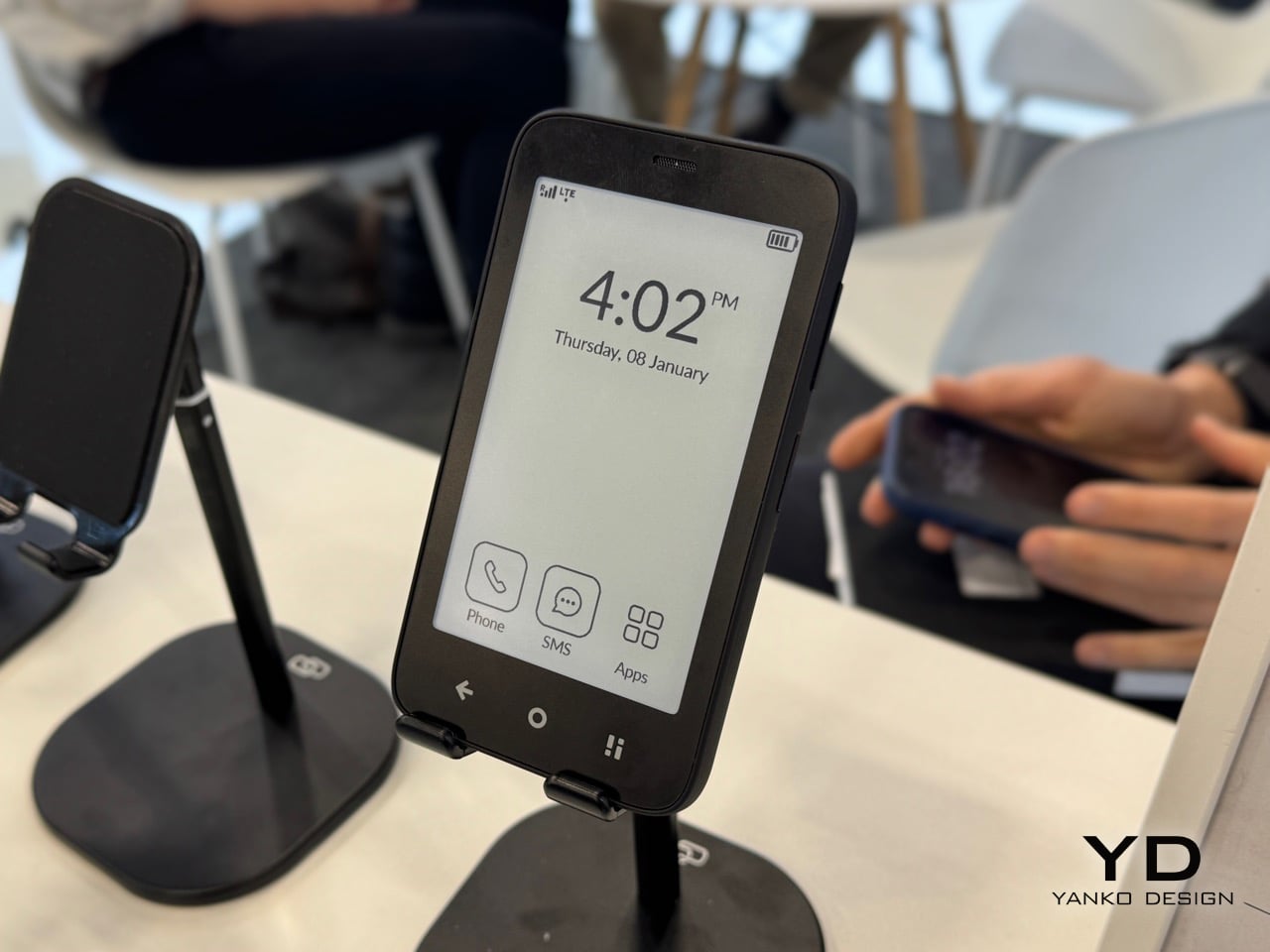
Mudita is a company that focuses on minimalism and mindfulness in technology, a rare philosophy in an industry that relentlessly chases engagement metrics and data monetization. At CES 2026, while competitors showcased AI-powered everything and sensor-packed gadgets, Mudita’s booth felt like a calm oasis in the chaos. CEO Michał Stasiuk explained that most people quickly grasp the concept behind Mudita’s products when they hear what the company does, noting that “most of our conversations here were with people who, you know, when they hear what we are about, what we are doing, what the product is about, they do get the concept.”
The real challenge, Michał acknowledges, isn’t explaining the philosophy but implementing behavioral change: “The difficult part is to actually implement the usage in their own lives because it’s a trade-off between the convenience and the less usage of the device and the peace of mind.” We sat down with Michał to discuss how Mudita positions itself as the antidote to big tech’s attention economy, why the company deliberately avoids AI, and how it’s building trust with consumers who are burned out and skeptical of technology promises.
Mudita Kompakt
Trading Convenience for Calm in a Sensor-Saturated World
CES 2026 was dominated by products cramming sensors into everything, trying to capture data at every opportunity. Mudita stands in stark contrast, deliberately avoiding data gathering and Google APIs. When asked how it feels to be such an outlier, Michał responded positively, explaining that visitors “do get the concept” fairly quickly. The philosophy resonates because people recognize the problem in their own lives, even if acting on it requires uncomfortable changes.
The company frames its products as a deliberate trade-off: “It’s a trade-off between the convenience and the less usage of the device and the peace of mind so the difficult part for them is to actually use the screen less and use the phone less for their benefit but with the trade of convenience.” This honesty about sacrifice sets Mudita apart. Rather than promising effortless transformation, they acknowledge that reclaiming attention requires genuine commitment and a willingness to forego some modern conveniences.
Michał cited sobering statistics: “The average screen time is above six hours a day in the US.” He suggested that all that time could be spent elsewhere, “doing other stuff,” emphasizing that “this device is designed for that purpose of reducing the screen time.” By acknowledging the scale of the problem without sugar-coating the solution, Mudita positions itself as the company willing to say what others won’t.
Band-Aids vs. Built-In Guardrails
The interviewer characterized messaging from Apple and Google about mindfulness and digital well-being as “putting a band-aid on a problem that is actually a really big problem,” noting that their corporate ethos centers on data gathering. Michał agreed, pointing out that big tech companies acknowledge the problem by implementing screen-time controls, which means “they are admitting that the issue is there, right?” However, he argued their implementations are “less efficient” because “you can disable the screen time limitations with no problem whatsoever on your device any time you like.”
Mudita’s approach hardens the constraints: “The device that we’ve made can be much more efficient in that regard. Because when you’re making a decision to use our phone instead of, for example, iPhone or Samsung, it’s much more difficult to break the habit of not using the phone so much.” The key difference? “You cannot disable the limitation on this device.” This is product design as commitment device, locking users into healthier patterns by removing escape hatches.
The business model distinction is fundamental: “The main difference is that the business model of large companies is set to monetize the data, for example, and to make the device as appealing as possible. So our device is designed not to be as appealing as possible, rather it’s designed for our users, clients, to do what they need to do on the phone and then move on.” The goal is to free up time “in life, spending their time elsewhere, doing actually meaningful things instead of staring at the phone, whatever brings joy to them and not spend so much time using a phone.”
Recognition Arrives Fast, Habits Follow Slowly
Michał noted that “the niche is growing and quite fast,” with significantly more awareness in recent years: “What we’ve seen for the last couple of years is definitely more awareness and people get the concept now. Most of the people understand the concept now.” He contrasted this with a few years ago when “it wasn’t the case,” meaning the minimalist phone category had to overcome basic comprehension barriers that no longer exist.
Regulatory momentum supports this shift. Legislators, psychologists, and even big tech insiders are talking about “serious damage happening and mental damage and psychological damage happening with these devices that are constantly taking our attention.” Michał highlighted parental demand as a key driver, noting that “in the last year 2025 there were three phones released on the market designed solely for the purpose of digital minimalism.” The market is validating Mudita’s early bet.
Yet Michał tempered expectations about speed: “I wouldn’t say that the change is very fast in terms of consumer habits because the consumer habits take long time to change much longer but in terms of understanding the issue I would say that everybody agrees.” Many visitors tell him the phone is something “someone would buy for their children” because “a lot of parents are concerned with the screen time of their children so actually they are looking for solutions.” Understanding precedes action, and the gap between the two is where Mudita must operate.
Mudita Bell 2 & Harmony 2
Old Problems Don’t Need New AI
At a show where AI appeared in “literally every product now,” including “an AI alarm clock” and “an AI toaster,” Mudita’s CEO was blunt: “We do not see any need for AI usage in the products that we are creating so far, because the problems we are trying to solve do not require AI, like for example in the alarm clocks, the problem we are trying to help to solve is better sleep and to improve sleep which is harmed by extended use of mobile devices like phones before going to bed.”
He explained that people “scroll for three hours before they go to sleep and this can disturb the sleep and circadian rhythm,” and that Mudita’s alarm clocks use “e-ink display like the phone does and for that reason it does not emit any blue light right so you do not need to look at the blue light before you go to bed.” The solution is material science and interface design, not machine learning. Solving sleep disruption doesn’t require algorithms; it requires removing the stimulating screens that prevent sleep in the first place.
Michał clarified the stance isn’t ideological: “We are not against AI in general but until now there wasn’t any need to use AI.” It’s a refreshing example of technology restraint, deploying tools only when they serve a genuine purpose rather than chasing trends. By avoiding AI where it’s unnecessary, Mudita reinforces its core message that more technology isn’t always the answer.
How Mudita’s Design Language became Instantly Recognizable
When asked about Mudita’s distinctive design DNA, Michał described the unifying principles: “In every product that we are making we are aiming for similar outcomes for example we want to create simple products we want to create products that are easy to use and easy on the eyes without any eye strain so we design all of our interfaces to be pleasant not very cluttered without any jumping elements.” The aesthetic is functional, driven by the goal of reducing cognitive load and visual stress.
He elaborated on the interface philosophy: “In our phone we design the user interface not to have any popping up notifications that could be disturbing and to be as simple as possible and black and white aesthetics are very good fit for that purpose and E Ink displays are also very good fit for what we are trying to achieve without the blue light emission and black and white interfaces.” The monochrome palette isn’t a stylistic flourish; it’s a deliberate choice to make devices less stimulating and more restful to look at.
Rather than building a data-sharing ecosystem, Mudita envisions “an ecosystem but of a different sort,” where devices like alarm clocks work well with lamps “that will have colors adjusted for bedtime like for example you can have warmer colors without any blue light emission.” Importantly, “there is no need for data transfer between those two devices,” and the philosophy is “if they can solve an issue or solve a problem being simple there is no need for us to complicate things with the massive ecosystem that’s not needed.” Simplicity, kept simple.
Transparency as the Trust Strategy
Given that potential customers “have a problem with big tech because they’ve had issues of their own whether it’s data breaches, whether it’s mental health exhaustion or any sort of anxiety,” the challenge for Mudita as “ultimately a tech company” is “how do you win their trust when they’re already so skeptical?” Michał’s answer centers on transparency: “What we are trying to do is to be transparent so basically what you see is what you get okay we are describing our products on our marketing information like, explicitly saying what they are what they are not just to make sure that every important information is out there communicated.”
The company uses community feedback to calibrate disclosure: “We have a forum that people are very active and this is like a source of information for us, what’s important to them, what information should be disclosed and so on,” adding that “it’s not always obvious for us what people are looking into.” Additionally, “what we are trying to do is to deliver what we say when we announce it, so if we announce that there is going to be released with some changes, we are doing everything we can to deliver exactly those changes in exact time that we promised our clients and community.”
Michał summed up the philosophy: “We are doing our best to be as transparent as we what you see is what you get what you see is what you get this is this is like something is a model yes.” By contrast to big tech’s opacity and broken promises, Mudita offers radical honesty about capabilities, limitations, and timelines. Trust isn’t assumed; it’s earned through consistent delivery and clear communication about what the products can and cannot do.
The post From Alarm Clocks To Minimal Phones: How Mudita Is Building A Calm “Anti‑Ecosystem” For Digital Detox first appeared on Yanko Design.