
Tablets promised to revolutionize early learning. Instead, they delivered passive screen time, accidental in-app purchases, and kids hypnotized by algorithmically-served content they didn’t choose. The interface designed for adult fingers forces children into frustration. The endless app notifications destroy focus. The flat glass slab offers zero tactile feedback for developing motor skills.
Royal Tyagi and Aarna Mishra looked at this mess and asked a better question: What if a learning device was actually designed for how children learn, not how adults think they should learn? Their answer is Puzzle Pals, a smart interactive game concept that ditches the tablet playbook entirely and borrows from something far more effective: the chunky, intentional design of 90s handheld gaming.
Designers: Royal Tyagi, Aarna Mishra
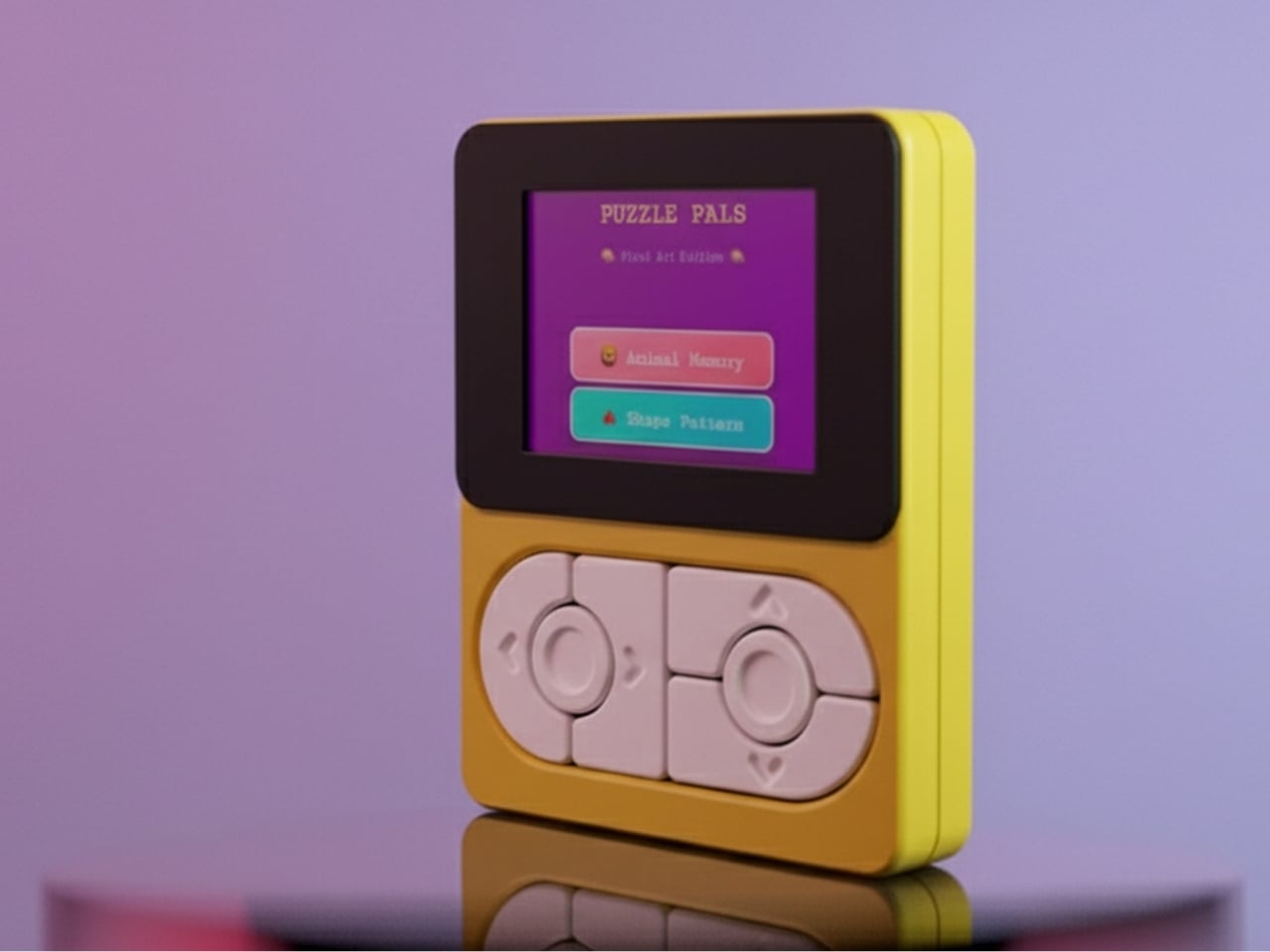
The device sits somewhere between a Game Boy and a Fisher-Price toy, which is precisely the sweet spot it should occupy. It’s unapologetically retro in its aesthetic, with that handheld form factor that screams late 90s gaming. But here’s where it gets interesting: every design choice serves a developmental purpose. Those rounded edges aren’t just there to look friendly. They create an ergonomic grip that actually fits the way young children hold objects. The slightly curved body mirrors the natural curl of small fingers.
Look at the button layout and you’ll see thoughtful restraint. Instead of cramming in a dozen tiny inputs that would overwhelm little users, Puzzle Pals features large, well-spaced buttons arranged in a way that makes accidental presses nearly impossible. Each button has a distinct shape, supporting tactile learning before kids even understand what they’re supposed to do with them. The high-contrast color scheme isn’t a random aesthetic choice either. It’s engineered for instant visual recognition, helping children navigate independently without constant adult intervention.
The games themselves (Animal Memory and Shape Pattern) follow a similarly intelligent design philosophy. Three difficulty levels per game mean the device grows with the child rather than getting abandoned after a week. Too many kids’ tech products assume a static skill level, but Puzzle Pals acknowledges that children are constantly evolving learners. The progressive difficulty keeps them engaged without triggering frustration, that delicate balance every parent desperately seeks.
What really sets this concept apart is its approach to failure. After three incorrect attempts, the game simply provides the correct answer and moves on. No punishing sounds, no game-over screens, no shame spiral. It’s a remarkably compassionate design decision that prioritizes learning over winning. Kids continue building skills without the emotional baggage that can turn educational activities into sources of anxiety.
The reward system is equally clever. Instead of generic “great job!” messages, every correct response triggers a fun fact or informative snippet. It transforms each small victory into an opportunity for additional learning, creating positive associations between achievement and curiosity. That’s the kind of psychological design that usually requires a team of child development experts, yet it’s been seamlessly integrated into gameplay.
The physical prototype shows how the designers balanced playfulness with functionality. Available in eye-catching colors like sunshine yellow, cherry red, sky blue, deep purple, and lime green, each device looks like something a child would actually want to pick up. The matte finish and smooth curves feel premium without being precious. There’s a speaker grille up top for audio feedback, and the screen size is perfectly proportioned for the overall footprint.
What Tyagi and Mishra have articulated through Puzzle Pals is bigger than just another kids’ gadget concept. Their vision centers on making learning genuinely joyful, not just tolerable. They want to build core cognitive skills like recognition, problem-solving, sequencing, and pattern understanding while encouraging creativity and exploration. Most importantly, they aim to instill a love of learning itself, that intangible quality that determines whether a child approaches new challenges with excitement or dread.
The post Game Boy-Inspired Kids’ Device Concept Fixes What Tablets Get Wrong first appeared on Yanko Design.