
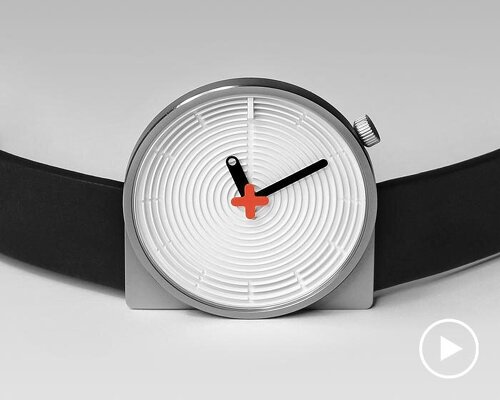
good+evil Ways rotating watch adapts from wrist to desk
Christo Logan is launching good+evil Ways, a watch whose circular clock is gently perched on a rectangular plinth and rotates on command. This allows its wearer to set the watch rotation at various angles, like a custom driving watch that fits exactly what they’re doing at any given moment. It also means the watch doubles as a mini table clock when off-wrist. Ways is the follow-up to Logan’s first watch, the good+evil Omen, which launched on Kickstarter in 2024. The Omen’s D-shaped steel case allows it to rest on its side when not worn, but that of course yields a sideways clock: Thinking it would be a fun challenge to make a watch work in this orientation, Logan designed the Ways watch to have 120° of rotational freedom. This allows it to be used as a driving watch on either arm, so that the 12 marker is pointing straight up even on an angled wrist. Rotating the face a full 90° clockwise, the watch can sit comfortably on its flat edge, serving as a desk clock during work or a bedside clock at night.
good+evil Ways by Christo Logan | all images courtesy of Christo Logan
Raised rings and carved markers form a sculptural dial
The case is composed of a set of stacked sandblasted stainless steel solids: the circular front volume houses all clock functions, and the rectangular rear volume contains integrated lugs to attach the black leather strap. These two parts move relative to each other with the same clicking mechanism that is used on rotating watch bezels, giving the turning action a satisfying feel as it snaps at every minute marker. In contrast to the pared-down exterior, the watch shows off a sculptural dial of raised rings and grooves that takes full advantage of the interior volume. There are no glued-on or printed markers or logos to disrupt the ‘zen garden’ with its shadowy carved out spaces that act as hour markers. Meanwhile, the good+evil ‘+’ logo floats above as the seconds hand.
Even with such an unconventional design, the Ways uses entirely standard materials and parts for reliability and to keep the price accessible. A Swiss quartz movement provides set-it-and-forget-it convenience, and durability is provided by an anti-reflective sapphire crystal set into the CNC-milled case finished with a polished chamfer. ‘There are no watches that look like the Ways because its visual design is a direct outcome of its unique functional capability,’ shares designer Christo Logan. Preorders are live on Kickstarter, where backers can choose between Stainless Gray and Carbon Black with DLC coating.
a circular dial perched on a rectangular base
rotating watch face adjusts to any angle
designed to keep 12 always upright
dial rotates with 120° of freedom
stacked sandblasted stainless steel case
sculptural dial formed by raised rings and grooves
carved markers defined by light and shadow
Swiss quartz movement ensures reliability
rear volume integrates strap lugs
comes in Stainless Gray and Carbon Black
a watch that adapts to driving positions
rotating parts connected by a clicking mechanism
floating ‘+’ symbol acts as seconds hand
project info:
name: good+evil Ways
designer: Christo Logan | @good.plus.evil
model: Ways
case dimensions: 40 W x 8.8 T x 40 LTL mm
case material: Sandblasted stainless steel
case colors: Gray, Black with DLC coating
water resistance: 5 atm / 50 m
crystal: Sapphire with underside AR coating
dial: White Lug
width: 18mm
strap: Black leather quick release
movement: Ronda quartz
functions: Hours, minutes, seconds
battery: SR521SW / 379
availability: Preorders open
warranty: 2 years
designboom has received this project from our DIY submissions feature, where we welcome our readers to submit their own work for publication. see more project submissions from our readers here.
edited by: christina vergopoulou | designboom
The post good+evil ways watch rotates on command to match driving, typing, and resting positions appeared first on designboom | architecture & design magazine.