
Habitario explores Mexican domestic spaces and their wounds
Habitario by Brenda Isabel Pérez is an art and research project presented in the format of a board game that examines domestic space in Mexico through narrative construction and spatial speculation. The project defines habitarios as both physical and symbolic environments in which everyday life unfolds, social relationships are formed, and collective memory is shaped. Within this framework, domestic space is treated as a site for rethinking existing structures and imagining alternative spatial models. Developed with the support of the Jóvenes Creadores grant (formerly FONCA), Habitario forms part of U/Topías domésticas, the project awarded the 2024 Jóvenes Creadores grant in the Architecture category. The work operates at the intersection of research, narrative, and material assembly, translating literary and social analysis into a participatory spatial system.
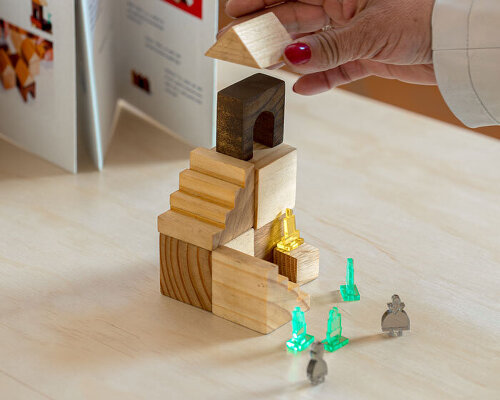
The game draws on four short stories written by Mexican women authors, Inés Arredondo, Amparo Dávila, Elena Garro, and Gabriela Damián Miravete, whose writing addresses domestic interiors as spaces shaped by care, control, and gendered expectations. Rather than directly illustrating these narratives, Habitario abstracts their themes into a set of spatial and narrative prompts. Players construct speculative houses using wooden components, acrylic figures representing characters, and action cards derived from scenes of domestic life.
Each participant begins by drawing a character defined through recognizable domestic roles, such as daughter, mother, or guest. These archetypes establish initial relationships to space without requiring prior knowledge of the literary sources. Gameplay unfolds through the gradual placement of components and the interpretation of narrative fragments, resulting in a collectively assembled domestic environment. Sessions conclude either when all cards are drawn or when a spatial configuration is completed, producing different outcomes each time.
game table and table set | all images by Amy Bello unless stated otherwise
women’s reflection on memory, trauma, and domestic labor
Designer Brenda Isabel Pérez’s literary references underpinning the project include La sunamita, El anillo, El huésped, and Espanto del mundo nuevo. Research for the project extended beyond the texts themselves to include the authors’ biographical and geographic contexts, examining the houses they inhabited, regional climates, and social conditions that informed their writing. This research shaped both the character archetypes and the conceptual framework of the game, which also draws on Marcela Lagarde’s Los cautiverios de las mujeres, a study of social structures that restrict women through prescribed domestic roles.
The speculative houses generated through Habitario operate as a living methodology. Using wooden components and acrylic figures, participants without architectural training assemble complex spatial configurations that prompt reflection on domestic memory and spatial practice. The process raises questions about past living environments, such as the presence of courtyards, circulation patterns, and spaces for domestic labor, as well as potential transformations, omissions, or removals. It also opens broader inquiries into alternative forms of living that emerge when housing is no longer structured around the traditional family model, and how domestic space might be reorganized to support different modes of use and care. As gameplay progresses, participants construct imagined domestic elements, including an always-open zaguán, a plant-filled corridor for hiding, or a window made for shouting, in a way to rework the traumatic experiences of characters such as Guadalupe or Luisa, women constrained by reproductive and domestic expectations in the twentieth century, whose conditions remain painfully current.
Habitario positions architecture as an affective and social practice, emphasizing how spatial organization influences labor, intimacy, and collective life. The project avoids predetermined narratives, instead offering open-ended configurations that allow each session to operate as an independent exploration of domestic space and its possibilities. Habitario is currently exhibited at Centro Cultural San Roque, where it will remain on view until March 22, 2026.
resulting houses, instructions and postcards
Habitario activation
play as a tool for imagination and resilience
game table and board game
folding instructions | image by Paulina Ojeda
resulting houses, instructions and postcards
character cards | image by Julieta Catalan
characters and vegetation | image by Julieta Catalán
spatial variants | image by Julieta Catalán
the artist, Brenda Isabel Pérez, and her table board game | image by Paulina Ojeda
project info:
name: Habitario
designer: Brenda Isabel Pérez
collaborators: Marcos Popotla, Montserrat Quintanar, Julieta Catalán, Carpintería Samuraí
photographers: Amy Bello, Julieta Catalán, Paulina Ojeda
designboom has received this project from our DIY submissions feature, where we welcome our readers to submit their own work for publication. see more project submissions from our readers here.
edited by: christina vergopoulou | designboom
The post habitario board game challenges domestic models in mexico through women’s narratives appeared first on designboom | architecture & design magazine.