
AATISMO builds an unconventional artist’s home
Haniyasu House by AATISMO overlooks a valley in Kamakura, Japan, a place shaped by earthen cliffs which hold rows of ancient cave tombs carved into the rock. The area carries a dense geological and cultural presence, and the house answers that weight with a low, grounded profile that follows the slope of the land and keeps close contact with soil and stone.
Designed for the architects themselves and their parents, both ceramic artists, the renovated dwelling supports two generations whose lives center on clay. Domestic life and making share the same territory, and the project treats this overlap as the starting point for every spatial decision. Rooms, work areas, and outdoor zones interlock so that firing, glazing, cooking, and resting occur within an open plan rather than in isolated rooms.
images © Sato Shinya
the earthen Haniyasu House shaped by its natural context
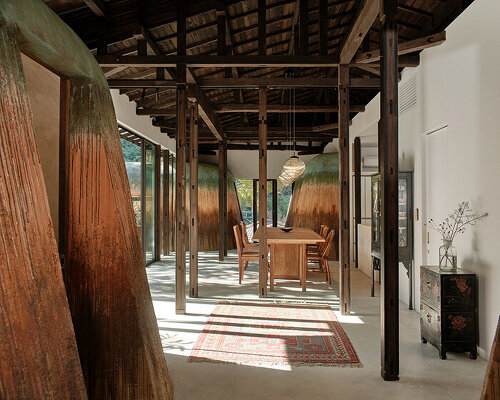
The Haniyasu House renovation by AATISMO began with a modest single story wooden structure built in 1967. All interior walls and ceilings were removed, opening the plan into a single volume that connects directly to the surrounding garden and sky. Into this open core, new rooms were inserted at the four corners. Their compact, heavy forms read as earthen masses rising from the ground, giving the composition the character of a small settlement gathered around a shared center.
This central space operates as a common plaza where meals, conversation, and everyday tasks take place. Circulation moves freely across the floor, with long views from one corner to another. Light shifts across the surfaces during the day, revealing the texture of plaster, soil, and timber. The atmosphere feels calm and tactile, with the sound of work and family life carried through the open volume.
the two-family home is designed by the AATISMO team for themselves and their ceramic artist parents
cave-like rooms for resting and making
Each of the Haniyasu House’s organic, corner addition by AATISMO provides a private, cave-like room for sleeping and work. The father’s studio to the northwest carries deep brown tones made from soil taken directly from the site. A kiln and outdoor glazing area sit close by, allowing the entire ceramic process to occur within one zone. Tools, clay, and finished pieces remain within arm’s reach.
Across the house, the mother’s room takes on a lighter presence, finished with lime mixed with bisque-fired clay and fitted with built-in cabinetry and underfloor storage. The architects’ own space, the largest of the volumes, features lowered earthen floors and cantilevered desks used to display furniture and lighting from their practice. A guest room doubles as a tea room with tatami mats, a tokonoma alcove, clay-rich walls mixed with bamboo charcoal, and soft daylight entering from above.
four new corner volumes for sleeping and work rise like earthen masses
design led by material experimentation
Material experimentation guided the construction. Soil from the site and discarded clay from the pottery studio were crushed, fired, glazed, and tested in repeated cycles. Exterior walls received layers of site soil and bisque-fired clay combined with plaster containing iron and copper powders. Oxidation slowly alters the color, so the surfaces deepen and shift with weather and time. The four corner volumes also serve as seismic reinforcement, concentrating shear walls in new foundations while preserving the original columns that hold the tiled roof.
Named after Haniyasu, the deity associated with earth and pottery, the Haniyasu House channels a close relationship between land, craft, and habitation. The work of AATISMO gives physical form to a way of living where making continues throughout the day and architecture participates in that process through weight, texture.
the father’s studio integrates a kiln, glazing, and pottery making within one continuous zone
natural materials include site soil, clay, lime, and metal powders
the 1967-built wooden house is opened into a single shared interior
the central open space functions as a communal area
the house brings living and making together through an architecture shaped by earth and craft
project info:
name: Haniyasu House
location: Kamakura, Japan
photography: © Sato Shinya
The post haniyasu house: AATISMO renovates home for ceramic artists with cavernous clay additions appeared first on designboom | architecture & design magazine.