
louis denavaut gives the Elysées Lincoln a new vibrant identity
At a moment when independent cinemas across Europe are dimming their lights for good, Louis Denavaut breathes new life into the historic venue of the Elysées Lincoln in Paris, France. The architect creates a sequence of atmospheres for this project, reflected in three distinct interior worlds that are clad in various materials and colors, from hushed velvet greens to saturated pinks and soft pastel tones. Hints of Wes Anderson–like palettes, precise geometries, and textures surface across the three rooms, as a way of heightening the sensorial charge of the cinema experience.
The hybrid cultural and event space gets a new identity, one where color, texture, and atmosphere set the stage for the act of gathering to watch stories together. Across L’Audito, Le Studio, and Le Club, Denavaut treats each room almost like a film genre, establishing a different mood, a different palette, and a different tempo, all contributing to a renewed sense of cinematic presence.
all images by Mary Erhardy via @CinemaElyseesLincoln, unless stated otherwise
three chromatic worlds for contemporary cinema in paris
Part of the Multiciné network of independent Parisian theaters, art-cinema Elysées Lincoln operates as both a cultural venue and an event platform. Louis Denavaut’s renovation reorganizes the space through three spatial typologies, featuring an auditorium for large shared screenings, a small-format premium room for intimate projections, and an adaptable lounge for social or professional gatherings. Technical upgrades, including 4K laser projection, a fully equipped catering office, and a customizable LED facade visible from the avenue, support this expanded program. Through his revamp, the French architect suggests that the survival of independent cinemas may no longer lie in competing with big-chain comfort but in crafting atmospheres that feel specific and sensorially rich.
The main auditorium, L’Audito, establishes the quietest atmosphere of the three. Rows of deep olive-green velvet seats sit within walls patterned in a muted pink harlequin motif, giving the room a steady visual rhythm. The carpet, a dense botanical print, hints at the past of the cinema without sliding into nostalgia. Oversized black wall-mounted speakers punctuate the geometry, becoming sculptural elements rather than concealed equipment. A thin LED line washes the lower wall in green, producing a soft underglow that subtly floats the seating volume. The overall effect is enveloping and slightly retro, a room tuned to calm the viewer’s attention before the film begins.
Le Club is bathed in baby-pink tones | image via Multiciné
hot-pink immersion and pastel curves
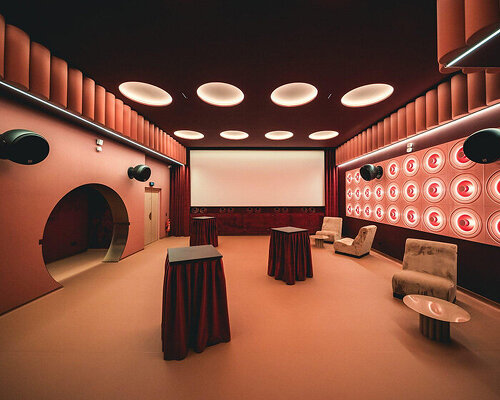
The walls, ceiling, and floor of Le Studio shift between reds and hot pinks, creating a monolithic chamber. Plush magenta seating introduces a softer layer, almost domestic in scale but heightened through repetition. The space is designed for small audiences, private screenings, or strategic meetings where light, comfort, and acoustic clarity operate as a single system.
The third room, Le Club, is bathed in baby-pink tones. The space uses arches, rounded wall niches, and glowing circular sconces to create a softer, more social environment. A grid of circular relief panels, echoing speaker cones, turns one wall into a glowing sculptural surface, while round ceiling fixtures amplify the spatial rhythm. It can shift between cocktails and seated events, supported by a bar area and a separate entrance. Reflective surfaces catch the soft lighting, introducing subtle golden highlights that echo the festive, lounge-like character of the room.
By dividing the cinema into three moods, Louis Denavaut offers an argument for why independent cinemas remain culturally vital. They can become anchors of atmosphere, places where people return not only for the film but also for the sensorial environment that frames it. Set within one of Paris’s most commercial districts, the revamped Elysées Lincoln asserts that intimacy, texture, and careful design can still draw audiences into shared darkness and maybe even keep these kinds of spaces alive.
glowing circular sconces to create a softer, more social environment | image by DePasquale + Maffini via @CinemaElyseesLincoln
the space can shift between cocktails and seated events | image via Multiciné
arches and rounded wall niches | image by DePasquale + Maffini via @CinemaElyseesLincoln
reflective surfaces catch the soft lighting | image via Multiciné
L’Audito establishes the quietest atmosphere of the three | image via Multiciné
rows of deep olive-green velvet seats sit within walls patterned in a muted pink harlequin motif
the carpet, a dense botanical print, hints at the past of the cinema
the overall effect is enveloping and slightly retro
the walls, ceiling, and floor of Le Studio shift between reds and hot pinks | image via Multiciné
designed for small audiences
plush magenta seating introduces a softer layer | image by DePasquale + Maffini via @CinemaElyseesLincoln
project info:
name: Elysées Lincoln cinema renovation | @elysees_lincoln
architect: Louis Denavaut | @louis_denavaut
location: 14 rue Lincoln, 75008 Paris, France
The post historic parisian cinema is reborn in wes anderson-like pastel hues and velvet touches appeared first on designboom | architecture & design magazine.