
darkest fabric inspired by riflebird’s ultrablack feathers
Researchers at Cornell University have developed a method that allows them to create the darkest fabric ever made, inspired by the ultrablack feathers of the magnificent riflebird. In the study, the group says that material can be used to improve solar thermal systems as well as camouflage clothing designed for thermal control. It is because the bird’s feathers can absorb almost all light with their complex physical structure and the melanin inside them. Ultrablack in this context means a surface that reflects less than 0.5 percent of incoming light, and the group has been able to make the textile using a method based on natural structures found in the feathers of the fowl. The project began in the Responsive Apparel Design Lab, which is part of the College of Human Ecology at the university. The team used white merino wool knit fabric as the base material and applied a two-step process.
First, they dyed the wool with polydopamine, which is a synthetic form of melanin. They chose this dye because melanin is the pigment that helps many animals produce ultrablack surfaces. For the process, the dye went deep into the fibers of the wool, coating every section of the textile and making it hold the dark color. The second step in creating the darkest fabric ever made was plasma etching. The researchers at Cornell University placed the dyed merino wool inside a plasma chamber, which removed small amounts of surface material. After this process, the outer fibers of the wool developed nanofibrils, or the tiny growths that stand up from the fiber surface, which are a shape that traps incoming light. In this case, when light enters the space between these structures, it bounces repeatedly and doesn’t ‘escape’ from the fabric, preventing reflection and producing the ultrablack effect.
all images courtesy of Cornell University
Light-absorbing material can be applied to solar thermal systems
The researchers at Cornell University studied the riflebird feathers to understand how similar structures function in nature. In their study, tests showed that the new fabric had an average reflectance of 0.13 percent, making it the darkest textile reported so far, they say. The darkest fabric also stays ultrablack across a wide viewing angle of 120 degrees, and the team considers this a breakthrough because existing ultrablack materials often change appearance at different angles, so the Cornell University process has managed to solve this. So far, the design team has used only common materials: merino wool, polydopamine dye, and standard equipment available in textile labs.
The method can also be used on other natural fibers such as cotton and silk, and the group explained that the process is simple and scalable for larger production. It also produces a textile that can be worn and moved without losing its light-absorbing properties. The team explores potential uses for the darkest fabric inspired by ultralight feathers, with solar thermal systems as one potential. In these systems, absorbed light is converted into heat, and the ultrablack textile could increase the amount of light absorbed. Another potential use is camouflage clothing designed for thermal control, because the textile traps light and could help regulate heat exchange. The team has applied for patent protection and plans to move their research toward commercial use.
the team used white merino wool knit fabric as the base material
the researchers dyed the wool with polydopamine, which is a synthetic form of melanin
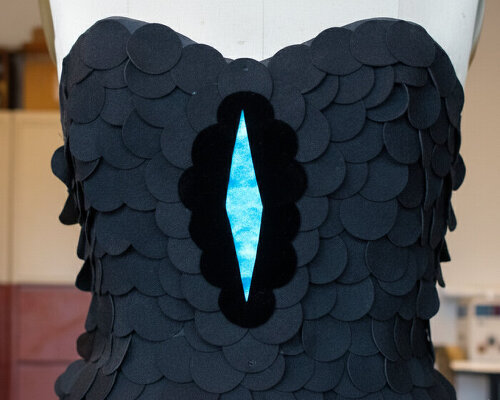
dress designed by Zoe Alvarez, a fashion design major, which uses the ultra-black material | photo by Ryan Young
the researchers draw inspiration from the ultrablack feathers of the magnificent riflebird
detailed view of the dress by fashion major student Zoe Alvarez
the ultrablack material stands out from the ‘typical’ dark textile
project info:
name: Ultrablack wool textiles inspired by hierarchical avian structure
institutions: Cornell University, Responsive Apparel Design Lab, College of Human Ecology, Cornell Lab of Ornithology | @cornelluniversity, @cornellhumec, @cornellbirds
researchers: Hansadi Jayamaha, Kyuin Park, Larissa M. Shepherd
study: here
The post how a bird’s ultrablack feathers inspired researchers to create the darkest fabric ever made appeared first on designboom | architecture & design magazine.