
How A Mouldy House Became A Sustainable Sanctuary, Thanks To Savvy Renovation
Sustainable home badge
Inside the Rifle Range Retrofit by HèHè Design and Carland Constructions.
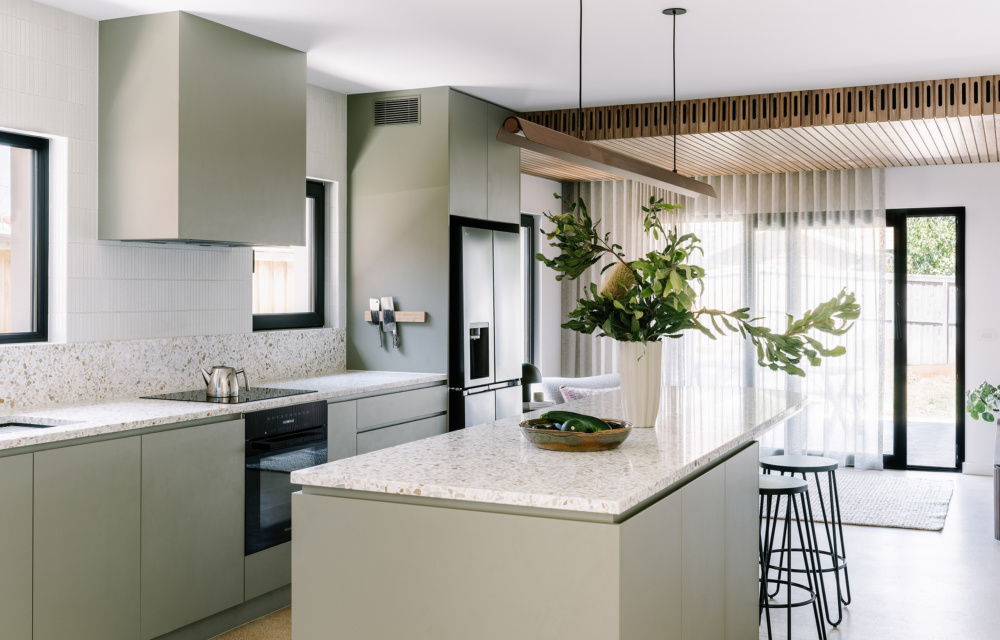
Terrazzo benches add soft pops of colour to the kitchen.
Low-VOC finishes and a restrained natural colour palette create a calm, breathable interior. Timber panelling by Crafted Hardwoods.
Storage was cleverly integrated into the home’s existing footprint, as a curved wall conceals the concealing the laundry and mechanical ventilation systems from Passive Tech.
Artwork by Charlotte Swiden from Lander-Se.
Triple-glazed windows from Binq ensure high thermal performance.
The laundry.
The bedroom.
Green tiles bring tones of nature inside.
Despite all efforts, it’s not always possible for a renovated building to achieve the full Passive House certification.
That’s why the Passive House Institute has developed EnerPHit: a rigorous retrofit version of the Passive House standard, which stands as a benchmark for achieving substantial energy savings and comfort improvements with an existing building.
So when it came to renovating an old home in Melbourne’s inner west, where sustainability was ‘non-negotiable’, the homeowners enlisted the help of HèHè Design and Carland Constructions to go all in reaching for this impressive certification.
But the existing build was riddled with issues.
‘The home was a 1990s volume-built house that had been sitting vacant as part of a deceased estate. It had widespread black mould, a strong musty smell, and very poor thermal performance,’ Carland Constructions builder Matthew Carland says.
Like many homes of that era, it lacked airtightness, adequate insulation, and didn’t support the clients’ lifestyle as a young family.
Yet rather than altering the external footprint, HèHè Design focused on transforming the internal experience of the existing shell — carving out newfound storage and integrating biophilic principles wherever possible.
‘A sculptural curved timber wall became a defining feature in the heart of the home, concealing the laundry and mechanical ventilation infrastructure while guiding movement through the home,’ interior designer Erin Fairmaid says.
‘Oversized timber-lined ceiling bulkheads were used to conceal ductwork and simultaneously zone the kitchen and living areas while providing a warm, visually striking design feature.’
The interior palette also served to ground the home in nature, embracing natural or reclaimed materials throughout. Blackbutt timber lining meets cork flooring, while terrazzo and green joinery echoes calming hues in both the kitchen and bathrooms.
From a technical perspective, the entire building was meticulously retrofitted to create what the team believes is the ‘first certified EnerPHit retrofit of a volume-built home in Australia’.
New continuous insulation helped meet the exceptional airtight requirements, as all windows and doors were upgraded to triple-glazed — installed carefully within the new insulation layer to ensure the external cladding could remain in place.
In line with Passive House principles, the home also features a Mechanical Ventilation with Heat Recovery system (MVHR) that pumps fresh filtered air inside, and a 10.66kW solar system.
‘This was genuinely uncharted territory,’ Matthew says of the project. ‘Converting a standard volume-built home into a certified Passive House required trust, experimentation, and a shared commitment to doing things properly.’
It took almost 18 months from design development to get the house to where it is today, but its success proves that meaningful, sustainable design doesn’t require demolition or complete redesign.
‘With the right team, patience, and technical ability, existing housing stock can be radically improved to better service our environmental, economical, and emotional needs,’ Erin adds.
‘This is where the future of residential design genuinely lies.’