
How An Architect Revived This Incredible Terrazzo-Filled ’60s Home
Architecture
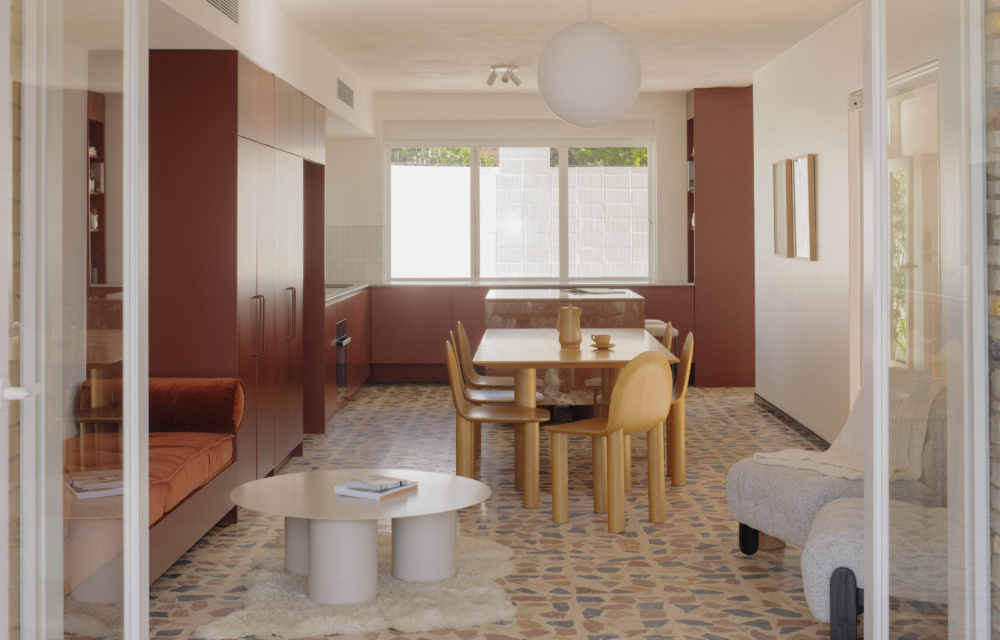
Inside Giuseppe’s House. The ground floor kitchen and dining area.
The original terrazzo flooring is believed to be the work of the Scolaros, a talented Italian family who created tiles in the 1950s-60s.
New red joinery ties in with the bold flooring.
Floor-to-ceiling cabinets provide newfound storage.
The mid-century staircase now features pink accents and cream terrazzo tiles. Artwork by Steven Brameld and Jay Staples.
A view from the double-storey void.
The upstairs living room overlooks the expansive balcony.
Artwork by Yukultji Napangati.
A neat study nook.
The bedroom on the ground floor means the lower level can be used as a ‘granny flat’ if required.
Artwork by Jordi Hewitt.
Cork flooring and intricate ceiling detailing features upstairs.
The main bedroom and en suite. Artwork by Jordi Hewitt.
Tiles maintain the home’s original retro energy.
Modernist salmon bricks are paired with columns of Toodjay stone on the exterior.
The mid-century gem has been beautifully revived both inside and out.
A glimpse into the upstairs living area from the street.
In the early years of starting her Fremantle-based architectural practice, Whispering Smith director Kate Fitzgerald saw many of the character-filled homes in Perth’s neighbourhoods being lost to homogenous volume builds, while not enough quality infill housing was being built.
This inspired her to create a sister company, New Resident: ‘a sustainable development company that finds the best urban infill sites with existing character homes and mature trees, and saves them.’
So when a 1960s brick house built by an Italian immigrant came up for sale in Fremantle, it was exactly the kind of property the team wanted to preserve.
Beyond the quintessential mid-century facade, the interiors at Giuseppe’s House (as it’s now known) were like a time capsule. One that needed significant, specialist repairs.
Everything from the beautiful, cracked terrazzo floors to the lifting parquetry and butter-yellow laundry revealed stories of the family who had cherished the house for more than 60 years.
‘We stripped back what was failing, and kept what mattered,’ Kate says of the sensitive renovation.
Most of the entry, double-height stair void, bedrooms, living rooms and kitchen were all able to be retained, with only minor alterations to the windows and doors for improved thermal performance.
Small surgical interventions helped reimagine the floorplan. A new full-length joinery wall renewed the kitchen as the heart of the home; additional wet spaces were tucked into a series of ‘wasted little nooks and crannies’; soft white terrazzo tiles were selected for the restored balconies.
But finding the right colours and materials to go along with the bold original interiors was one of the most ‘rigorous’ parts of the redesign.
Drawing heavily from the flecks of red, black, and yellow in the bold flooring, the dining and kitchen downstairs now feature burgundy cabinetry with a daring red marble island to match.
The bathroom was also reimagined as more a contemporary version of the existing powder-blue fitout.
While the ground level features a bedroom for possible multi-generational living or house-sharing, upstairs reveals new cork floors throughout the four remaining bedrooms and the sunny living room, which overlooks the leafy street.
‘To have both insanely bright, strong colours and soft pastel-toned materials seemingly working so well in harmony was such a beloved feature of Giuseppe’s house when we first purchased it,’ Kate notes.
The result is nothing short of a masterclass in reviving the kind of housing that often ends up being deemed too difficult to restore. They even managed to peel back the concrete backyard for more planting, working carefully around Giuseppe’s enduring lemon and fig trees.
‘A DIY “property flipper” typically spends about $50,000 on a cosmetic renovation, and our budgets are often 10-20 times that, because we’re treating each home like it’s a legacy project — a forever home,’ Kate says.
It’s proof that with the right expertise, enough dedication, investment, and care, there’s still plenty of life left in these old-school gems.