
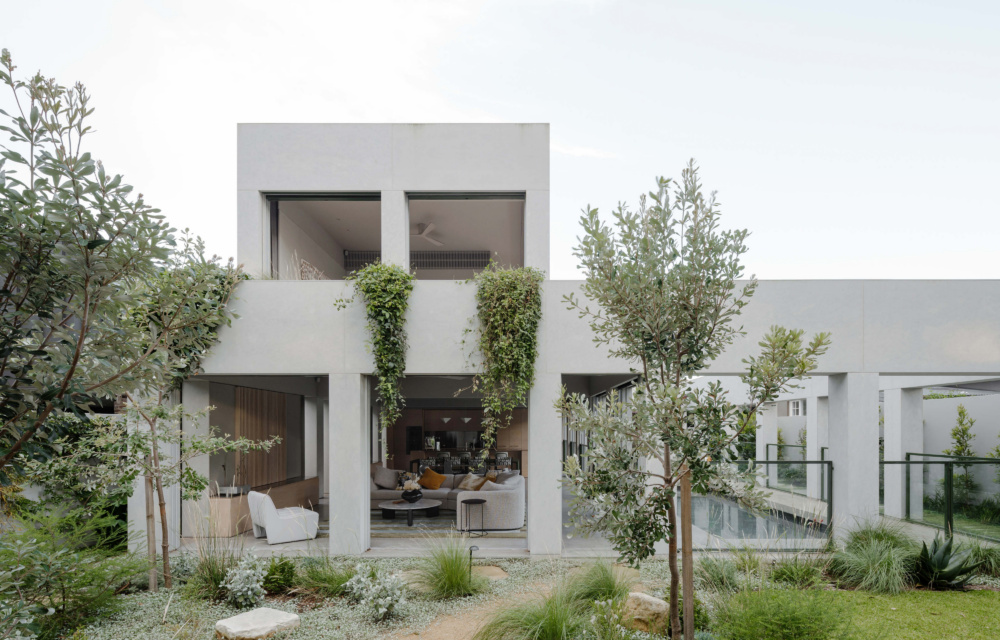
How This Sydney House Shapeshifts Depending On The Weather
Architecture
The rear extension features operable windows, screens, and blinds.
A path leads into the kitchen from the backyard and pool.
All of the openings can be closed over with counterweighted windows and for retractable blinds.
The architectural columns subtly reference ancient ruins.
A glimpse into the window mechanisms.
The landscaping was a key focus of the design.
The living room.
Lush garden views at every turn.
Muted greys, greens, and timbers feature throughout.
An undercover pavilion for entertaining.
A view across the pool and bedroom upstairs.
The bedroom opens to a rooftop garden.
A circular skylight floods the shower with natural light.
Joinery by Jonathan West.
A central courtyard.
Where the original structure meets the new extension.
Heritage flair remains in the original structure.
The charming Federation-style facade.
For lack of a better term, Active House in Sydney’s eastern suburbs is a bit of a shapeshifter.
Almost every corner of its rear extension features some kind of retractable windows, screens, and blinds that can be closed for privacy, or completely disappear from view, blurring the threshold between interior and the gardens beyond.
And when everything is pulled back, Panov—Scott director Anita Panov likens the open-air structure to ‘a picturesque ruin’ — calling to mind images of the Roman Colosseum.
The unique family home belongs to Four Pillars Gin co-founder Matt, his wife Bec, and their two children. After living in the Federation-style property for more than a decade, the couple approached Panov—Scott for a total transformation.
‘The house was both large and small, in all the wrong places,’ Panov—Scott director Andrew Scott says of the existing home.
‘We sought to make serene spaces, a place of calm at the centre of some very busy lives.’
The original four-room house was largely retained and restored, keeping the charms of the red-brick facade and stained-glass windows. Meanwhile, the ‘awkward’ 20th-century additions at the rear were demolished to make way for a contemporary extension made from Barestone-clad walls.
The idea to make the house an ‘active’ participant in the landscape came up early in the design process, as the clients and architects talked through how the interactive details could help the home respond to differing weather conditions.
On the ground floor, square columns feature green counterweighted windows and blinds that can be astonishingly well hidden into the structure by sliding downwards or sideways — turning the living, kitchen and dining area into an open-air pavilion with views into the garden designed by Emily Simpson Landscape Architecture.
The same mechanisms enclose the pool area and the bedroom upstairs, bordered by succulents planted on the rooftop.
‘This radical operability enables the family to actively remake the interface between the house and the environment moment to moment,’ Anita says.
‘The hope is that this active engagement will develop an acute understanding of the environment, in the manner of say a surfer or sailor. And out of that environmental responsiveness, an authentic sense of environmental responsibility will arise.’
At 242 square metres, the house feels large and luxurious, yet much consideration was given to its sustainable performance. Walls are well insulated, and the design optimises the collection of water and solar power, as the shading and ventilation strategies also help the family manage the home’s temperature.
Internally, the floors, joinery, and furnishings — curated by YSG — tend to muted and warm greys, deliberately pushing the focus back on the natural world outside.
‘If contemporary Australian domestic architecture is defined by the isolated pavilion within a dramatic landscape, this project stands apart,’ Andrew says.
‘The place comes alive through active engagement of windows and screens, but also through the evolving nature of the garden. This ephemeral beauty is always changing and so attuned to the daily rhythms of dwelling.’