
How This Thriving Melbourne Garden Brings Neighbours Together
Gardens
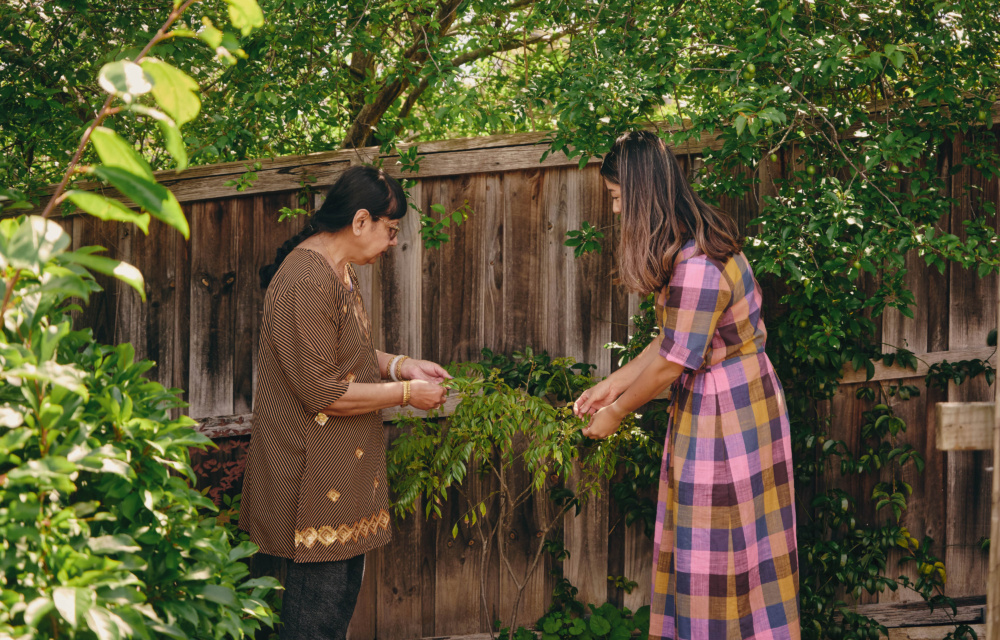
Shirley Shakuntala and Connie Cao.
Shirley stands with one of her Murraya koenigii (curry tree).
Shirley harvests her plums to make plum jam.
Murraya koenigii (curry tree) leaves.
Connie has taken notes from Shirley’s abundant curry trees for her own garden.
Mint, potatoes and self-seeded beetroot flourish in a challenging patch that doesn’t get enough sunlight.
Ocimum tenuiflorum (Tulsi basil, or holy basil) is grown for Hindu prayers.
Desmostachya bipinnata (Kusha grass) for prayers.
Cymbopogon (lemon grass).
Shirley makes a variety of pickles and chutneys from her harvests.
The large Eureka lemon tree produces enough lemons to pickle and make into chutney.
Among a garden of perfumed roses lives Shirley Shakuntala and Peter Pramod, an Indian couple from Fiji. We’ve been neighbours for close to eight years now, trading veggies and stories along the way.
In summer, my garden often brims with homegrown veggies that I walk across the road to share with Shirley and Peter. A few hours later, Shirley’s at our door bringing back a portion of what she’s made with the bounty: grilling our eggplants to make a Baigan Chokha and turning our pumpkins into Kaddu Puri.
Through our gardening swaps, I’ve expanded my Asian veggie cooking repertoire, shared hyper-local knowledge on what grows well in our area and learned about how Shirley celebrates her cultural heritage through her garden.
Shirley’s backyard is home to numerous fruit trees, including a prolific Eureka lemon tree that produces giant lemons throughout the year. It’s so fruitful that I don’t need a lemon tree in my own garden, for I know if I ever need one, I can just pop by her door. She pickles her lemons and makes lemon chutney – both enjoyed as a side with roti or rice.
Behind the glossy leaves of citrus trees lives a thriving Murraya koenigii (curry tree) that grows fragrant leaves and is a popular herb in Indian cuisine. Curry trees are native to sub-tropical areas and can drop their leaves in Melbourne winters. However, by creating a sheltered microclimate, Shirley has nurtured her tree to provide pickings year round. It flowers and fruits yearly too, and I’ve taken notes from her unassuming strategy for my own curry tree adventures.
Shirley’s garden is a testament to finding the right plant for the right place. Against the northern back fence is a challenging patch that doesn’t get enough sunlight for fruiting plants, but this year it seems like she’s cracked the code: it’s now a rambling garden of potatoes, mint and self-seeded beetroot.
While I shy from the idea of planting mint in ground due to its ability to spread, Shirley keeps hers under control with regular harvests to make her famous mint chutney: a combination of mint, garlic, ginger, lemon juice, chili, salt and sugar blended together. Shirley’s preserving game doesn’t stop there, she also makes sweet chili pickles, Kushla (her recipe uses apple instead of mango), Imli (Tamarind) and Amra (Hog Apple).
In her potted garden there’s Cymbopogon (lemon grass), which she twists into a knot then pours boiling water over to make fresh lemongrass tea (the Fijian way). There’s also Desmostachya bipinnata (Kusha grass) and Ocimum tenuiflorum (Tulsi basil), grown for Hindu prayers. We call her Tulsi basil a ‘tree’, as its two-metres tall and over a decade old. Both of us are surprised it just grows and grows, as while it is a perennial, it doesn’t like frosts. It’s the brick wall nearby, radiating heat, that keeps it persisting through winter.
Sharing Shirley’s garden story has reminded me of the power of gardening in bringing people together, the cultural stories woven into each of our gardens, and the abundance that comes from building community.