
How Three Sisters Turned Their Father’s Former Grocery Store Into A Space For Culture + Community
Studio Visit
An art piece hanging in Dukkana reads, ‘As a minority in a predominantly white space, to take up space is itself an act of resistance.’
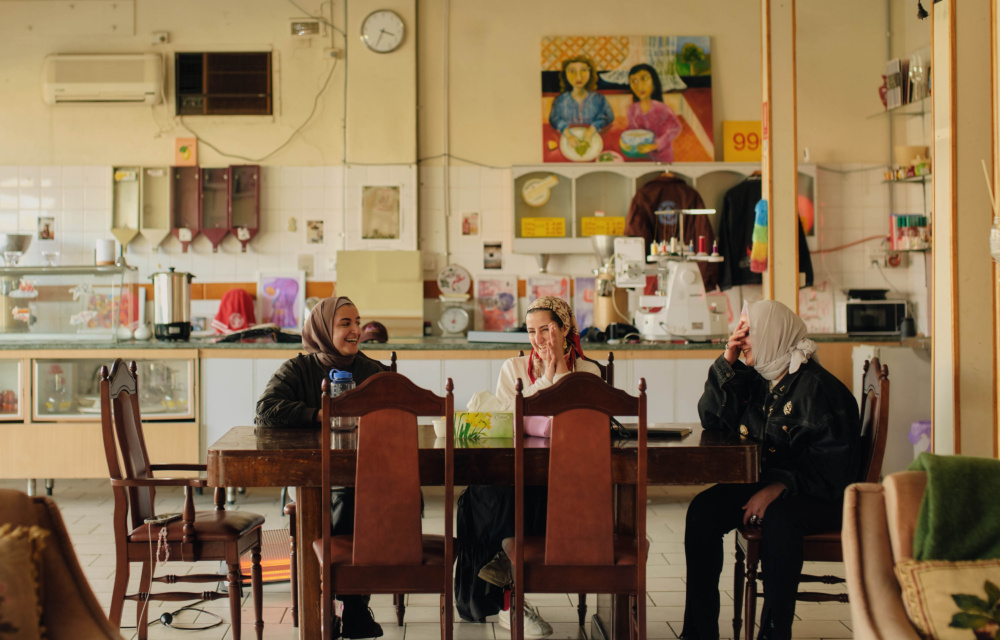
The El Samad sisters, Emina, Safa and, Fatima.
The Great Book Return.
Visitors are invited to browse, settle in and read the ever evolving literary archive filled with books an artworks by Lebanese, Palestinian, Syrian and First Nations authors and artists.
Safa’s embroidery.
An embroidery buffet.
From behind the old deli counter, Safa embroiders hats, garments and artworks with Arabic lettering and distinctive motifs.
Samples of Safa’s work.
Dukkana is run out of the El Samad sisters’ father’s former Lebanese grocery store.
At first glance, Dukkana looks like any other Middle Eastern food store in Coburg. The old coffee grinders are still perched on high shelves and behind the deli counter, a familiar scent of mint tea drifts through the air.
But this isn’t your average local store, and this is no ordinary family business.
Dukkana is a pop-up shop and community space led by three sisters — Safa, Emina and Fatima El Samad — in the building that once housed their father’s Lebanese grocery store, ‘Hassoon’s’.
After sitting empty for three years following the impact of Covid, the sisters persuaded their father to hand over the keys to the shop where they once spent their school holidays, and in early 2025, they opened Dukkana (derived from ‘corner store’ in Arabic).
‘Emina grew up working here. I didn’t make the cut because I didn’t want to be here. I complained the whole time,’ Safa laughs, remembering her short-lived stint behind the counter.
‘I never, ever thought that I would ever be back here!’
Yet Dukkana is a very different kind of store now. No longer selling coffee and groceries, this space offers something far less tangible, but deeply needed: connection, culture and community.
Each sister brings their own creative vision and skills to the project.
Safa, an artist with a fashion degree and a masters in architecture, has set up her embroidery machine behind the old deli counter. From here she embellishes hats, garments and artworks with Arabic lettering and distinctive graphic motifs, while brewing mint tea for visitors — ‘playing shop’ in the most joyful sense.
‘Even though I’m usually doing embroidery behind there, my favourite thing to do is make tea, and just offer hospitality,’ Safa says. ‘That comes from my family, and you know, it’s cultural.’
Emina, the eldest, is the archivist of the trio. A curator, teacher and meticulous documenter, she runs ‘The Great Book Return’ — an evolving literary archive filled with books and artwork by Lebanese, Palestinian, Syrian and First Nations authors and artists. Visitors are free to browse, settle in, and read.
‘The archive is a gift to the community,’ Emina explains. ‘There is no community, and no learning, without shared resources.’
Fatima, the youngest of the three, has a background in urban planning and local government and is the thinker behind Dukkana’s most powerful idea: the creation of a true ‘third space’.
‘We’re trying to create this third space — a free, semi-public space that is accessible to BIPOC and Middle Eastern people. It’s not just for one group. It’s open to anyone,’ she explains.
It’s this combination of art, archive and activism that gives Dukkana its quiet magic.
Events pop up organically: collage workshops, secondhand markets, film screenings, shared meals, even impromptu acupuncture sessions.
But, what makes Dukkana especially moving is its full-circle story. The space that once represented the grind of familial duty now symbolises freedom, creativity and self-determination.
The family business has been reimagined by the next generation, not for profit, but for community.
Their father, ever the pragmatic shopkeeper, still wonders when the coffee machine will be switched back on to make some money. But the sisters are gently shifting that narrative. As Safa puts it, ‘Our purpose isn’t to make money. It’s to offer something we felt was missing.’
In a time marked by global grief, disconnection, and displacement, Dukkana’s generosity feels rare and precious — a reminder that the most valuable spaces aren’t built to sell you something, they’re built for belonging.
For now, Dukkana remains a pop-up, but its impact is already lasting. The sisters hope to keep the space going this year, and if necessary, to find a new home for their vision in the future.
Whatever happens, the spirit of Dukkana won’t end here — the El Samad sisters are just getting started.
Dukkana
99-101 Harding Street,
Coburg, VIC