
How To Layer Plant Shapes To Create A Bountiful Flower Garden
Gardens
Jac Semmler.
I think of colour, shape and scale as the big-picture decisions you will make about the visual aesthetics of your garden.
These manifest in the plants you bring together. It’s where you can fully engage your imagination and where your personal preferences really come into play.
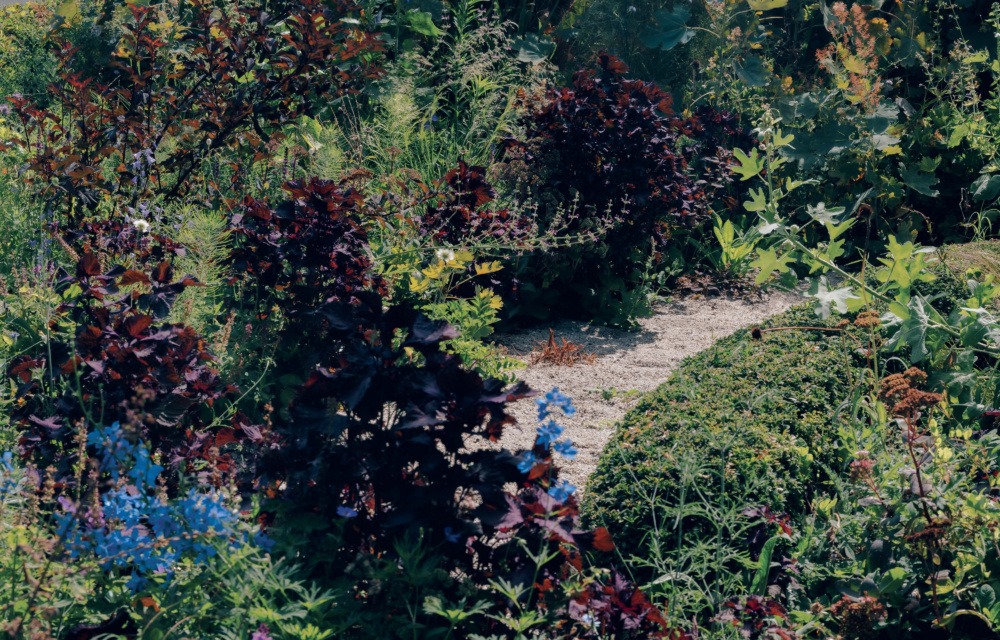
Shapes, their form and outline, are part of our spatial experience in the world. They help form the topography of a planting, provide visual texture, and inspire that hoped-for feeling within the garden. It is the interaction with similar and contrasting shapes that compose the garden overall.
Silver White cloud
Rosette of the deep foliage Mangave.
Mounds + Rounds
Mounding forms look like a slumped or half circle on the ground or a rounded ball in the air, whether naturally or through pruning. A mound or round shape can be a pause in a planting, a form that brings readability and easy-to-follow patterns for the human eye.
Plants with a rosette shape grow their leaves from a central point and spiral out from ground level. Eventually they form clumps and rise as they grow to make mounds over time.
Kangaroo paw.
Jerusalem sage rising upwards with its whorls.
Verticals + Uprights
Vertical and upright plants capture the eye, sending it skyward. With clear, readable definition, they can frame moments within a planting or function as exclamation points.
Some plants become vertical in form when they reach flowering stage, though not before when they are still at the foliage stage.
Good examples are the strong upright stems of a Kangaroo paw (Anigozanthos ‘Landscape Lilac’) or the flowers of a Pineapple lily or Hollyhock.
A light and see-through Grevillia.
Vanilla lily in gauzy wisps.
Wisps
One of my favourite shape outliers are wisps. Fanciful, free-spirited and far too organic in shape to be a strong vertical or upright, it’s a much looser form that angles upwards, gently weaving its way through neighbouring plants or meshing the visual foreground and background of planting with a degree of transparency.
The floating blood Dianthus.
Green Feather head.
Base Foliage + An Airy Bloom
Floating orbs
A plant form of delight! These layered beauties are known for their discrete basal growth at ground level, where the vegetation remains close to the ground as the plant grows.
These are plants that have mass of foliage separate to the bloom held finely aloft on the plant. There is a visible difference between the bulk of a plant’s form and the visible flower above so that the flower is the colourful floating pinnacle. While they are uprights at certain times, the stems – as in the case of Eryngium and Coneflower – are often hardly visible, giving the impression that the flower is hovering like a small cloud above the planting.
They can also have ‘naked stems’, where a flower stem emerges and blooms without visible foliage.
Gauzy transparents
The thin stem of the flower stalk heads upwards, barely visible in the planting, and the flowering creates a gauzy cloud from a cluster of blooms.
These plants differ in the visibility of their flower stem and proportion of wonder at the flowering. This experience can extend to flowers that expand like a mist with a multitude of smaller flowers, such as Baby’s breath and Flax.
Their flowers catch their light in multiples, as do the finer, smaller seed heads of some grasses.
Salmon Species gladiolus arching up and away.
Freesia arching over their garden beds.
Arches + Diagonal Lines
This group of shapes is inclusive of singular diagonal plants that boldly arch without their corresponding symmetrical partner. If planted in a cluster or if naturalised over time a group of diagonals and arches will form (as in Gladioli salmoneus) as a collective.
The upside-down bell forms of the budding Podolepis.
The vase of the Artichoke.
Vases + Bells
Vases either expand in their form to meet the sky or slope downwards to meet the ground. They have a great accentuation in their plant shape, either in meeting or departing the ground, in comparison to mounds. There is a cone-like quality to the outline of both vases and bells, even when the foliage and stems are sparse.
Horizontals + Plateaus
Horizontal and plateau shapes follow the ground plane and extend across and along. These plants cover and coat the ground or the space above without a rounded dome.
Other plants can arise from this layer and be noticed, especially verticals and uprights and mounds and rounds.
How shapes interact:
By mixing and matching shapes, we can create compositions that highlight certain plants, meld them together or balance each other. A simple hand sketch or mud map can be a useful thing to play with here.
As you can see from the lines, squiggles, swoops, curves and circles superimposed over the image above, a layered combination of all these plant shapes will create a beautiful and interesting garden.
This is an edited extract from Flower Power by Jac Semmler, published by Thames & Hudson Australia, AUD$85.00.
Flower Power by Jac Semmler, published by Thames & Hudson Australia, AUD$85.00.