
Sound sculptures by yuri suzuki form social architecture
Yuri Suzuki‘s sound sculptures propose a simple yet radical idea: that collective life can be built through listening. Across his work, the horn appears as a recurring instrument, a flared tube that gathers sound at one end and releases it at the other. While its function is technical, in Suzuki’s hands it becomes social in order to carry voices across space and turn sound into a shared experience. The horn acts as a connector, a device that closes distance and brings people together through interaction, resonance and exchange.
The London-based artist and designer develops this approach through playful, interactive installations that unfold in public space. Working across airports, parks, plazas and museum forecourts in cities including Bangkok, Berlin, Shanghai, San Francisco and Singapore, his practice consistently centers on participation and collective use. Using materials such as powder-coated steel, aluminum and electronic components, Suzuki constructs sculptural systems that invite people to engage with one another, allowing sound to emerge as a trace of shared presence. Within this framework, his work reimagines how communities can form in the present, not as fixed ideals but as lived, audible encounters.
all images courtesy of Yuri Suzuki
Public art and furniture that connect communities
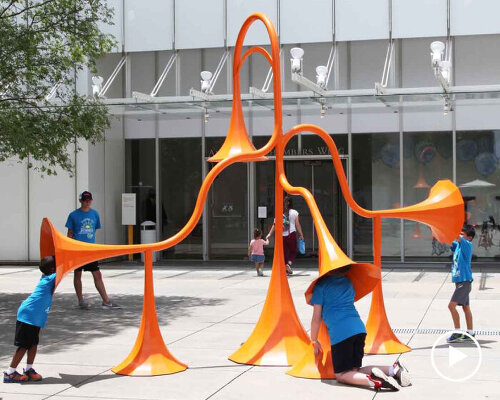
Horn as an interactive sound sculpture that connects communities carries the artist’s practice and ethos into every work. At the High Museum of Art in Atlanta, Yuri Suzuki creates Sonic Playground and places six steel sculptures in the outdoor Sifly Piazza, each one using pipes and horns to transport sound from one point to another. To hear the parabolic dish at its clearest, viewers have to find the exact spot, meaning they have to move, explore, adjust their position. It isn’t a passive listening experience, but a physical interaction with the sculpture, encouraging viewers to be active if they want to experience the experience.
Yuri Suzuki has also put up his sound sculpture in Berlin’s Potsdamer Platz, named Sonic Seating, where it functions as street furniture. It uses the colors of the U-Bahn and S-Bahn lines, the transit network that connected the city back together after division, and it sits in public space as a place to pause, listen, and make contact with the sounds the city is already producing. It listens to its environment and responds, and over time it became a landmark. That wasn’t planned for a sound sculpture as temporary as Yuri Suzuki’s intentions then. It happened organically upon discovering that a piece of public furniture that listens could create a valuable community gathering.
Interactive horns allow viewers to become active participants
Throughout his sound sculptures, Yuri Suzuki shows he’s not interested in sound as spectacle. He uses it as a form of evidence that sound, in different ways and kinds, can put people in the same space at once, interacting and communicating. His work allows a city to have a voice far from advertising or announcement; a language made up of words from different origins but meeting at once; a stranger’s voice, passed through a pipe, that can reach another one, who may be listening, and offer them temporary company.
In Bangkok, the artist crafts Metropolitan Symphony, a series of two sculptures in dialogue with each other: one in a new development district and one in front of the Wireless House, a communication hub in the region. Each sculpture captures ambient city noise and the voices of passersby, processes them through software, and transmits them back to the other. The two sculptures exchange sounds in real time, as if the new city and the old city hear each other, speaking back and forth through a system that runs continuously, without an operator, without a schedule.
Speaking of language, the artist has played with vowels and consonants, broken into their component sounds and distributed through standing horns. It’s called the Crowd Cloud, which fills the arrival hall of the Haneda Aiport in Tokyo, an installation on the phonemes of the Japanese language. The work, made in collaboration with Miyu Hosoi and commissioned under the curatorial direction of Paola Antonelli, uses lacquer and a visual language drawn from gold and black cloud paintings in Japanese art history. It sits in a space of transit and turns the moment of airport arrival into an invitation to listen to the Japanese phonemes that the horns carry.
Then there’s UTOOTO, Yuri Suzuki’s participatory sound sculpture where visitors build a city from modular sound structures. The name carries two meanings: the Japanese word for the state between waking and sleep, and the Okinawan prayer word utouto, which expresses reverence. The work hovers between those two registers, sacred and playful, serious and childlike. Visitors add elements to it, producing a soundscape of vowels and consonants drawn from many languages, similar to the idea of the Crowd Cloud.
It’s clear to see and hear that Yuri Suzuki’s horn sound sculptures form a communicative and social texture, that the sound of many voices, stripped of the specific meanings that divide them, finally find the pattern they share. Take UTOOTO, which draws from utopian architectural visions, especially from Walt Disney’s original concept for EPCOT, or the Experimental Prototype Community of Tomorrow.
It wasn’t a theme park, but a city, planned as a place where collaboration and design could shape a better way of living. However, Disney never built it, but at least, Yuri Suzuki created his own version of it. Through this work, he asks what it would look like to prototype a community that gathers and communicates through and in sounds. His sound sculptures can answer as the horn collects the sound, the pipe carries it, and the people on the ends listen and reply back. There’s an exchange, a transaction, repeated in voices and notes, consonants and words. In this way, the artist answers his own question at human scale, one sculpture at a time.
project info:
artist: Yuri Suzuki | @yurisuzukilondon
The post how yuri suzuki builds social architecture through sound sculptures and playful interaction appeared first on designboom | architecture & design magazine.