
lakeside Ashui Pavilion floats in hanoi
The Ashui Pavilion by H&P Architects sits beside a lake in Hanoi, shaping a curved timber-and-tile structure that draws the city’s attention back to water.
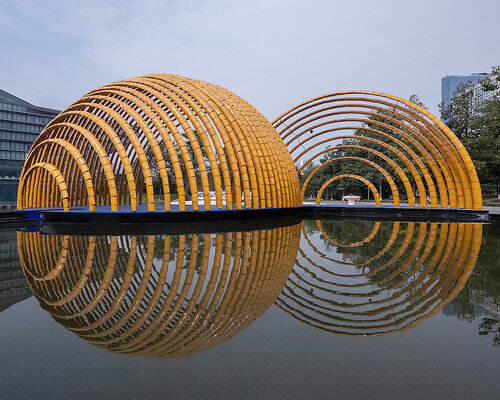
Hanoi’s landscape has shifted over decades, with lakes and canals giving way to paved surfaces. The pavilion responds to this condition by placing water at the center of its spatial experience. Set partly within a shallow basin, the structure meets the surface directly and allows reflections to double its presence and extend its geometry outward.
images © Le Minh Hoang
A structure formed through repetition
The team at H&P Architects shapes its Ashui Pavilion with a hemispherical volume composed of closely spaced ribs. These curved elements rise from a circular base and trace a continuous arc, creating a shell that feels both open and enclosed. From a distance, the structure reads as a complete dome; at close range, the gaps between members allow air, light, and movement to pass through.
Each rib is clad in small, golden glazed tiles. Their modular scale introduces a fine grain to the overall form, while their color shifts with the daylight. The repetition of these units gives the pavilion a steady rhythm, where the structure is understood through accumulation.
the Ashui Pavilion by H&P Architects sits at the edge of a lake in Hanoi
Material memory and environmental intent
The tiles reference bamboo joints, a familiar element in Vietnamese construction. Arranged along each rib, they suggest a continuous line that recalls both plant growth and the movement of water. This association links material choice to a broader environmental narrative, where the pavilion proposes a renewed attention to natural systems within the city.
Light enters through the gaps between the ribs and scatters across the blue platform below. As the sun moves, bands of shadow shift across the floor, creating a changing interior condition. The pavilion remains open to its surroundings, with views extending across the water and into the adjacent park.
the structure uses curved ribs to form a hemispherical open shell
the pavilion reflects across the water to imply a suspended orb
gaps between the ribs allow sunlight and air to pass through
golden glazed tiles wrap each rib to create a continuous textured surface
the tiles reference bamboo joints and connect the structure to local material culture
the project draws attention to the loss of water surfaces in Hanoi
project info:
name: The Source, Ashui Pavilion
architect: H&P Architects | @hp_architects
location: Hanoi, Vietnam
The post H&P architects forms arching, bamboo-like pavilion of glazed ceramic tiles in hanoi appeared first on designboom | architecture & design magazine.