
Star-Shaped Units Form a Self-Supporting Timber Structure
Astral Ascent is a site-specific installation that explores the relationship between geometry, structure, and spatial perception through a modular construction system. The project, designed by Yue Fei Zheng, draws on traditional timber joinery principles, reinterpreting mortise-tenon logic within a contemporary framework based on repetition and interlocking components.
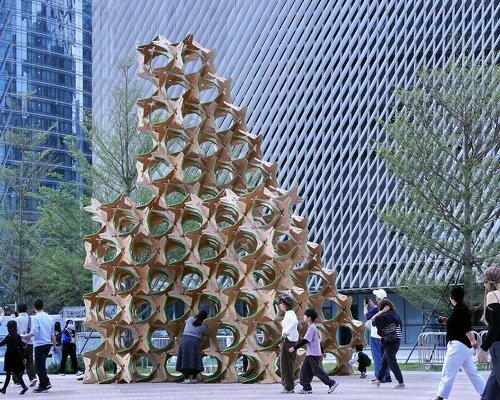
The installation is composed of more than 700 star-shaped modules fabricated from sustainable panels. Each unit is designed to function both as an individual geometric element and as a structural connector within the larger system. Using an adapted mortise-tenon approach, the components interlock without mechanical fasteners, forming a self-supporting assembly. This method extends the principles of traditional sunmao joinery into a multi-directional, modular configuration.
Assembled in layers, the units create a vertical structure that transitions from dense aggregation at the base to a more open configuration toward the top. This gradation establishes a spatial and visual shift from solidity to porosity, allowing the structure to be read as both mass and framework.
all images courtesy of Yue Fei Zheng
Shifting Light Reveals the Geometry of Solid and Void
The installation’s spatial experience is defined by the relationship between solid elements and voids. The star-shaped modules form the primary mass, while the spaces between them generate a secondary system of negative form. These voids vary in scale and orientation, changing in appearance as the viewer moves through and around the structure.
Light plays a key role in articulating this relationship. Sunlight passes through the openings, projecting shadows that register the geometry of the voids onto surrounding surfaces. This interaction introduces a temporal dimension, as shifting light conditions alter the perception of form throughout the day.
Materially, the project by designer Yue Fei Zheng emphasizes the natural qualities of its components. The use of sustainable panels with visible grain, cut marks, and exposed edges highlights the fabrication process. The installation also responds to site conditions, including light, airflow, and surrounding vegetation, integrating environmental factors into its spatial performance.
star-shaped modules assemble into a vertical spatial system
Through the combination of modular geometry, interlocking construction, and material expression, Astral Ascent examines how traditional building logic can be adapted into a contemporary system that operates without additional fasteners while maintaining structural and spatial coherence.
over 700 units form a self-supporting structure without fasteners
interlocking components reinterpret traditional mortise-tenon joinery
repetition generates a layered architectural framework
the structure shifts from solid mass to porous framework
voids emerge between modules, shaping spatial perception
movement reveals changing relationships between solids and voids
shadows trace the structure’s internal logic onto surfaces
openings vary in scale and orientation across the structure
sustainable panels retain visible grain and fabrication marks
exposed edges highlight the process of cutting and assembly
project info:
name: Astral Ascent
designer: Yue Fei Zheng
designboom has received this project from our DIY submissions feature, where we welcome our readers to submit their own work for publication. see more project submissions from our readers here.
edited by: christina vergopoulou | designboom
The post hundreds of interlocking star modules build a porous timber installation appeared first on designboom | architecture & design magazine.