
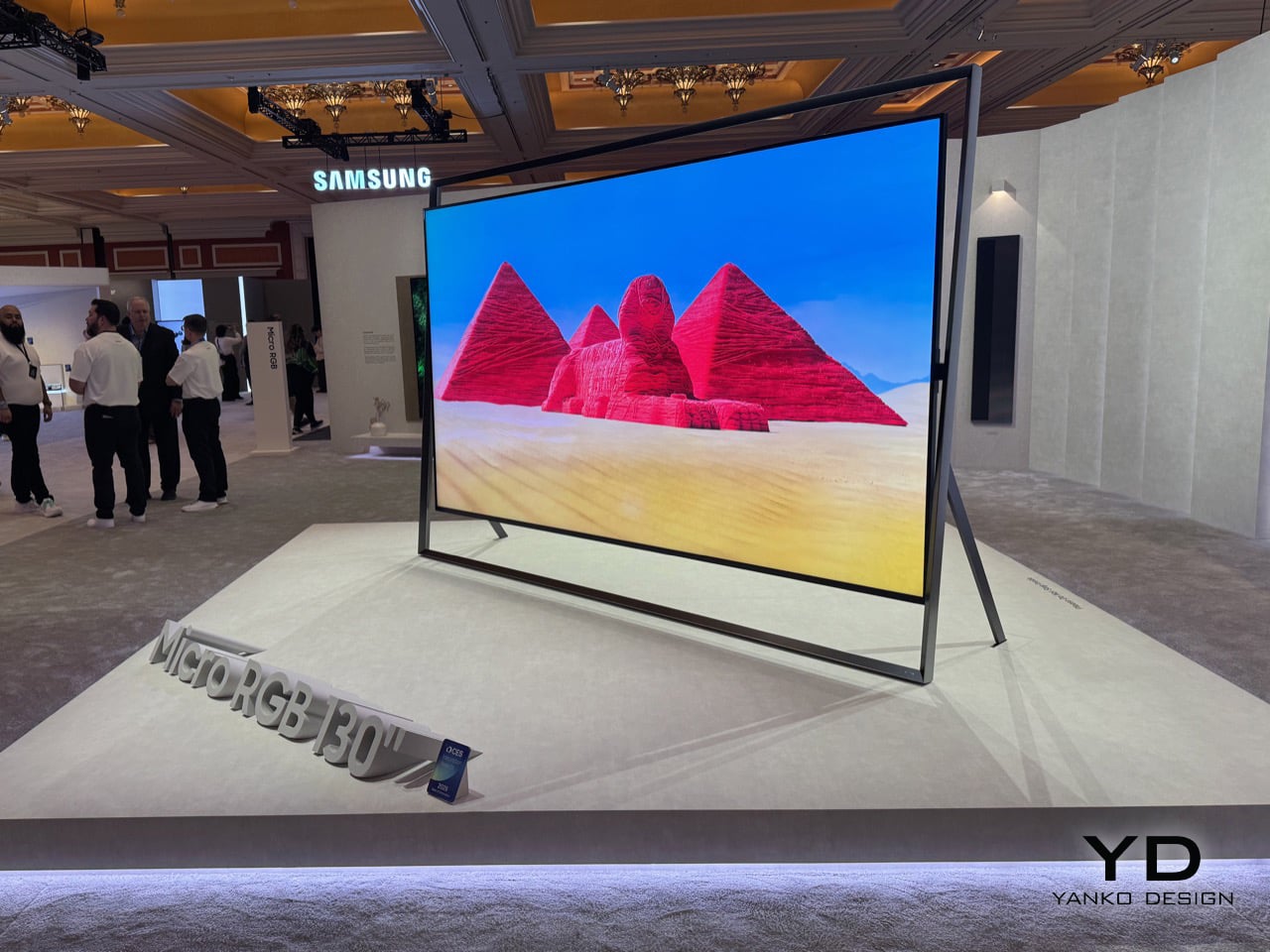
A television spanning 130 inches diagonally creates immediate questions about physics, aesthetics, and whether something this massive can exist as anything other than spectacle. Samsung’s answer at CES 2026 involves treating the R95H Micro RGB model as architecture rather than appliances, borrowing design language from gallery easels and luxury retail interiors to create what the company describes as an “extra-large window” that transforms room perception. The display sits on angular metal supports that create a triangular footprint, making the enormous panel appear suspended rather than heavily grounded. At just 35.7mm thick based on Samsung’s technical specifications, the screen maintains a profile impossibly slim for something measuring nearly 11 feet corner to corner.
Samsung revived its Timeless Frame concept from 2013, refining the original bold outlines into thinner borders that house integrated audio components while maintaining visual distinctiveness. The frame contains Samsung’s Eclipsa Audio system, solving the practical challenge of speaker placement for ultra-large displays while preserving the aesthetic of a unified object. When wall-mounted, the frame’s lower edge meets the floor rather than floating at eye level, reinforcing the window metaphor while distributing the weight more safely than traditional TV mounting. The Glare-Free coating becomes essential at this scale, preventing the massive reflective surface from mirroring the room and destroying contrast.
Designer: Samsung
The “Micro RGB” name is the key to the great visuals. Instead of using a standard white or blue backlight and then filtering it through quantum dots and color filters, this panel uses microscopic, individual red, green, and blue LEDs as the light source. This means color is generated directly at the source, which is a fundamentally cleaner way to do things. It’s how they are hitting that claimed 100% BT.2020 color gamut, a spec that display nerds have been chasing for years. This direct emission approach eliminates multiple layers of conversion that can introduce impurities and reduce color volume, resulting in purer, more vibrant hues that pop off the screen with an almost unnatural vivacity.
Of course, the easel stand, while gorgeous, demands a colossal footprint. You aren’t tucking this into a corner of your apartment; you are designing a room around it. The angular legs extend far from the screen to keep the whole assembly stable, meaning it occupies a significant amount of floor space both in front of and behind the panel. This is a television for lofts, galleries, and homes with minimalist, open-plan layouts where it can be appreciated as a sculptural object. The alternative wall-mount option, which has the base of the TV resting on the floor, is equally bold. It is a deliberate choice that forces you to treat the display as a permanent architectural feature, a commitment that most people are not prepared to make for a piece of technology.
Ultimately, this 130-inch beast is Samsung planting its flag. With OLED technology becoming the benchmark for contrast and black levels, Samsung needed a halo product to prove that its LCD-based technologies could still lead the pack in other areas, specifically color volume and peak brightness. The R95H is a brute-force demonstration of engineering prowess, a statement piece that screams technological dominance. While very few people will ever own this specific model, the underlying Micro RGB technology is the real takeaway. We will see this tech trickle down to more mainstream sizes like 55, 65, and 75-inch models in the near future, which means the advancements in color purity we see here will eventually land in living rooms that don’t require a special permit for delivery.
It is an absurdly beautiful, and almost certainly astronomically expensive piece of hardware. And that is precisely what makes it so fascinating. It pushes back against the trend of electronics trying to be invisible and instead makes the television a focal point of design and conversation. It’s a beautiful object that forces us to reconsider how a screen can interact with a physical space, moving it from an appliance to a piece of deliberate, functional art, sort of like the Serif TV, but on a much grander scale.
The post I saw Samsung’s 130‑inch Micro RGB easel TV at CES 2026 and now regular screens feel tiny first appeared on Yanko Design.