
A Transitional Structure opens at Limbo Museum
The Limbo Museum opens an architectural installation in Accra, Ghana, reinterpreting the traditional Japanese porch, or ‘engawa’. The project was developed in partnership with New York-based art center Art Omi and designed by TAELON7 under the direction of architect Juergen Benson-Strohmayer.
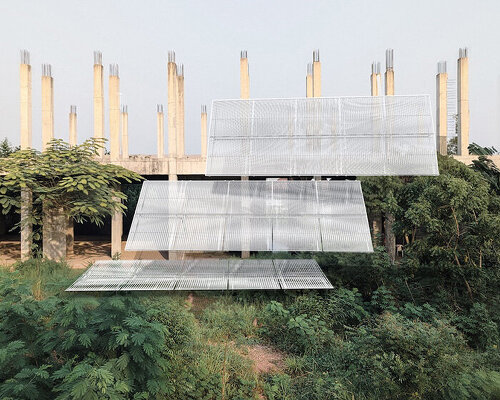
Set within the skeletal concrete frame that houses Limbo Museum, which opened in November 2025, the project introduces a series of lightweight woven structures that reshape the unfinished building into a space for gathering. The intervention operates within a space that remains open to the elements, where columns and slabs outline rooms yet the surrounding landscape remains present.
Limbo Engawa brings a woven intervention to the Limbo Museum in Accra | images courtesy TAELON7
reworking the concept of ‘engawa’ in accra
With this installation for the Limbo Museum, the team at TAELON7 draws from the Japanese concept of engawa, a transitional zone that mediates interior space and the outdoors. In residential architecture, this threshold supports informal social life, providing a place to sit, pause, and observe the environment beyond the house.
In the context of the Accra museum, the installation translates that spatial idea into a modular architectural system. Steel profiles form rectangular frames that hold woven strips cut from salvaged billboard material. The panels create surfaces that filter light and air while maintaining visual connection with the cultivated ground all around.
steel frames and salvaged billboard strips form modular elements for gathering
Working Within an Unfinished Structure
Limbo Engawa occupies a concrete structure in Accra left deliberately incomplete. Floors and columns define a framework that remains open on all sides, allowing vegetation, air, and sound to move through the building. The installation works with this condition by positioning its woven elements between columns and along walkways.
At a human scale, the structures create areas for sitting, conversation, and rest. Their woven skins cast patterned shadows across the concrete surfaces during the day. As visitors move through the building, the installation guides movement across shaded thresholds and open areas where the surrounding landscape comes into view.
The use of salvaged billboard strips bring textures drawn from Accra’s urban environment. Once cut into narrow bands, the material becomes flexible and durable, so that it can be woven across the steel frames. The method recalls everyday building practices found across construction sites and informal structures throughout the region.
the installation draws from the Japanese spatial concept of engawa
A Project Between Accra and New York
Limbo Engawa forms the first chapter of a two-part architectural commission that moves between Ghana and the United States. While the Accra installation operates inside an unfinished building, the same structural system will appear later this year at Art Omi in Ghent, New York. There, the modular components will reconfigure into a freestanding pavilion positioned within open fields.
section perspective, courtesy TAELON7
project info:
name: Limbo Engawa
architect: TAELON7 | @taelon7_
location: Accra, Ghana
museum: Limbo Museum | @limbomuseum
collaborator: Art Omi | @art_omi
dates: March 12th — April 12th, 2026
photography: © courtesy TAELON7
The post inspired by the japanese engawa, a new installation opens at accra’s limbo museum appeared first on designboom | architecture & design magazine.