
Editor’s Note: In the aftermath of yesterday’s horrific and senseless shooting in Minneapolis, questions of motive and meaning once again dominate the public conversation. This essay looks beyond the headlines to examine the quieter, more pervasive roots of cruelty—how it first appears, how it is normalized, and how the logic of “why not?” can grow from a childhood impulse into something far more dangerous.
In each playground there was one child — usually a boy, but not always — who enjoyed passing his after-school hours by dismembering Daddy Longlegs (Daddys Longleg?) one leg at a time, just because he could. This was the same child who discovered that if you captured an insect and held it under a magnifying lens in the sun, it would slowly burn to death, eventually bursting into flame. I’m thinking in these two cases of a specific child, who, when I close my age-hobbled eyes, I can still see clearly. I was horrified by his actions — most of us were, except for those few who, recognizing his burgeoning psychopathic tendencies, decided that it would be safer for them to befriend him and become part of his posse.
Finally, one day I asked him: Why? Why are you doing this? He had a two-word, simple answer: Why not?
I was mystified; it made no sense to me. I had certainly been bullied to an extreme as a child, but this was different. Five years after I told my grandmother what was happening, this kid tried to land a job walking my eighty-pound Airedale. My grandmother said no. After the spiders, she said, there would likely be mice. Then cats. Then dogs. And then people.
My grandmother was smart and a good judge of character, and she was right. I don’t know if he harmed small animals — we certainly didn’t let him anywhere near our pets — but eventually, he took to standing on a Grand Central Parkway overpass not far from where we lived and dropping heavy, fist-sized rocks onto the windshields of oncoming cars. He was eventually caught by the cops, and they asked him why he was doing it. Why not? he said. He was a preteen, so the police released him to his parents with a warning: if it happened again, he was going to end up in what we used to call juvy.
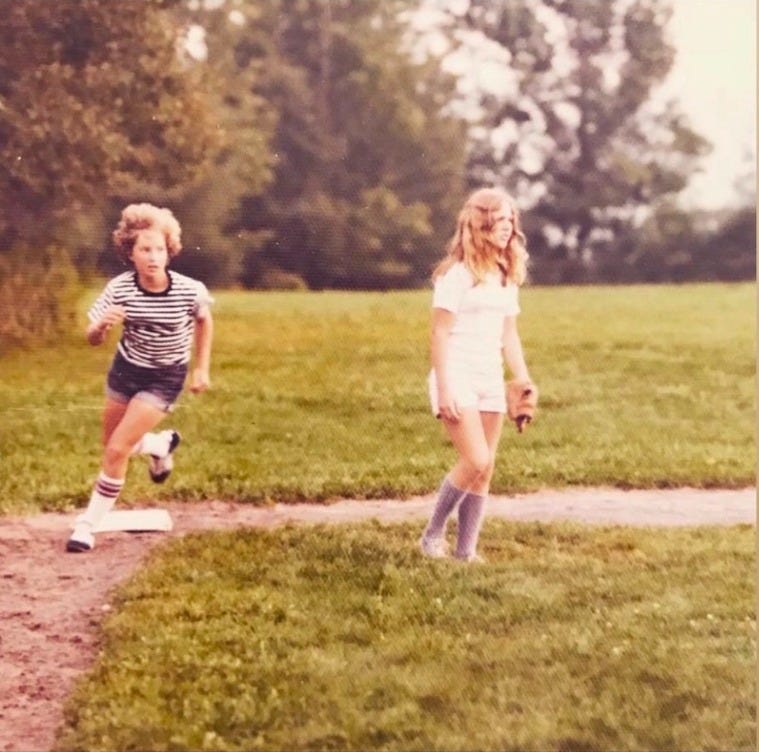
Two weeks later, she tripped me. Just because. 1975
The girls who did this kind of thing were less inclined to be impersonal about it; I remember being in sleepaway camp in 1975 and running the 440 during a track meet. I was struggling hard to pace myself, and really concentrating — I’m not a natural runner — and as I came down the last straightaway, on the inside and in the lead, a kid from my group who was standing off to the side of the track stuck her foot out in front of me. I don’t remember much more than a counselor running over to see if I was okay, and then walking me to the infirmary, where I spent an hour having the camp nurse remove bits of gravel from my bloodied knees with a pair of tweezers.
Why did you do it? this girl was asked by the head counselor.
Why not? she shrugged, adding, It was fun.
We were both twelve years old.
What I am getting at here: the inclination to commit acts of cruelty just because. To harm others just for the hell of it. To commit these acts at all seems completely antithetical to human nature and instinct, although it is here that my friends in the clergy tell me I’m wrong. It’s just another version of hell, they say, to live with a brain that commands you to intentionally harm others. And this is the definition of cruelty: the intentional infliction of suffering or the inaction towards another’s suffering when a clear remedy is readily available. But do those who commit cruelty even bother to look for that clear remedy? Or is the dopamine hit that comes with a sadistic act so strong that it simply overrides everything, not only removing any control over it but enticing the cruel to just keep going, to want more and more, in the way that some of us just can’t stop after the first drink? Years ago, in the days of my heavy wine imbibing, I would turn into someone else after the third glass. My wife described me as a dog with a bone. I had inherited my father’s temper. After what began as a pleasant evening with a bottle of wine or two, there would be a shift. I’d pick a fight with her and pick and pick and pick until she fled the house in tears. One day she said to me You can be incredibly cruel when you drink too much. The person I love more than anyone else in the world held a mirror up to me, and I hated, truly hated, what I’d become. Stopping has been a large part of this final third of my life. Chemical-induced rage and cruelty and I are no longer on speaking terms.
We are all, every one of us, at risk of it; it’s our job to recognize it, to realize it, to halt it. People who like to fight, to argue, to engage in emotional sadism because it hits a dopamine target: this is also cruelty, with its roots in the soil of unfinished business. It was Vivian Gornick who said we need to see the loneliness of the monster and the cunning of the innocent. That’s because it exists in every one of us, to a lesser or greater degree; the greater the degree, the more likely the tip-over into psychopathology.
Is cruelty addictive? Did the man I once saw in a schoolyard on West Houston Street and Sixth Avenue, beating his sweet young Chocolate Lab with a leather leash, not stop because he couldn’t, or because he wouldn’t, not even after I screamed at him, yelled to the fucker that I was calling the police, and a crowd of angry New Yorkers gathered around me, some trying to climb the chain link fence to get to him, and the man just didn’t seem to care?
Cruelty is surprisingly complicated; there are certainly neurochemicals involved. Young children are often the recipients of cruelty at the hands of their parents or teachers in an effort to impart some sort of lesson of the This hurts me more than it hurts you variety. But there’s always a moment when a master switch is flipped, and it ceases to be about the lesson, and just becomes about control and punishment and the funneling of unbridled rage that has nothing to do with the recipient. When I was still in single digits, I said or did something that annoyed my father, who at times could be prone to both psychological and physical violence, and instead of sitting me down and having a conversation about it, he didn’t talk to me for a week. I was not yet ten years old. First, I thought it was my imagination. And then I realized it wasn’t, and he was waiting for me to beg forgiveness, warranted or otherwise, just to hear him say my name. It resulted in a lifetime of being so attuned to the behavior of others that I’ve been convinced that if only I were this instead of that, I wouldn’t have made them so angry.
(A lot of therapy.)
There are points in time when entire communities engage in cruelty because it’s sanctioned. It’s official. It’s approved and rewarded:
In March 1968, when US Army C Company tortured and executed an entire unarmed village of South Vietnamese civilians, they did so because they believed their actions were sanctioned by the US government. Someone told them in words or deeds that they need to do THIS regardless of what THIS is, and cruelty and its execution, having been successful, will be rewarded. Lieutenant William Calley, who was found guilty of murdering twenty-two Vietnamese civilians, was given a life sentence; he served minimal time, and his sentence was commuted to three years by President Nixon, who was reported to have said to Henry Kissinger that no one gave a shit whether he killed those people or not. (For more on this, see the incredible documentary, Cover-Up, about the investigative reporter Seymour Hersh.)
Shoot your puppy? Get rewarded with the job of Homeland Security Director.
Let a woman bleed to death because of an abortion ban that prevents her from getting any help? Oh well: just following orders.
Force an eighty-year-old farmer to march into the forest outside her town and dig her own grave with her family and neighbors? Sanctioned and approved mass murder committed by a formerly art-and-music-loving modern society looking for a scapegoat. What they did to my great grandmother in 1942 was not against the law; it was the law, like letting that young woman in Texas bleed to death.
What is it that moves people to such abject cruelty? Never mind the kid with the spiders, or the girl who tripped me just because, or even my father deciding that not talking to me was a smart thing to do to a nine year old to teach them a lesson. Can entire cultures and populations become psychopathic? Yes; I believe they can.
There’s an old expression: there is nothing more dangerous than an NPD who is out of options. He (or she) will commit to distraction. He or she will organize a community that will get behind him or her, no matter what; more distraction. This party of the cruel will make it their job to follow the orders of a person who likely once was that kid in the schoolyard torturing spiders and dropping rocks on oncoming cars, no matter how outlandish, outrageous, and inhuman those orders are.
What is the answer to this? How to deal with it? And now I’ll sound like a message on a coffee mug or a T-shirt: Be kind. Relentlessly. Impossibly. And if you can’t be kind, be patient. And if you can’t be either of those things, walk away and do the only thing that is left to do: preserve your humanity.
This post was originally published on Elissa Altman’s blog Poor Man’s Feast, The James Beard Award-winning journal about the intersection of food, spirit, and the families that drive you crazy. Read more on her Substack, or keep up with her archives here.
Image courtesy of the author.
The post Is Cruelty Addictive? appeared first on PRINT Magazine.