
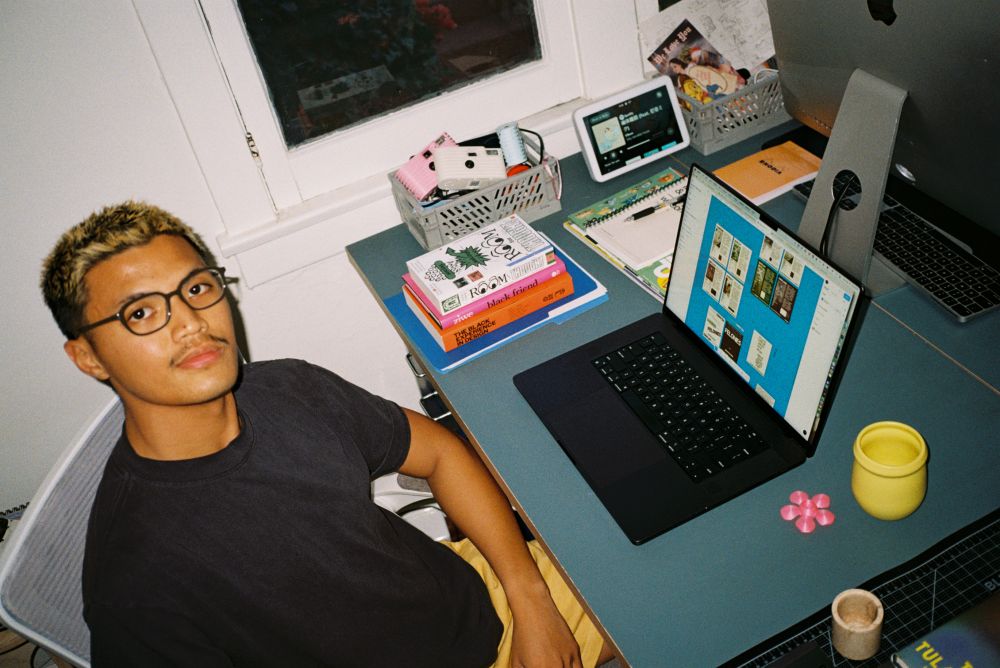
Not to be hyperbolic, but I do believe Los Angeles born and based graphic designer and culture critic Andrei James Dominiq represents the next wave of designers who will save us.
Working under the moniker James Junk, Dominiq found his voice as a graphic designer and culture writer during the height of COVID when he was sent home from college for lockdown. Before this creative awakening, he felt directionless, not unlike many college kids figuring it out.
“I didn’t grow up thinking I’d become a designer, or even any kind of creative,” he tells me. “Call me ignorant, but the creative field was much too murky for me to dive into. It was never even a thought.” So he flitted around from major to major, taste-testing each one to see what stuck. “I majored in anthropology first but then I quickly realized, no offense to anthropologists, but I don’t think we need more of those right now. I feel like we’ve got that covered.”
Dominiq tried marketing next, which is where he first dipped his toe in the graphic design waters. But while holed up at home during COVID, that sense of ennui crept back in and a profound feeling of disconnection. “I woke up one day and was like, nothing that I’m doing is making me happy. I was like, Girl, what are you doing?” he says. “Also, life was feeling so short because people were dying, literally dying. And I was like, Holy shit, I have to do something. So I started writing notes about life. I realized that’s what I was missing; I didn’t have an outlet. So that was my COVID hobby: spiraling into my Notes app. And then I had the urge to share it.”
Dominiq started posting his Notes-app thoughts, designing the infographics with his base-level Illustrator knowledge. “It became this visual way of getting my feelings and thoughts out that had been in me, but I’d just never let out before. That’s when I started being a more introspective person.”
This practice scratched that creative itch for Dominiq, and provided a much-needed routine and structure for him during COVID. He then parlayed this hobby into working for Impact, a Gen Z-led media brand. “It focuses on social issues, so basically I was designing carousels about shit we should all care about,” he said. “A lot of my work for Impact involved designing visuals around civic engagement, social awareness, and environmental justice. Being part of that showed me that design can be a tool for participating in in culture and conversations, and not just necessarily making things look good. It’s never enough that something looks cute, it has to be functional. To me, it’s like, Why are we making this? The the fact that I was able to channel that energy for Impact made me feel like I had a purpose. Purpose is probably the most important thing in my creative practice and in my life.”
Design can be a tool for participating in in culture and conversations, and not just necessarily making things look good.
The work Dominiq did at Impact was affirming and empowering, indicating to him that he was finally on the right path. Since then, he’s honed his design eye to develop a personal style that’s graphic, vibrant, and direct, often referencing old-school internet aesthetics.
“I like bold colors, I like retro influences, I like personality in anything that I make. But more than style, there’s a point of view in what I make,” he explains. “Obviously your point of view can’t be in everything that you make for every client that you work with; that’s okay, that’s just part of being in this industry. But that’s also why it’s important for me to have my own playtime, which is the stuff that I post on my Instagram account. Sometimes it’ll be little essays of what I’m thinking about that I turn into a carousel. That tickles my urge to write about what I’m thinking, and also design something to make it presentable and cute. It’s not for anybody but myself. Anything that I post on my account is like a gift to myself.”
When it comes to his client work, Dominiq is adamant that this sense of purpose remains his guide. “I will work on any project as long as the project has the same values that I have,” he says. “Maybe it’s social impact, maybe it’s educational, maybe it’s sustainability. I worked with the brand Fotofoto, for example, which are disposable cameras that are 100% made from up-cycled materials. It’s stuff like that that really excites me. The constant through-line with my projects is that they’re culturally placed and have the intention not to just to look cute but to be useful too.”
Action and community are pillars of Dominiq’s practice, especially when it comes to his own online design persona, James Junk. “I don’t really think of my followers as followers, they’re my friends. I talk to them like they’re my friends because we’re all in this together,” he says. “My account isn’t a design influencer account. It’s a design diary account maybe? That sounds corny.” A byproduct of Dominiq’s viral success has certainly been working with brands and promoting design tools on his account, but that’s still far from his focus. “That’s not what that account is for. It’s not to share products, it’s to share out my ideas about the world.”
“My account isn’t a design influencer account. It’s a design diary account maybe? That sounds corny.”
While Dominiq isn’t an intentional influencer per se, he’s almost accidentally fallen into being a voice people turn to for thoughtful analysis on the modern-day design landscape. “I’m not purporting myself to be somebody who’s like, God’s great gift to graphic design, identity, and culture,” he says, but as a hyper-online Gen Z graphic designer who is still able to retain a clear moral code and purpose, Dominiq’s criticism feels important and holistic.
When asked where he gets his ideas for these videos and essays, he tells me they come from noticing things that piss him off. “I wrote about documenting work and showing works in progress last month because it was pissing off how much work-in-progress content is being posted,” he explains. “I don’t judge people for what they post, it’s their account; your body, your choice, girl. But a lot of what I write about is out of concern and aggravation at how there’s like a lack of discernment. We live in a world where information is everywhere, and we have so much access to it, but nobody taught us how how to question things.”
“A lot of my criticism is that everything is being posted, and everything is being made into content or consumption,” he continues. “And I understand we’re all cogs in the wheel of capitalism; it’s not our fault that we were born in this stage of capitalism where everything is a product, even ourselves. But a lot of my commentary comes from, Let’s go back! Let’s go back to how our ancestors did it. How did they commune? How did they think? They were so simple and happy. Our lives are so complicated, and that’s what’s making us so unhappy in so many ways. We’re so focused on next, more, everything, and it’s like, can we calm down?”
We’re so focused on next, more, everything, and it’s like, can we calm down?”
As someone on the inside navigating all of this personally and professionally, Dominiq has the perfect vantage point from the font lines to synthesize these issues. Coming of age online and during COVID is a uniquely Gen Z experience that has indelibly shaped his understanding of making it as a modern-day artist. “The internet and social media function on repetition and predicability,” he explains, “but as creatives, it’s inherent for us to be exploring and experimenting all the time with different shit, right? So what does it do to our creative habits and intentions and and actions when only one thing from our creative practice ‘works’ on social media? And social media is the thing that gets us clients, gets us attention, gets us dopamine hits? We all become like monkeys, dancing to the same tune because that’s what gets us coins. And you can’t really blame this crop of social content creators because that’s just how it works. But at what cost?”
The wise-beyond-his-years Dominiq is the first to admit these ideas are messy and complicated, but that’s what makes them all the more worth dissecting. “The dream as an artist is to pay your damn bills and to make a living, right? And Instagram has made that possible, and I’m part of that!” he says. “But I think back to the discernment. It’s about knowing yourself.”
The post James Junk is the Voice Design Needs Now appeared first on PRINT Magazine.