
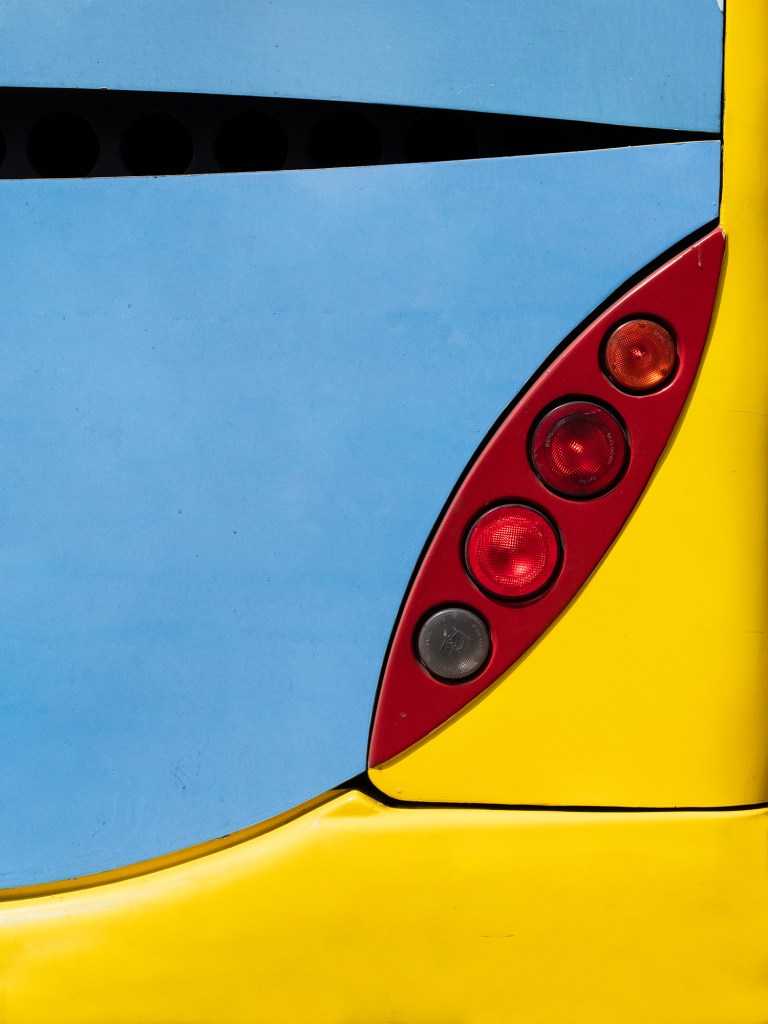
I still feel a bit like a tourist in the city. That feeling allows me to maintain a sense of wonder about things that routine usually makes disappear. Trying not to lose that sense of wonder is fundamental in photographic practice.
My favorite artists are those who find something worth their attention in the unexpected. They see potential where the rest of us don’t, and then frame it within their practice so that we suddenly see it too. This is the essence of street photography, and why I love it so dearly; photographers capturing the mundane and suddenly making it beautiful. Buenos Aires based photographer José De Rocco is a master at this art form, patrolling the streets of the city on his commute and creating graphic vignettes where others would find nothing.
This skill of De Rocco’s is flexed no better than in his “bondi” photo series, in which he takes tightly cropped photos of the backs of the buses in Buenos Aires (called bondi). He then digitally removes all of the ads, signage, and other additional markings from the image, so just the composition of the bus itself remains. The finished products become satisfying explorations of shape and color that are still identifiable as buses, yet simultaneously exist as standalone images.
De Rocco expounds upon this series and his photography practice below, his responses edited lightly for clarity and length.
When did you first start taking photos? What made you pick up a camera in the first place?
I started with a conscious search around 2007 or so. I say “conscious search” because even before that, I carried a small camera with me all the time, even when I went out with friends.
But I remember a photographer friend, Diego Medina, showed me some photos he was taking and I became hooked. I had this strong feeling that I wanted to run out and do the same thing. In some way, I needed to replicate it. This is something that still happens to me when I see works that move me: I immediately want to go out and take photographs in that style.
This was also reinforced by a practice I carried out for several years. It came from seeing in museums how art students stand in front of paintings by masters like Velázquez, Goya, and Rembrandt and literally copy the work. When I saw that, I thought: Why not do the same with my photographic practice? Take the photographers who interest me as references and copy them, or rather, try to. Study their images and go out to replicate them. Think about how they see, what they see, where they stand when making a shot, maybe even what equipment they use, and based on that, make my own photographs.
Even if the intention is to copy something, the images end up having my own imprint because not only am I an individual, but I also exist in a different set of coordinates in the world than the references. That approach not only opened up a wide field in terms of my way of seeing, but it also strengthened my interest in art history in general, and in the history of photography in particular.
What is your typical photographic process like? Where do you usually find inspiration, and what kinds of images or scenes attract your attention?
My photographic process is one of daily production. I’m someone who carries a backpack with a camera everywhere I go. That always allows me to have more material, more possibilities, more variety, and more fun.
From that material that accumulates over the years, ideas emerge; thematic lines that I pursue in parallel. Sometimes I get more excited about one and focus on it for a while, then I let it rest and move on to another idea that has been circulating in the background. And alongside all that, I always allow myself to make images without a prior idea. This is what really shaped this process that works for me and keeps me entertained at the same time.
I’m someone who carries a backpack with a camera everywhere I go. That always allows me to have more material, more possibilities, more variety, and more fun.
It seems like city streets are a constant source of inspiration for you. Can you explain what attracts you so much about urban life and the streets in your work?
I’m attracted to the urban environment because it’s where I move through every day. To get to my job, I have to pass through those spaces full of visual stimuli. But those stimuli are everywhere; what interests me most is creating images wherever I am. I move through urban spaces a lot, but if I had to stay at home for a long period of time, I would still take photographs.
I’m reminded of the book Stems by Lee Friedlander, whom many people quickly associate with urban photography. But of course, he’s someone who photographs everything, all the time. That book came out during a period when, after a leg operation I believe, he couldn’t leave his house for a while, and he ended up making a series of photographs of flower stems in vases. It’s a beautiful book.
It doesn’t matter where or what, what matters is how.
Why did you start photographing the backs of buses? What attracted you to them?
I started several years ago, during a period when my photographic interests were strongly influenced by geometry and color, and by the idea of including very few objects in the image. Over time, that idea changed radically, and the intention of cleaning up the image evolved into making it as complex as possible.
At that time, I got this idea to photograph bondis, as we call urban buses in Buenos Aires. The seed of the idea came from a school bus. School buses here are orange, and they don’t have as much information printed on their surfaces as public transit buses. When I photographed the school bus, I found an attractive design, clean and very striking. But the problem came when I tried to replicate that photograph with other buses. There was too much information competing and saturating the image: advertisements, informational text, line numbers, internal fleet numbers, and so on. Since my main idea was to highlight the base design of the buses, I decided to digitally remove any information that wasn’t purely part of that design.
This work was forgotten for several years, but last year I decided to post it on Instagram and it had a response I really didn’t expect. That push made me want to resume the project, and here we are with new things emerging (like this interview, for example!) and if everything goes well, the possibility of a photo book publication this year.
What makes the aesthetic of bondi so distinctive and striking to you?
I’ve lived and worked in Buenos Aires for 23 years, and even though that’s a long time, I still feel a bit like a tourist in the city. (I’m originally from Pinamar, a coastal city in the province of Buenos Aires.) That feeling allows me to maintain a sense of wonder about things that routine usually makes disappear. Trying not to lose that sense of wonder is fundamental in photographic practice.
The particularity of the buses has several facets. On the one hand, there is the purely visual aspect. The framing I use and the “cleaning” I apply to the image transforms something functional into something close to geometric abstraction. Not only do I find that attractive, but I’m also interested in how something can be taken out of context with a simple idea.
On the other hand, there is an emotional dimension. There is a certain attachment to specific bus lines that one feels as part of life, because they naturally accompany us in our daily activities, routes, and experiences. (It’s worth mentioning that here each bus line has its own design, and there can even be different designs within the same line.) There are moments in life when one uses a particular line a lot and develops a kind of bond with it. From that comes a nostalgia for the bondi and for certain lines in particular.
There is also a social dimension. Public transportation is mostly used by working people. We cross paths with others who live experiences similar to ours, people who feel the city not necessarily from a place of enjoyment, but often from one of subsistence.
And finally, and most importantly, the urban landscape of the city would not be the same without the presence of the buses. Those patches of color moving through the streets are a signature mark.
The post José De Rocco Brings New Meaning to “Street” Photography with a Unique Eye for the Everyday appeared first on PRINT Magazine.