
I’m a challenge to buy gifts for, according to my family and friends. However, a compelling book, whether a novel or an art tome, is always a sure bet. I’ve been known to hint at titles I’d enjoy, but I’m sure to act utterly surprised, with tears of joy, when unwrapping them.
If you need a little inspiration for hard-to-gift loved ones, I’ve reflected below on memorable books I’ve received and continue to treasure.
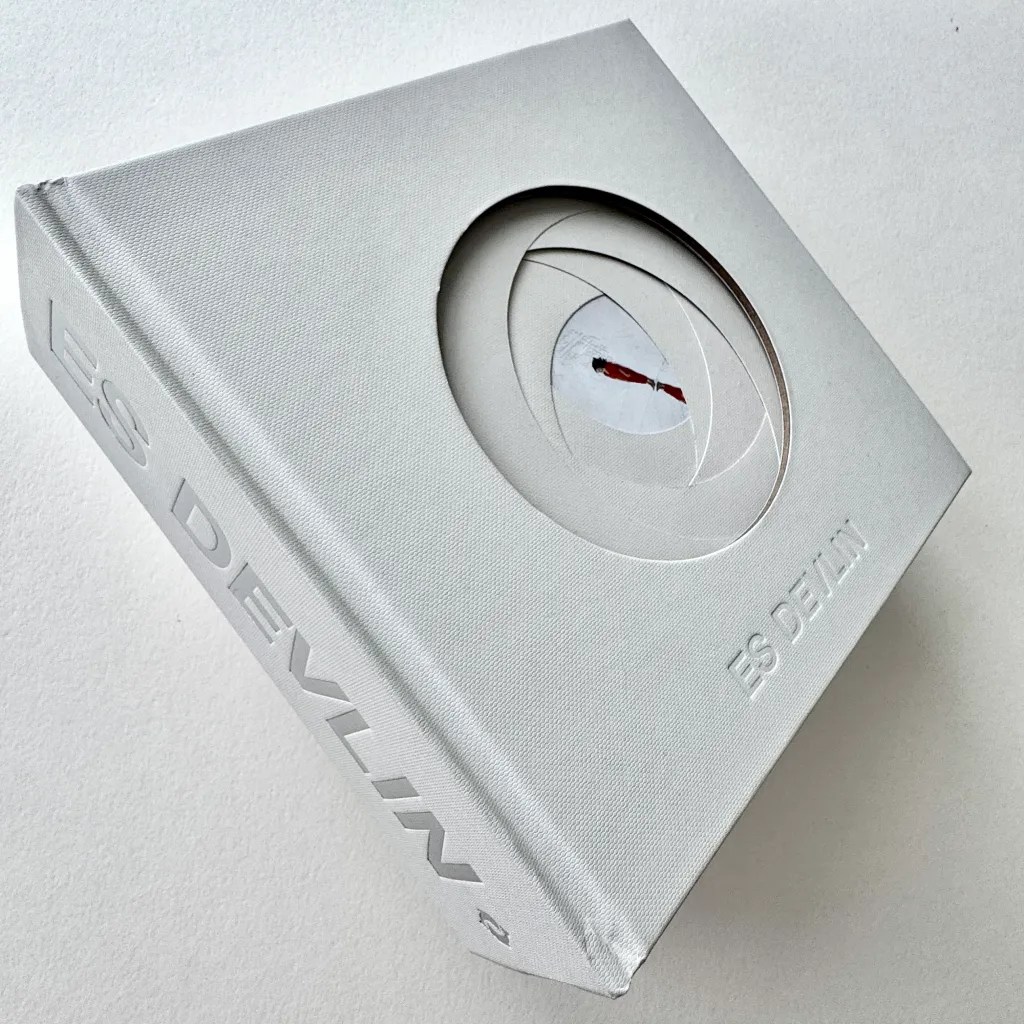
An Atlas of Es Devlin*
by Es Devlin (Thames & Hudson, 2023)
Weighing five pounds, this multidimensional 540-page monograph showcases the designer’s outstanding career—a tour de force of creative genius. It contains her stage and performance designs for an enviable client list from Batman to Beyoncé. This book features Super Bowl halftime performances, rock concerts, and independent off-Broadway productions, shown in rough sketches and photographs of completed structures. Her total command of spatial design, lighting, material, and scale places her in a class of her own.
For any designer or “design enthusiast,” this book will thrill.
The Birth of a Style: The Influence of the Basel Educational Model on Swiss Design
by Dorothea Hofmann (Triest, 2024)
In 1970, I was obsessed with playing rock & roll, avoiding the military draft, and studying graphic design. Enrolled at the Philadelphia College of Art, I began early training in a design program known for its European modernism, particularly Swiss. The young faculty was trained by legendary figures such as Armin Hofmann, Emil Ruder, and Wolfgang Weingart.
As a “disciple of these disciples,” this book evokes rich memories of the precise, process-driven approach I later applied in my design career and reveals the influence this methodology continues to have on contemporary graphic design.
Ocean Flowers: Impressions from Nature*
by Carol Armstrong and Catherine de Zegher (Princeton University Press, 2004)
In my pantheon of beautiful books, Ocean Flowers ranks among the top tier. This impressive historical account examines artists, illustrators, and naturalists from the 19th and 20th centuries who were obsessed with nature’s beauty. Originally published as the exhibition catalog for New York City’s Drawing Center, it features gorgeous reproductions of plant life from land and sea rendered exquisitely in full color by noted artists. The design by Luc Derycke prioritizes the illustrations with graphic and typographic restraint befitting their era.
As a bonus, this book introduced me to pioneering photographer Anna Atkins, whose seminal work and utterly beautiful cyanotypes are generously represented.
Amy Vanderbilt’s Complete Cookbook
by Amy Vanderbilt (Doubleday, 1961)
Anyone who has attended my dinner parties knows I’m a capable host but not a master chef. When I received this gift one Christmas, I got the hint. My brother—a rare book collector—gave it to me, and I wondered why until I noted who illustrated it. Published in 1961, all the delicate line illustrations were by one Andrew Warhol.
It’s fun to imagine what “Andy” thought when “Amy” asked him to diagram cuts of beef, lamb, pork, and veal.
Matisse: The Cut-Outs & Matisse: Jazz*
by Gilles Néret and Xavier-Gilles Néret (Taschen, 2014)
If you choose one book about Matisse (actually two), this monumental collection is essential. Measuring 12” × 15.5” and weighing 15 pounds, it highlights the artist’s revolutionary late period when, essentially bedridden, he surrendered his brush for scissors, creating astonishing works of pure shape and vibrant color.
Book One: The Cut-Outs provides an excellent account of Matisse’s time in the South Pacific, resulting in stylized interpretations of flora and fauna in flat color.
Book Two: Jazz is the artist’s paean to this music, produced as a “facsimile portfolio” with the feel of a limited edition.
This set looks impressive on any coffee table.
All the Light We Cannot See
by Anthony Doerr (Scribner, 2014)
Ten years after its first printing, Pulitzer Prize, 15 million copies sold, and Netflix adaptation, you likely need no introduction to this remarkable work of contemporary literature.
Anthony Doerr’s masterful character development and atmospheric detail have earned him respect as a 21st-century literary star. The structure, with parallel stories featuring dual protagonists in alternating chapters, fascinated me. As with any powerful work of fiction (The Road by Cormac McCarthy comes to mind), I resist Hollywood interpretations because my visual story needs no embellishment. After reading the book, I illustrated all the characters as I imagined them in my journal.
Anyone who appreciates superb storytelling will be incredibly pleased by this gift.
Souvenir
by Christoph Niemann (Diogenes, 2017)
A talent like Christoph Niemann appears infrequently. I describe him as a comprehensive artist with the complete toolkit: stylistic range, wild imagination, deft storytelling, humor, and killer drawing skills.
Souvenir is my favorite of his books, full of lush ink and watercolor travel sketches from around the world. When it was originally published, I bought two copies, intending to frame pages from one. However, deciding that destroying one book would be sacrilege, I gifted it to a friend. At 10 × 15 inches, clothbound with 256 pages, it’s a treasure.
Buy it and travel with Christoph.
Modern Artifacts
by Michelle Elligott and Tod Lippy (Esopus Books, 2020)
Imagine a private tour of the Museum of Modern Art’s vast archives with permission to examine any file, letter, catalog, or exhibition plan. The next best thing is paging through Modern Artifacts.
With essays and an introduction by Michelle Elligott and editing/design by the ever-inventive Tod Lippy, the book compiles all 18 installments of a series that originally appeared in Esopus magazine between 2006 and 2018. Lippy deftly recreates the experience of rifling through the archive by reproducing actual-size letters, postcards, clippings, photographs, exhibition diagrams, and ephemera with tip-ins, special papers, and double gatefolds.
From a production standpoint alone, it’s essential and offers a unique look into MoMA’s premier role in the birth of modern art in America.
A Parisian Cabinet of Curiosities: Deyrolle
by Louis Albert de Broglie (Flammarion, 2017)
One of Paris’s hidden cultural gems sits at 46 rue du Bac in the 7th Arrondissement. Here you’ll find Deyrolle, a store that’s part cabinet of curiosities, part natural history museum. Founded in 1831 in the spirit of adventure and discovery, it showcases extraordinary examples of flora and fauna, taxidermy, and otherworldly creations, highlighting the intersection of science and art.
This lavishly produced book, with dramatic interior photographs and display details, is like taking a tour of the store from your favorite chair. P.S. Wes Anderson is a fan.
American Utopia
by David Byrne and Maira Kalman (Bloomsbury, 2018)
This delightful book wins the charm award for the joy it brings. When David Byrne’s show American Utopia opened on Broadway, it garnered wide praise for innovative staging, choreography, script, and music. I saw it twice. This book, produced by Byrne with artist Maira Kalman, is a poetic tribute to the theatrical event.
With text by Byrne and 150 paintings by Kalman, American Utopia expresses jubilation in life’s small moments and simple pleasures.
Muji*
by Masaaki Kanai, Chairman (Rizzoli, 2010 )
This book celebrates everything that has made Muji a world-class leader in design retail. From its kraft paper cover to stylish photographs of products and store interiors, the book captures the remarkable ethos of this exceptional brand, including corporate identity, packaging, advertising, and headquarters.
Paging through this monograph is a reminder that simple utility, affordability, and beauty are hallmarks of great design for everyday people.
Painting as a Pastime
by Winston Churchill (Current Edition: Unicorn Press, 2013)
More than 30 years ago, a friend gave me a vintage copy of this classic. Sir Winston Churchill not only recounts his delight in discovering painting in his later years but does so with childlike glee. He also offers valuable lessons on embracing lifelong learning as the key to living well. For such a modest book, it packs tremendous inspiration into 32 pages. I read it once a year.
Classic copies of Painting as a Pastime can still be found online, but the latest edition by Unicorn Press is handsomely produced.
Fortunately, most of these books remain available, so if you’re stuck on what to buy for a “picky” friend or relative, I offer this list as a guide.
Happy Holidays.
*Recommended for $$$pecial friends!
Ken Carbone is an artist, designer, musician, author, and educator. From 1976 to 2020, he was the Principal Creative Director at the Carbone Smolan Agency.
All imagery © Ken Carbone.
The post Ken Carbone’s Twelve Books of Christmas Past appeared first on PRINT Magazine.